
Quick Answer: 1 1/2 Quarts to Liters
1.5 quarts equals 1.42 liters (or more precisely, 1.419 liters). This conversion uses the US liquid quart, which you’ll commonly encounter in American recipes and kitchen measurements. Whether you’re scaling up a soup recipe, measuring liquids for baking, or converting a drink pitcher’s capacity, this ratio stays consistent. Just like converting smaller measurements such as 1 1/2 cups to liters, understanding this conversion makes following international recipes effortless. We’ll walk you through the formula, real kitchen examples, and practical tips to make this conversion second nature.
The Conversion Formula Explained
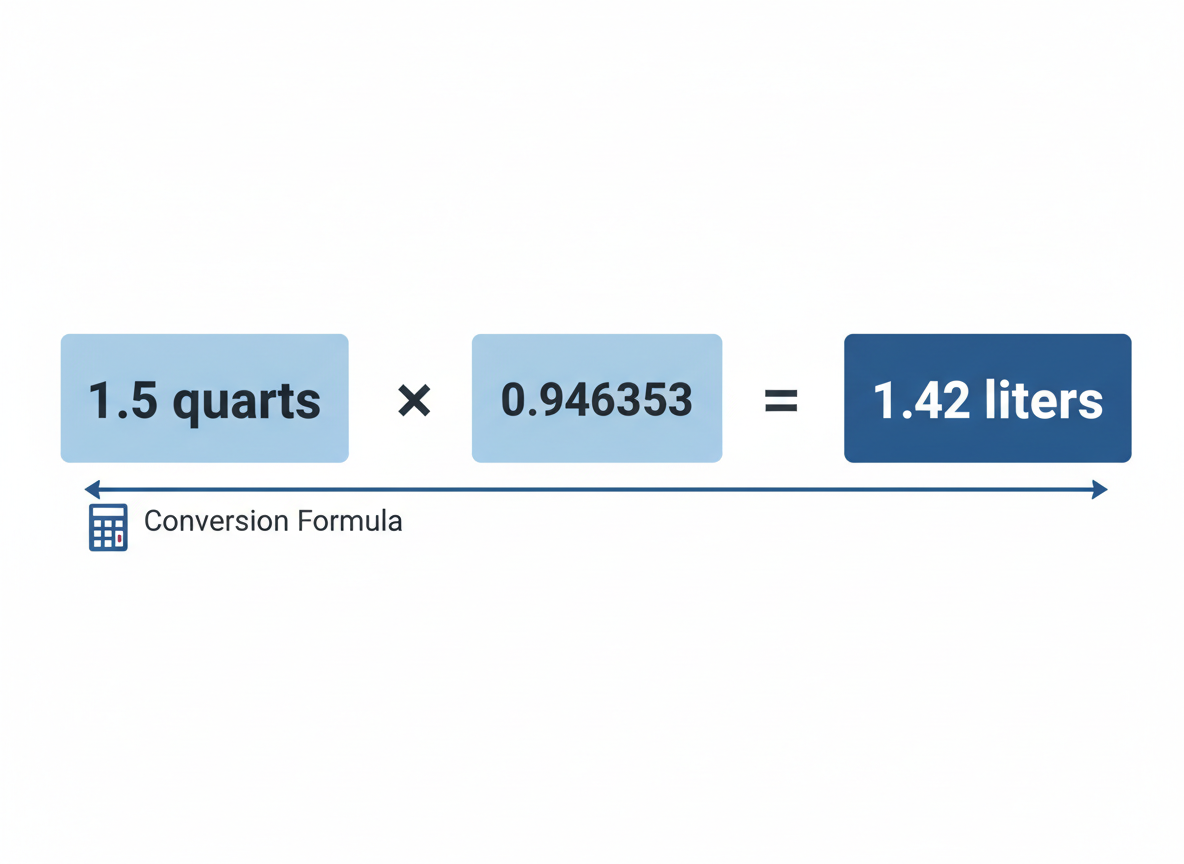
Here’s the math behind converting 1 1/2 quarts to liters. One quart equals 0.946353 liters, so you’ll multiply:
1.5 × 0.946353 = 1.419529 liters
For everyday cooking, round this to 1.42 liters—that’s precise enough for any recipe.
Step-by-step breakdown: 1. Convert mixed number to decimal (1 1/2 = 1.5) 2. Multiply by 0.946353 3. Round to two decimal places
Going the other way? Divide liters by 0.946353 to get quarts. So 1.42 liters ÷ 0.946353 = 1.5 quarts. If you’re working with smaller measurements, check out our 1 1/2 Liter to Cups guide for kitchen-friendly conversions.
Real-World Kitchen Applications
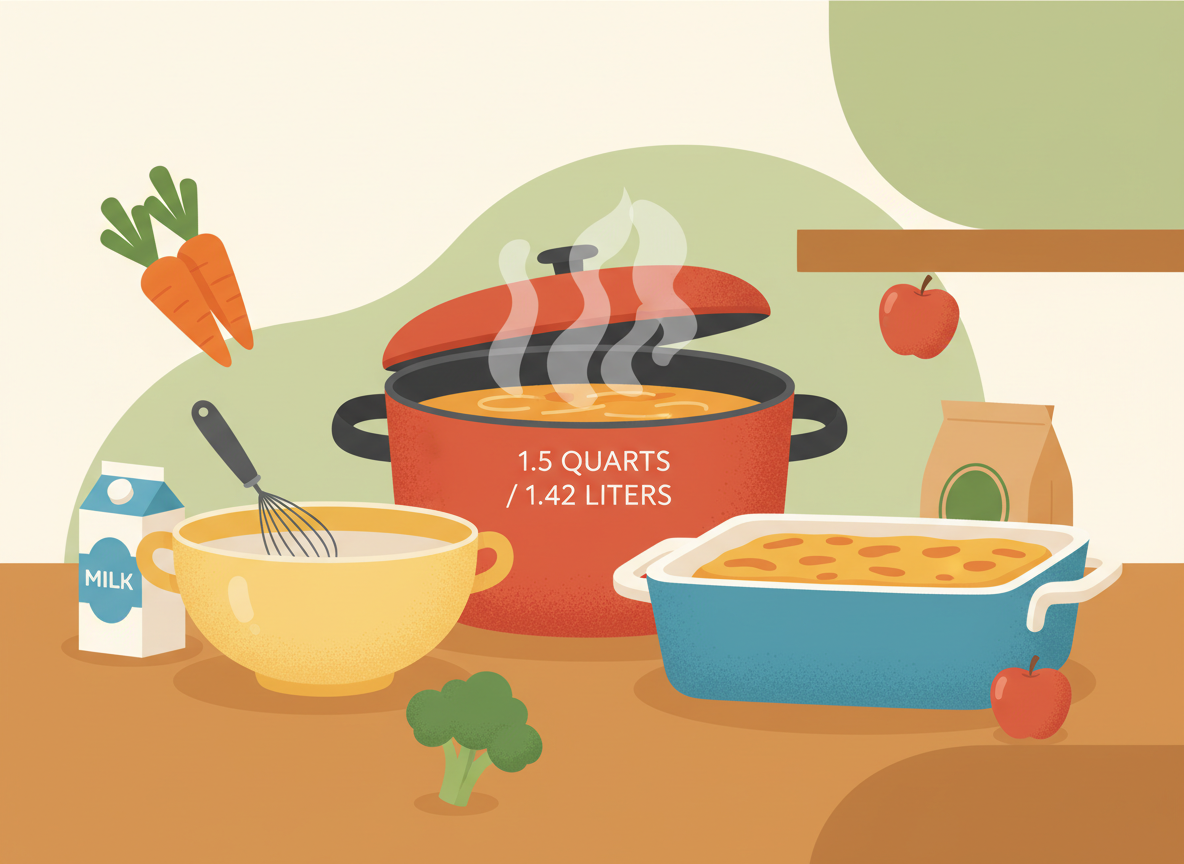
You’ll encounter 1.5 quarts (about 1.42 liters) constantly when making family-sized portions. Think hearty beef stew in your Dutch oven, creamy potato soup, or a classic chicken casserole. Most stock pots and mixing bowls list both measurements, but vintage cookware often shows only quarts.
This conversion becomes essential when you’re following European recipes or sharing your grandmother’s famous chili recipe with friends abroad. Baking gets tricky too—custards and bread doughs need precision, and a mixing bowl’s capacity matters when doubling recipes. Converting smaller volumes like 1 1/2 cups to liters follows the same principle but scales differently. Once you know the equivalent, adapting American classics to metric measurements becomes second nature.
Quick Reference Conversion Table
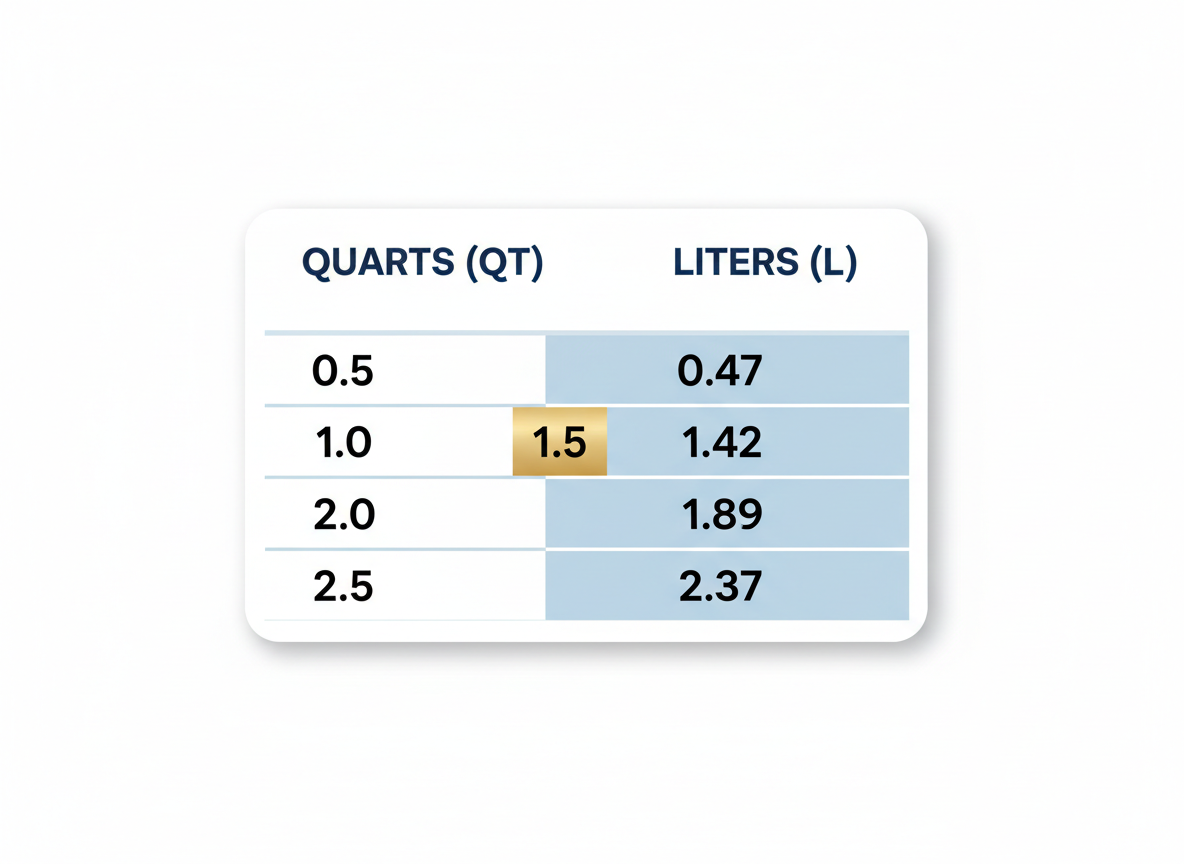
Here’s your go-to conversion table for the most common quart measurements you’ll need in the kitchen:
| Quarts | Liters (Precise) | Liters (Rounded) | Common Use | |——–|——————|——————|————| | 1/2 qt | 0.473 L | 0.5 L | Small sauces, dressings | | 1 qt | 0.946 L | 1 L | Stock, soup base | | 1 1/2 qt | 1.420 L | 1.4 L | Medium casseroles, stews | | 2 qt | 1.893 L | 1.9 L | Large batches, marinades | | 2 1/2 qt | 2.366 L | 2.4 L | Family-size soups | | 3 qt | 2.839 L | 2.8 L | Big-batch cooking |
For precision baking, stick with the exact values. Everyday cooking? The rounded numbers work perfectly. You can print this table and stick it inside your cabinet door for quick reference. When you’re working with larger volumes that need different units, tools like our liter to kiloliter converter come in handy for scaling recipes or industrial applications.
Mental Math Tricks for Quick Estimation
Here’s a handy shortcut: think of 1 quart as roughly 1 liter (it’s actually 0.95 liters). So 1.5 quarts? About 1.5 liters. This works brilliantly when you’re eyeballing soup recipes or mixing cleaning solutions.
For better accuracy, multiply quarts by 0.95. That gives you 1.42 liters for our 1.5 quarts—close enough for most cooking tasks.
When does precision matter? Medical dosing, laboratory work, and scientific experiments demand exact measurements. For these situations, use precise conversions (or specialized tools like those for microliter measurements). But for everyday kitchen adventures? Your quick mental math will serve you just fine.
Frequently Asked Questions (FAQ)
Is 1 1/2 quarts the same in US and UK measurements?
No, they’re different. US quarts are smaller—1.5 US quarts equals 1.42 liters, while 1.5 UK (imperial) quarts equals 1.70 liters. Most modern recipes use US measurements unless specified otherwise. If you’re working with vintage British cookbooks, double-check which system they’re using to avoid measurement mishaps.
What common kitchen items hold 1.5 quarts?
A standard medium saucepan typically holds about 1.5 quarts, as does a smaller mixing bowl or a large pitcher. Many slow cookers have a 1.5-quart capacity option, perfect for dips or small batches. Ice cream containers often come in 1.5-quart sizes too. If you’ve got a standard 6-cup measuring cup, that’s exactly 1.5 quarts.
How do I measure 1.42 liters without a metric measuring cup?
Use 6 cups (that’s 1.5 quarts) or fill a 1-liter bottle completely, then add about 420 milliliters more (roughly 1¾ cups). You could also fill a standard 500ml water bottle almost three times. It’s similar to how you’d approach other conversions—like converting 100 cm to meters—where understanding the relationship helps you work with what you’ve got.
Can I use 1.5 liters instead of 1.42 liters in recipes?
For most recipes, yes—the 80ml difference won’t make or break your dish. Soups, stews, and casseroles can handle this variation easily. However, precise baking recipes (especially bread or pastries) or candy-making need exact measurements. When accuracy matters, stick with 1.42 liters. For everything else, 1.5 liters works fine.
Why do some recipes use quarts while others use liters?
It’s all about where the recipe originated. American recipes typically use quarts, cups, and tablespoons, while European, Australian, and Asian recipes lean toward liters and milliliters. Science-based cooking and professional kitchens often prefer metric measurements because they’re easier to scale and more precise. That’s why having a reliable converter handy makes cooking from global sources so much easier.