Quick Answer: 0.1 mm to Mils Conversion
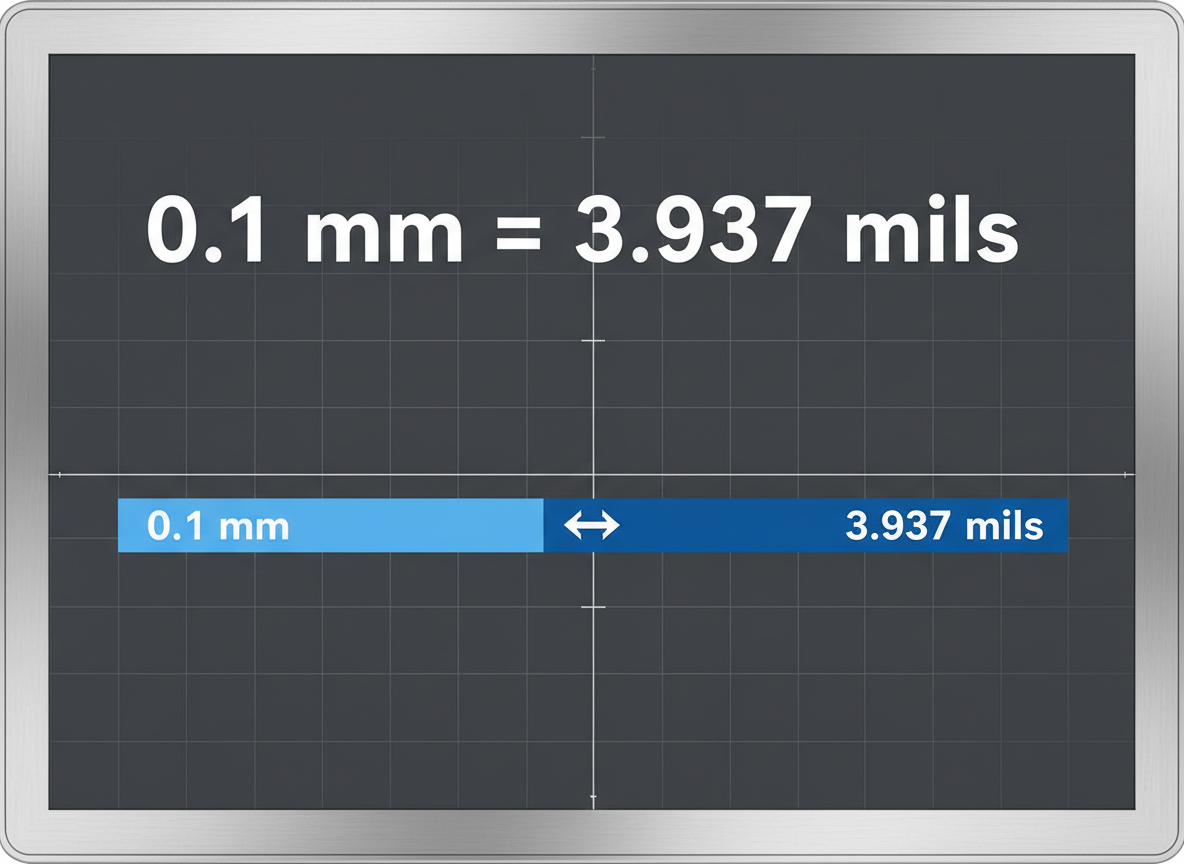
0.1 mm equals 3.937 mils (rounded to 3.94 mils for practical use). The conversion formula is straightforward: multiply millimeters by 39.3701 to get mils, or divide by 0.0254. This precise measurement matters everywhere from PCB design to aerospace engineering, where tiny tolerances make huge differences. Manufacturing teams rely on this conversion daily when working with international specifications. Need to convert other measurements? Unit Genie’s calculator handles any mm to mils conversion instantly, saving you from manual math errors.
Understanding Mils: The Thousandth of an Inch
A mil (sometimes called a “thou”) represents one-thousandth of an inch—exactly 0.001 inches. While the metric system dominates scientific work, mils remain the go-to measurement in manufacturing sectors like PCB design, where copper trace thickness matters, and coating industries that measure paint or wire insulation. You’ll also see them specifying plastic sheeting and film gauges. The distinction between mils and millimeters matters: 0.1 mm equals roughly 3.94 mils, which becomes significant when precision counts. Converting between systems? Check out our 0.1 mm in microns guide for related metric conversions.
Where 0.1 mm Measurements Matter Most
Electronics manufacturers rely on 0.1 mm precision for PCB trace spacing—the difference between a functioning circuit and a short. Medical device makers need this accuracy for catheter walls and implant specifications. Auto shops measure paint thickness in this range to catch warranty issues before delivery. Pharmaceutical packaging requires exact foil thicknesses to maintain product integrity. When you’re working at these tolerances, converting 0.1 mm to mils (approximately 3.937 mils) isn’t just math—it’s quality assurance. For even finer measurements, check out our 0.1 mm micron conversion guide.
Frequently Asked Questions
Is 0.1 mm the same as 4 mils?
Not quite. While 0.1 mm equals approximately 3.937 mils, many people round this to 4 mils for quick estimates. That’s fine for rough work, but if you’re dealing with precision manufacturing or quality control, that 0.063 mil difference can matter. Think of it like rounding $3.94 to $4—harmless for a quick mental calculation, but you wouldn’t want to do it on a purchase order for 10,000 units.
How do I convert mils back to millimeters?
The reverse is simple: multiply mils by 0.0254. So 10 mils × 0.0254 = 0.254 mm. If you’re working with something even smaller, like converting 0.1 mm to microns, you’ll find similar straightforward formulas apply.
What’s the difference between mil and millimeter?
A millimeter is one-thousandth of a meter in the metric system. A mil (or thou) is one-thousandth of an inch in the imperial system. Since an inch is 25.4 mm, one mil equals 0.0254 mm. They measure the same thing—small distances—but come from different measurement traditions.
When should I use mils instead of millimeters?
Stick with mils when you’re working in industries dominated by imperial standards: PCB manufacturing in North America, certain aerospace specifications, coating thickness in the US, and American wire gauges. If you’re collaborating internationally or working in scientific fields, millimeters usually make more sense. Match your client’s or supplier’s preference.
How precise do I need to be with 0.1 mm conversions?
It depends on your tolerance requirements. For medical devices or aerospace components, you’ll want at least three decimal places (3.937 mils). General manufacturing might round to 3.9 mils. Construction or DIY projects? Rounding to 4 mils won’t cause problems. Always check your industry’s tolerance standards before deciding how many decimal places you need.