
1 1/3 Cup Equals 0.315 Liters
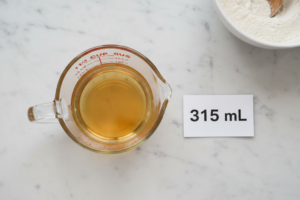
When you’re following a recipe that calls for 1 1/3 cups, you’re working with exactly 0.315 liters (or 315 milliliters). This fractional measurement shows up surprisingly often in baking and cooking because it’s one-third larger than a standard cup—perfect for scaling recipes or adjusting ingredient ratios. Whether you’re converting an American recipe to metric measurements or simply curious about the math, understanding this conversion makes kitchen work smoother. In this guide, we’ll walk through the conversion formula, share practical examples, and show you how Unit Genie’s instant converter can handle these calculations in seconds. Need a different measurement? Check out our guide on 1 1/2 cups to liters too.
Understanding the Conversion Formula
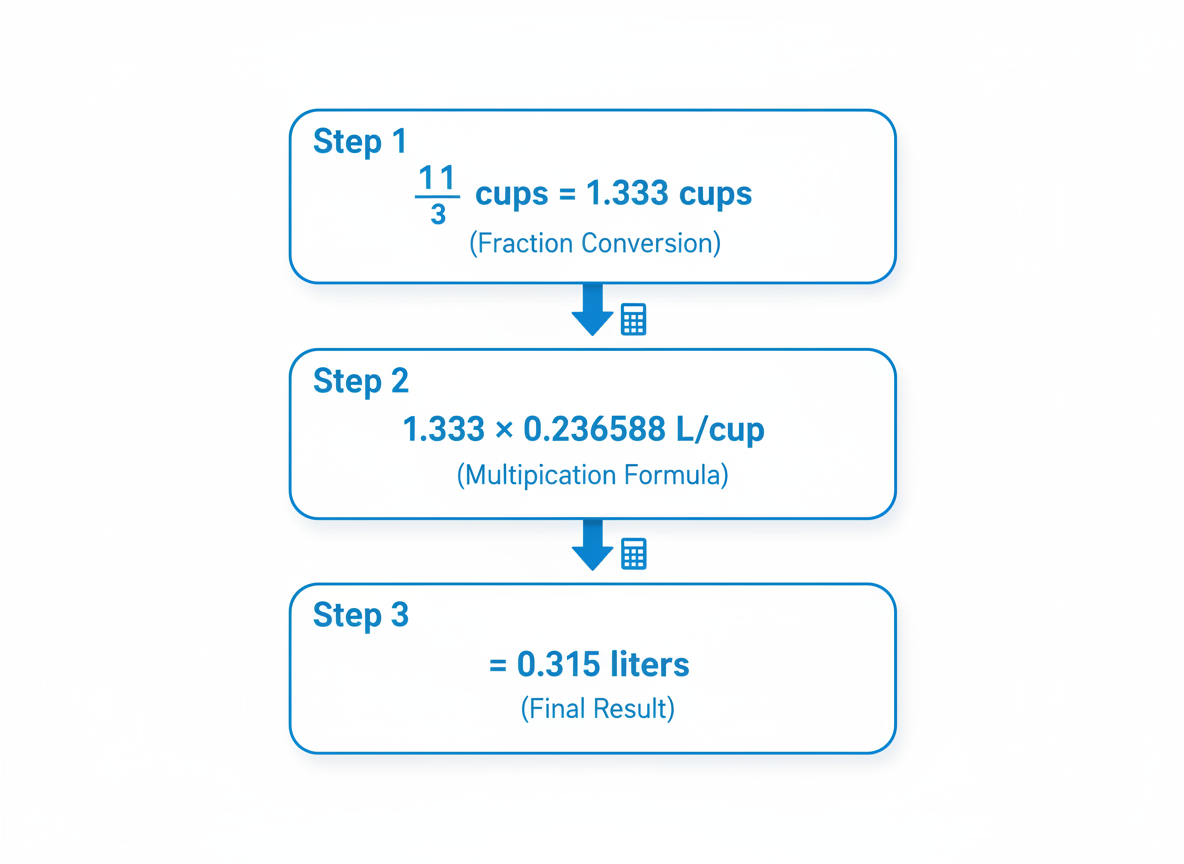
Here’s what you need to know: 1 US cup equals 0.236588 liters. To convert 1 1/3 cups, first turn that fraction into a decimal: 1 1/3 = 1.333 cups (the 3 repeats infinitely, but three decimal places work fine).
Now multiply: 1.333 × 0.236588 = 0.31545 liters.
For everyday cooking, round this to 0.315 liters or 315 mL—that’s your practical answer.
Without a calculator? Break it down: convert 1 cup (0.237 L), then 1/3 cup (0.079 L), and add them together. You’ll get close enough for any recipe. If you’re working with larger volumes like converting 1 1/2 liter to cups, the same principle applies—just reverse the math.
Quick Reference: 1 1/3 Cups in Different Units
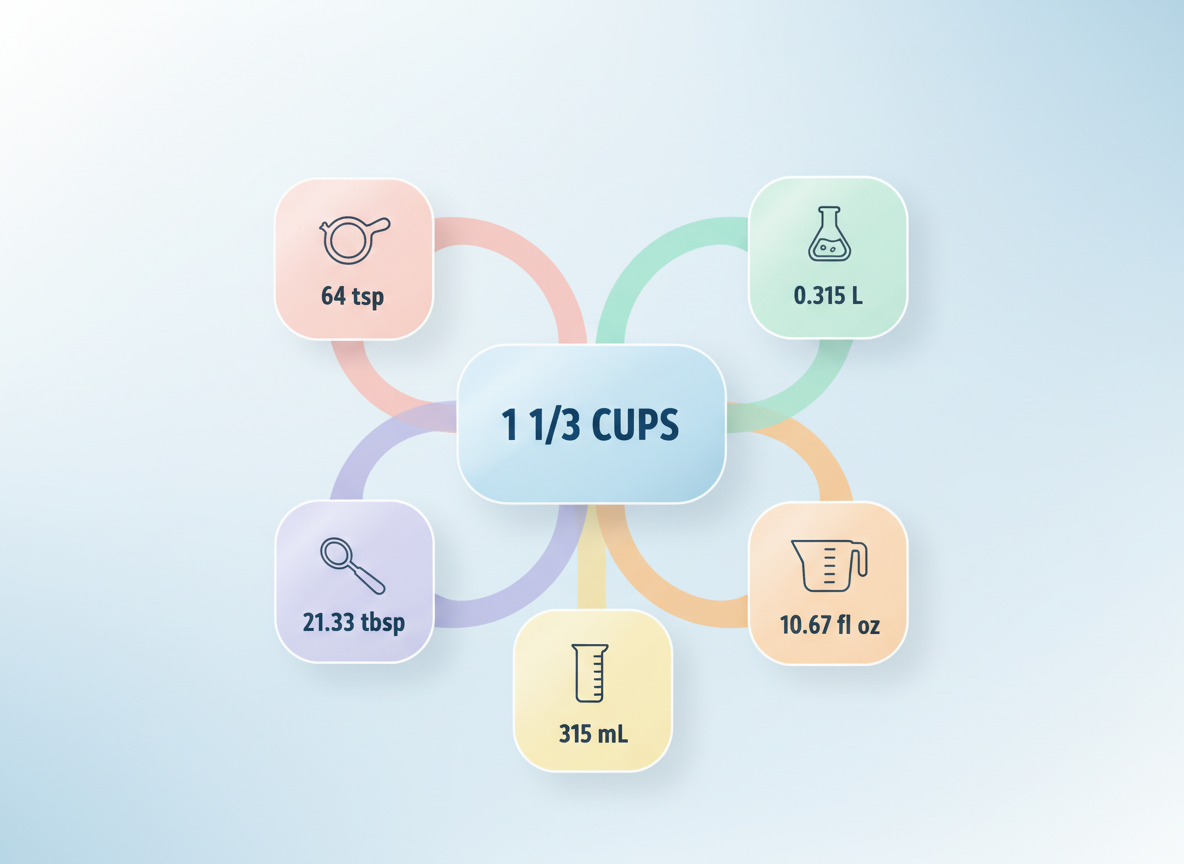
Here’s how 1 1/3 cups translates across different measurement systems:
| Unit | Conversion |
|——|————|
| Liters | 0.315 L |
| Milliliters | 315 mL |
| Fluid Ounces (US) | 10.67 fl oz |
| Tablespoons | 21.33 tbsp |
| Teaspoons | 64 tsp |
The milliliter and fluid ounce conversions are what you’ll reach for most often when following recipes. Keep in mind that US cups (236.6 mL each) differ slightly from metric cups (250 mL), which can matter in precision baking. If you’re working with larger volumes like 1 1/2 quarts to liters, the same conversion principles apply—just at a different scale.
Real-World Kitchen Applications
You’ll find 1 1/3 cups (about 315 ml) in countless recipes. Cookie doughs often call for this amount of flour, while soup bases might need exactly that much broth. International recipes become easier too—those European measurements convert smoothly when you know this ratio.
The easiest way to measure? Fill one standard cup, then add a 1/3 cup measure. In everyday containers, 1 1/3 cups sits slightly above a standard mug’s capacity.
Precision matters most with baking—bread, cakes, and pastries rely on exact ratios. Cooking soups or stews? You’ve got more wiggle room. When scaling recipes up or down, this conversion helps with meal prep portions. Need similar conversions? Check out our guide on 1 1/2 cups to liters for another common measurement.
Common Measurement Mistakes to Avoid
Not all cups are created equal. A US cup holds 236.6 mL, while metric cups contain 250 mL—that’s a 13.4 mL difference that’ll throw off your recipes. UK cups are even trickier at 284 mL.
Here’s what trips people up: confusing liquid and dry measuring techniques. Liquids need level readings at eye height, while dry ingredients should be spooned and leveled off. When you’re measuring 1/3 cup three times to get 1 1/3 cups, small errors compound quickly.
Rounding matters more than you’d think. For baking, precision counts—0.315 liters isn’t the same as 0.32 liters when you’re scaling recipes. But for everyday cooking? The difference between 315 mL and 320 mL won’t ruin your soup.
Always fill to the 1/3 mark completely, then level with a straight edge. Those slight dips or mounds add up fast. And if you’re working with tiny volumes requiring laboratory-level accuracy, check out proper techniques for precision measurements.
Frequently Asked Questions
How many milliliters is 1 1/3 cups?
Exactly 315 mL. Since 1 cup equals 236.588 mL, multiplying by 4/3 gives you 315.451 mL, which rounds to 315 mL for practical kitchen use.
Is 1 1/3 cups the same in all countries?
Not quite. The US cup (236.588 mL) differs from the metric cup (250 mL) used in Australia, New Zealand, and Canada. If you’re using a metric cup, 1 1/3 cups equals 333.33 mL instead of 315 mL—a noticeable difference in baking.
How do I measure 1 1/3 cups without a 1/3 cup measure?
Fill your 1-cup measure completely once, then add one more 1/3 cup. Don’t have a 1/3 cup? Use 5 tablespoons plus 1 teaspoon (which equals 1/3 cup). Or measure 1 cup plus 2 tablespoons plus 2 teaspoons—slightly over but close enough for most recipes.
Can I use 0.3 liters instead of 0.315 liters in recipes?
For most cooking, yes. The 15 mL difference (about 1 tablespoon) won’t ruin soups or sauces. But in baking—where precision matters—stick with 0.315 L. That extra tablespoon can affect texture in cakes and bread. Need help with other volume conversions? Check out our liter to kiloliter calculator for larger measurements.
What’s the easiest way to remember cup to liter conversions?
Think “quarter liter per cup.” One cup is roughly 0.24 L, so 1 1/3 cups is about 0.32 L (slightly rounded). Or remember: 4 cups make about 1 liter. Once you know that ratio, dividing and multiplying becomes second nature. Unit Genie handles the exact math when you need precision.