

Quick Answer: How Many Minutes Are in 1 Day?
1 day equals exactly 1,440 minutes. This simple conversion matters more than you’d think—whether you’re calculating work hours, planning study sessions, or managing project deadlines.
Understanding time conversions helps you make better decisions throughout your day. We’ll show you the math behind this conversion, share the formula you can use anytime, and explore real-world scenarios where knowing this number comes in handy. (And if you’re curious about smaller units, check out how to convert 1 day to seconds.) Let’s break down why this matters for your daily life.
The Simple Conversion Formula Explained
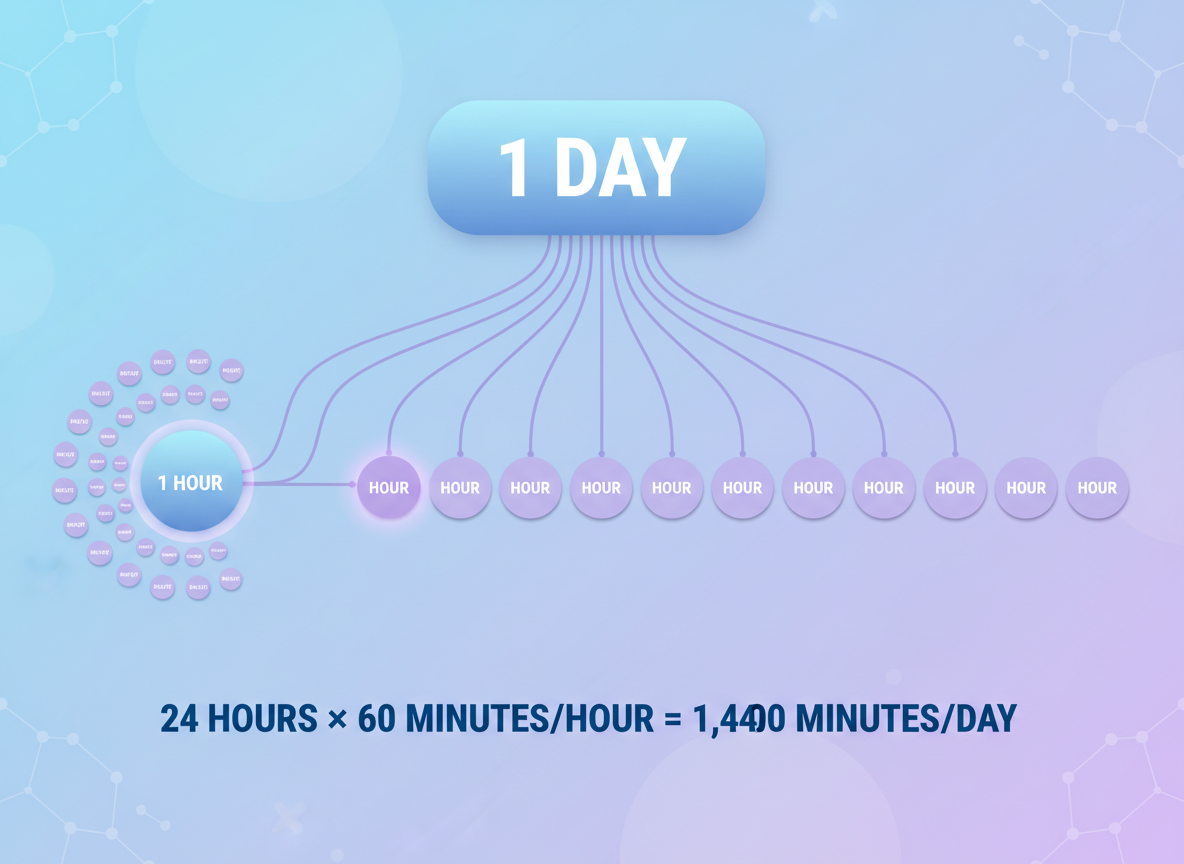
Here’s how the math works: Start with 24 hours in a day. Since each hour contains 60 minutes, multiply 24 × 60 to get 1,440 minutes. That’s your answer—every single day equals exactly 1,440 minutes.
Need a memory trick? Remember the “24-60-1440” pattern. It flows naturally from days to hours to minutes.
For quick verification, divide 1,440 by 60, and you’ll land back at 24 hours. This reverse check confirms you’ve got it right.
Real-World Scenarios: When You Need This Conversion
Converting 1 day to minutes matters more than you’d think. Project managers break down daily deadlines into 1,440-minute workflows to track granular progress. Fitness enthusiasts set daily goals—like hitting 30 minutes of cardio within their day—and monitor exact durations. Freelancers calculate billable hours by converting workdays into precise minute totals for client invoicing. Travel planners transform multi-day itineraries into minute-by-minute schedules, ensuring they don’t miss flights or connections. Students juggling assignments use this conversion to allocate study time effectively, turning “work on this today” into specific 90-minute blocks. Whether you’re optimizing productivity or simply managing your time better, understanding that 1 day equals 1,440 minutes helps you plan with real precision.
Quick Reference: Days to Minutes Conversion Table
Here’s your go-to conversion table for quick lookups:
| Days | Minutes |
|——|———|
| 0.25 days | 360 minutes |
| 0.5 days | 720 minutes |
| 1 day | 1,440 minutes |
| 2 days | 2,880 minutes |
| 3 days | 4,320 minutes |
| 4 days | 5,760 minutes |
| 5 days | 7,200 minutes |
| 6 days | 8,640 minutes |
| 7 days | 10,080 minutes |
Keep this handy for project planning, medication schedules, or whenever you need instant answers without pulling out a calculator.
Pro Tips: Making the Most of Day-to-Minute Conversions
Choose your time unit based on scope: minutes work best for tasks under two hours, while days suit project timelines. Mental math (multiply by 1,440) handles quick estimates, but reach for a calculator when precision matters—especially in healthcare or engineering contexts. Shift workers should account for actual hours worked rather than assuming full days. Here’s a shortcut: remembering that one day equals 1,440 minutes helps you quickly calculate partial days by dividing. Scientists tracking experiments need to consider leap seconds for ultra-precise measurements, though most everyday conversions don’t require this level of detail.
Frequently Asked Questions (FAQ)
Why is there exactly 1,440 minutes in a day?
It comes down to simple math: 24 hours × 60 minutes = 1,440 minutes. This system dates back to ancient Babylonian astronomy, which used base-60 counting.
Does a day always have 1,440 minutes?
Almost always, yes. Occasionally, scientists add a “leap second” to account for Earth’s irregular rotation, making a day 1,441 minutes long. These adjustments happen roughly every 18 months, though they’re being phased out.
How do I convert multiple days to minutes?
Multiply the number of days by 1,440. For example, 5 days = 5 × 1,440 = 7,200 minutes.
What about converting minutes back to days?
Divide the minutes by 1,440. So 2,880 minutes ÷ 1,440 = 2 days.
Is this conversion the same worldwide?
Absolutely. A day equals 1,440 minutes everywhere on Earth, regardless of time zones or geographic location.