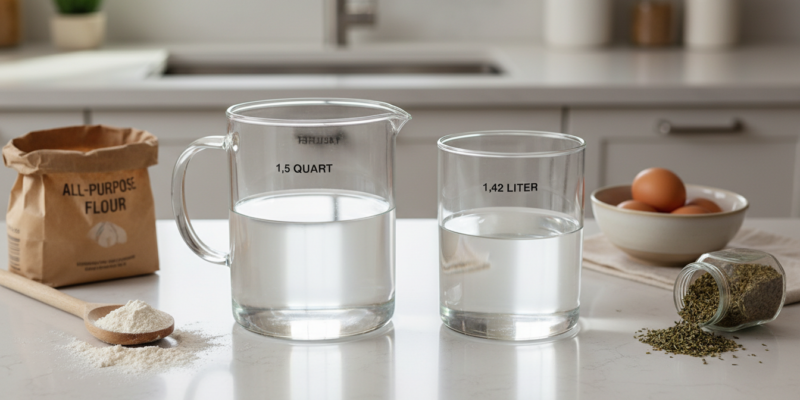
Quick Answer: 1 1/2 Quarts Equals How Many Liters?
1.5 quarts equals approximately 1.42 liters (or more precisely, 1.4195 liters). If you’re following a European recipe, doubling a sauce, or working with international kitchen measurements, this conversion comes up more often than you’d think.
Here’s why it matters: Many American recipes use quarts, while most of the world measures liquids in liters. When you’re making a 1.5-quart batch of soup or converting your grandmother’s famous chili recipe, knowing this number saves you from kitchen guesswork.
You’ll find this fractional conversion particularly useful for medium-sized recipes, beverage containers, and when scaling recipes up from single quarts. Need to convert other fractional measurements quickly? Unit Genie handles any conversion instantly, from halves to thirds to eighths—no calculator fumbling required.
Understanding the Conversion: Quarts to Liters Formula
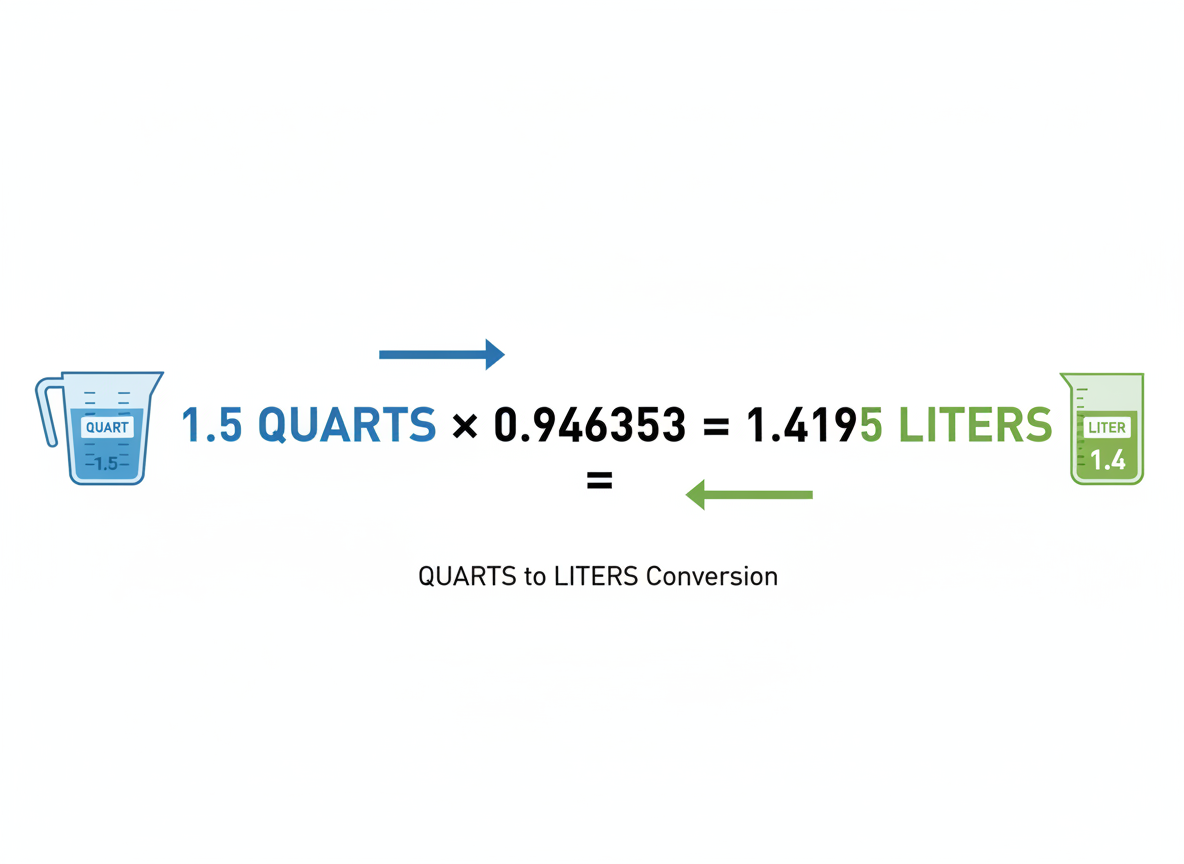
The conversion between quarts and liters relies on one key number: 1 quart equals 0.946353 liters. That’s the standard conversion factor you’ll need.
The formula couldn’t be simpler:
Quarts × 0.946353 = Liters
For 1 1/2 quarts (or 1.5 quarts), here’s how it works:
1.5 × 0.946353 = 1.4195295 liters
You’ll typically round this to 1.42 liters for everyday cooking. For scientific work or precise volume measurements, keep more decimal places.
Here’s a handy memory trick: one quart is slightly less than a liter. Think of it as about 95% of a liter. Going the other way, 1 liter equals roughly 1.06 quarts—just a bit more than a quart.
When you’re baking, rounding to 1.4 liters works fine. But if you’re mixing chemicals or calibrating equipment? Stick with the full precision.
Real-World Kitchen Examples Using 1.5 Quarts
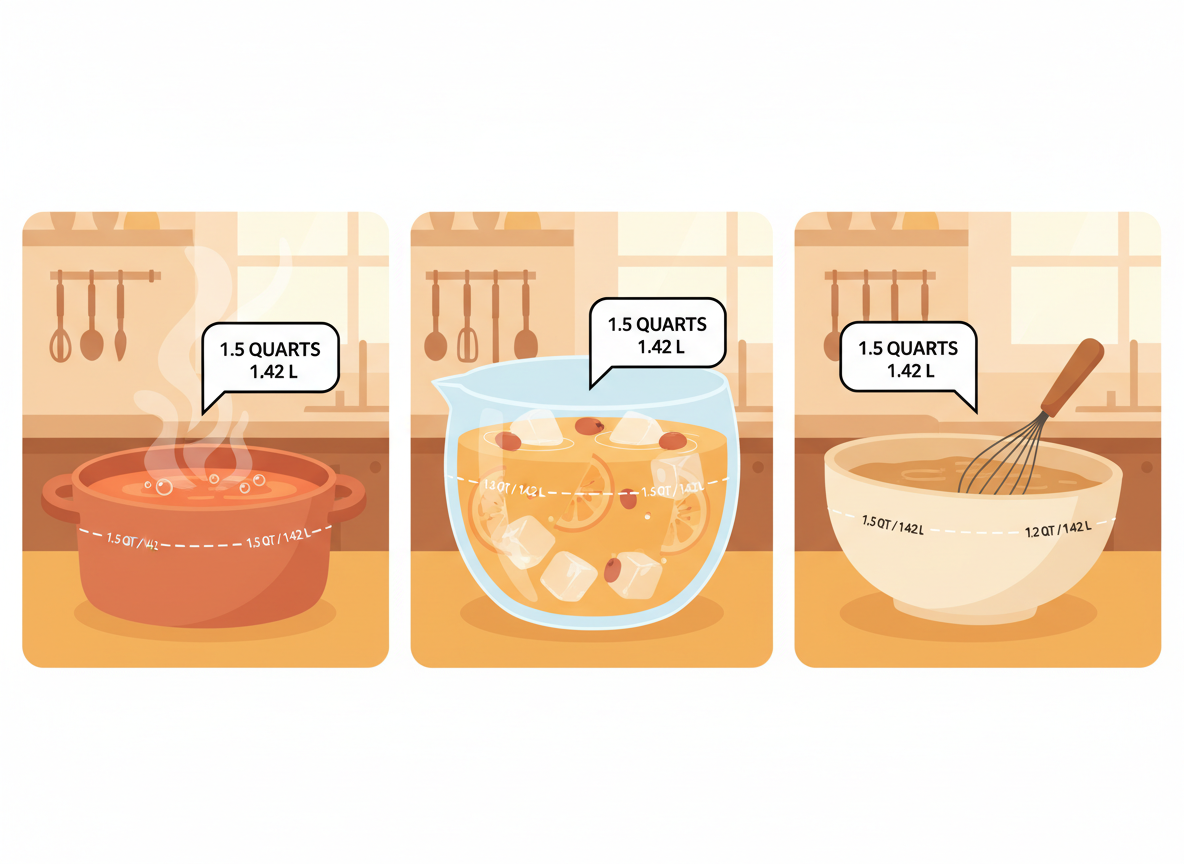
You’ll find 1.5 quarts popping up in plenty of recipes. Think homemade soup stock, party punch bowls, ice cream base, or big batches of marinara sauce. If you’re working with an international recipe calling for 1.42 liters, you’re essentially looking at the same amount—just round to 1.5 quarts for easier measuring.
Don’t have quart containers? No problem. Fill a 1-liter container, then add about 420ml more (roughly 1¾ cups). When scaling recipes up or down, knowing this conversion helps maintain the right proportions. Say you’re doubling a European recipe—convert those liters first, then multiply.
Switching between measurement systems gets simpler when you understand both volumes. For smaller conversions, check out our guide on 1 1/2 cups to liters for baking precision.
Quick Reference: Fractional Quart Conversion Table
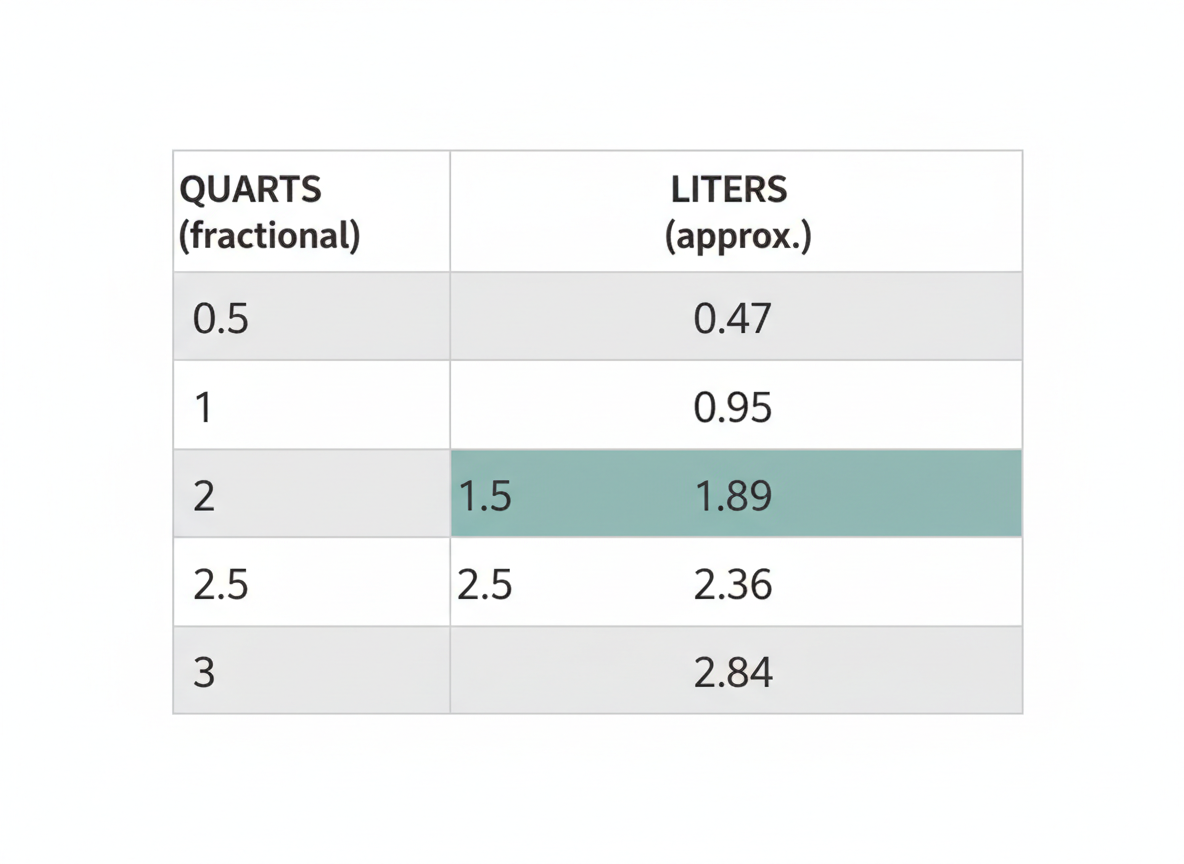
Here’s your go-to conversion table for common fractional quarts to liters:
| US Liquid Quarts | Liters (Precise) | Liters (Rounded) | Reverse (Liters → Quarts) |
|——————|——————|——————|—————————|
| 0.5 qt | 0.473 L | 0.5 L | 0.5 L = 0.53 qt |
| 1 qt | 0.946 L | 1 L | 1 L = 1.06 qt |
| 1.5 qt | 1.420 L | 1.4 L | 1.5 L = 1.59 qt |
| 2 qt | 1.893 L | 1.9 L | 2 L = 2.11 qt |
| 2.5 qt | 2.366 L | 2.4 L | 2.5 L = 2.64 qt |
| 3 qt | 2.839 L | 2.8 L | 3 L = 3.17 qt |
Important: These conversions use US liquid quarts. Dry quarts (1.101 L) and imperial quarts (1.137 L) differ slightly. For baking or cooking, you’ll usually work with liquid measurements. Need smaller conversions? Check out our 1 1/2 liter to cups guide for more kitchen-friendly measurements.
US Quarts vs UK Imperial Quarts: What’s the Difference?
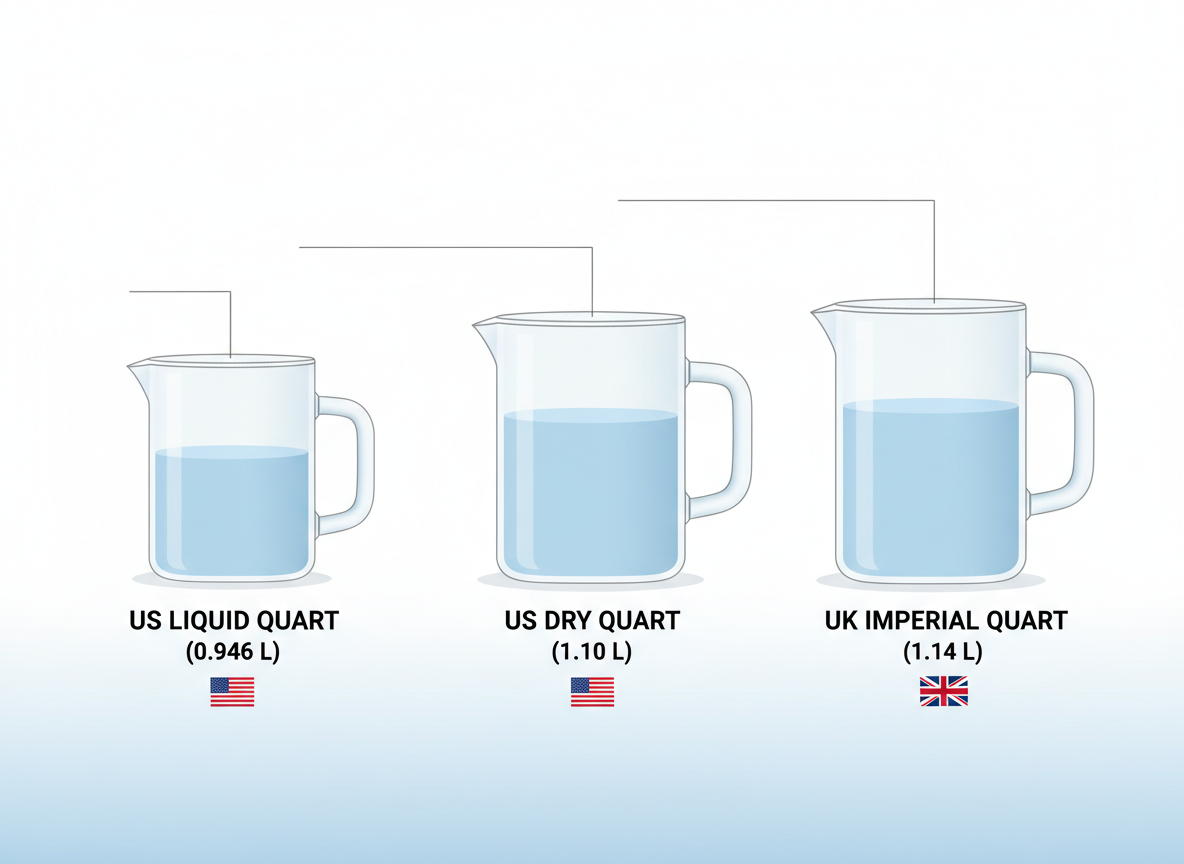
Not all quarts are created equal. The US liquid quart equals 0.946353 liters—this is what most recipes use. There’s also a US dry quart (1.101221 liters) for measuring berries and other dry goods, though you’ll rarely see it in home kitchens.
The UK imperial quart is the real curveball. At 1.13652 liters, it’s about 20% larger than its American cousin. That means 1.5 US quarts equals roughly 1.42 liters, while 1.5 UK quarts comes out to 1.70 liters—a difference that’ll throw off any recipe.
Following a British recipe with American measuring cups? You’ll need to account for this gap. Here’s the breakdown:
| Measurement | US Liquid | UK Imperial |
|————-|———–|————-|
| 1.5 quarts | 1.42 L | 1.70 L |
| Difference | Standard | +20% larger |
When converting between different volume measurements like this, precision matters. Just like knowing your cup to liter conversions, understanding which quart system you’re working with prevents kitchen disasters.
How to Measure 1.42 Liters Without a Liter Container
Don’t have a liter container handy? No problem. You can measure 1.42 liters using about 6 standard cups—if you need the exact breakdown for measuring liquids in cups, that conversion works perfectly. Alternatively, think of it as 3 pints (since 1½ quarts equals 3 pints) or 1420 mL if you’re working with a milliliter-marked container. For ultimate precision, combine 1 liter plus 420 mL. Here’s a handy tip: when measuring sticky ingredients like honey or syrup, lightly oil your measuring cup first—the liquid will pour out completely, giving you accurate results every time.
Frequently Asked Questions
How many liters is 1 and a half quarts?
Exactly 1.4195 liters. This precise conversion helps you nail measurements every time.
Is 1.5 quarts the same as 1.5 liters?
No. 1.5 quarts equals 1.42 liters, while 1.5 liters equals about 1.59 quarts. They’re close but not interchangeable.
How do I convert 1.5 quarts to milliliters?
That’s 1,419.53 mL. Just multiply quarts by 946.353, then you’ll get your milliliters.
What is 1.5 quarts in cups?
Six cups. Since one quart equals four cups, multiply 1.5 by 4.
Can I use 1.5 liters instead of 1.5 quarts in a recipe?
You’ll add about 5% more liquid (80 mL extra). For soups or sauces, that’s usually fine. For baking, stick with the correct measurement.
How do you calculate quarts to liters?
Multiply quarts by 0.946353. So 1.5 × 0.946353 = 1.4195 liters.
What measuring tools work best for 1.5 quart conversions?
A liquid measuring cup marked with both units saves time. Digital kitchen scales that measure volume work great too.