Quick Answer: 0.1 mm to Mil Conversion
0.1 millimeters equals 3.937 mils. A millimeter is one-thousandth of a meter, while a mil (or thou) represents one-thousandth of an inch. This precision matters when you’re working with coating thickness, PCB manufacturing, or medical device specifications where even slight variations affect performance. Our calculator below handles this and related conversions instantly—including 0.1 mm to microns for even finer measurements. Let’s break down everything you need to know about converting between these units accurately.
Understanding Mils and Millimeters
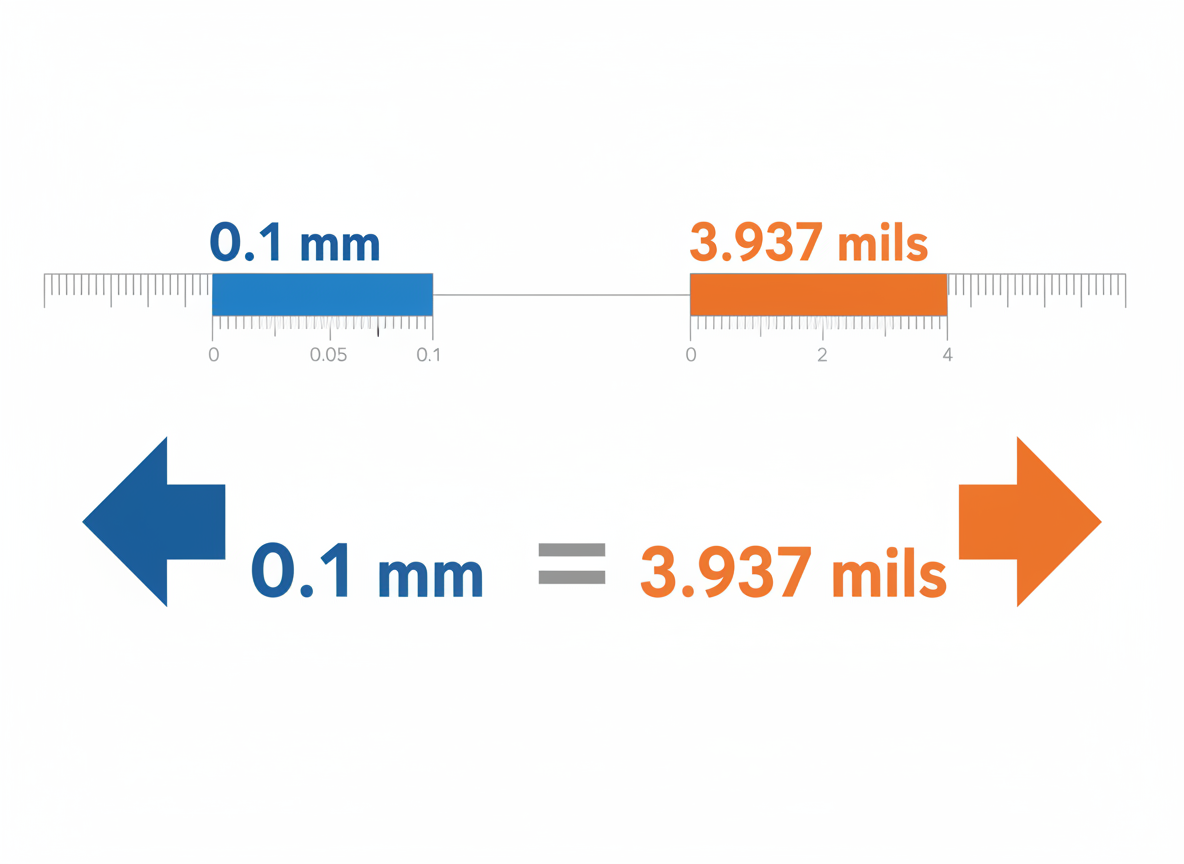
A mil represents one-thousandth of an inch (0.001″), commonly used in manufacturing and engineering across North America. Millimeters, part of the metric system, measure length in thousandths of a meter. When you’re converting 0.1 mm to mil, you’re bridging two measurement worlds: 0.1 mm equals approximately 3.937 mils. Both systems persist because legacy industries rely on imperial measurements while global trade demands metric standards. For even smaller precision work, you might also need to understand 0.1 mm in microns, which adds another layer to precision measurement.
The Conversion Formula
Converting 0.1 mm to mil is straightforward: mm × 39.3701 = mils. So, 0.1 mm × 39.3701 = 3.93701 mils (commonly rounded to 3.94 mils).
This conversion factor comes from the relationship between metric and imperial systems—there are exactly 25.4 millimeters in one inch, and one mil equals one-thousandth of an inch. Working backward: 1 mm ÷ 25.4 = 0.0393701 inches. Multiply by 1,000 (to convert inches to mils), and you get 39.3701.
Step-by-step breakdown:
1. Start with your millimeter value: 0.1 mm
2. Multiply by the conversion factor: 0.1 × 39.3701
3. Result: 3.93701 mils
For the reverse conversion (mil to mm), just divide by 39.3701: mils ÷ 39.3701 = mm. If you’re working with other small metric measurements like converting 1 1/2 cm to mm, the same logical approach applies—understand the relationship between units, then apply the math.
Real-World Applications of 0.1 mm to Mil Conversion
Engineers rely on 0.1 mm to mil conversions daily in PCB design, where trace widths and copper thickness directly impact circuit performance. Coating specialists use these measurements to verify plating thickness meets specs. Machinists depend on precise conversions for tight tolerances—often within fractions of a mil. Sheet metal fabricators and wire manufacturers reference both systems when working with international suppliers. Quality control teams compare measurements across standards to ensure products meet global requirements. For even finer precision work, converting between millimeters and microns becomes essential in semiconductor and optical applications.
Frequently Asked Questions
What is 0.1 mm equal to in mils?
0.1 mm equals 3.937 mils. Since a mil is 1/1000th of an inch and an inch equals 25.4 mm, you’ll multiply 0.1 by 39.37 to get your answer. Most situations only need two decimal places, so 3.94 mils works perfectly fine for practical applications.
Is a mil the same as a millimeter?
No—they’re completely different units. A mil is 1/1000th of an inch (Imperial system), while a millimeter is 1/1000th of a meter (metric system). One millimeter actually equals about 39.37 mils, making mils significantly smaller. This confusion happens often since “mil” sounds similar to the “milli” prefix.
Why do engineers use mils instead of millimeters?
In countries using Imperial measurements, particularly the U.S., engineers prefer mils because they integrate seamlessly with inch-based systems. PCB manufacturers, for instance, specify trace widths in mils since their equipment and standards revolve around inches. It’s all about consistency within existing workflows and tooling specifications.
How precise do I need to be when converting 0.1 mm to mil?
It depends on your application. Most machining and general engineering work needs two decimal places (3.94 mils). Electronics manufacturing might require three (3.937 mils). For everyday conversions—similar to going from 0.1 mL to liter—two decimals typically cover your needs unless you’re working with aerospace or medical device tolerances.
What industries commonly need 0.1 mm to mil conversions?
Electronics manufacturing leads the pack, especially PCB design where trace widths around 0.1 mm (roughly 4 mils) are common. Automotive engineers converting metric specifications to Imperial tooling use these conversions daily. Medical device manufacturers, coating specialists measuring film thickness, and precision machinists working with international suppliers all bounce between these units regularly.