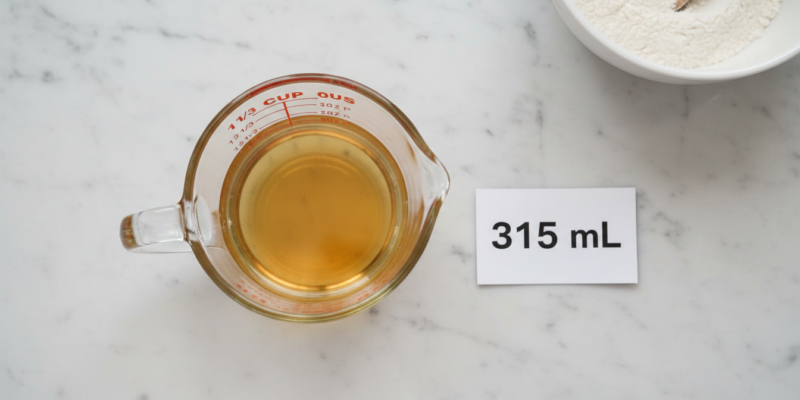
Quick Answer: 1 1/3 Cup Equals 315 mL
1 1/3 cups equals 315 milliliters when using the US standard cup measurement. That’s your instant answer if you’re in the middle of baking or cooking and need to convert right now.
Here’s the math behind it: one US cup holds 236.588 mL, so 1 1/3 cups (or 1.333 cups) comes out to approximately 315 mL. This conversion matters whether you’re following a recipe from Europe, measuring ingredients for precise baking, or working with kitchen tools marked in metric units.
In this guide, you’ll learn the exact conversion formula, understand why different measurement systems exist, and pick up practical kitchen tips that’ll make measuring easier. We’ll also cover related conversions—for instance, if you need larger measurements, check out our guide on 1 1/3 cup to liters for working with bulk quantities.
Let’s break down everything you need to know about this common kitchen conversion.
Understanding the Conversion Formula
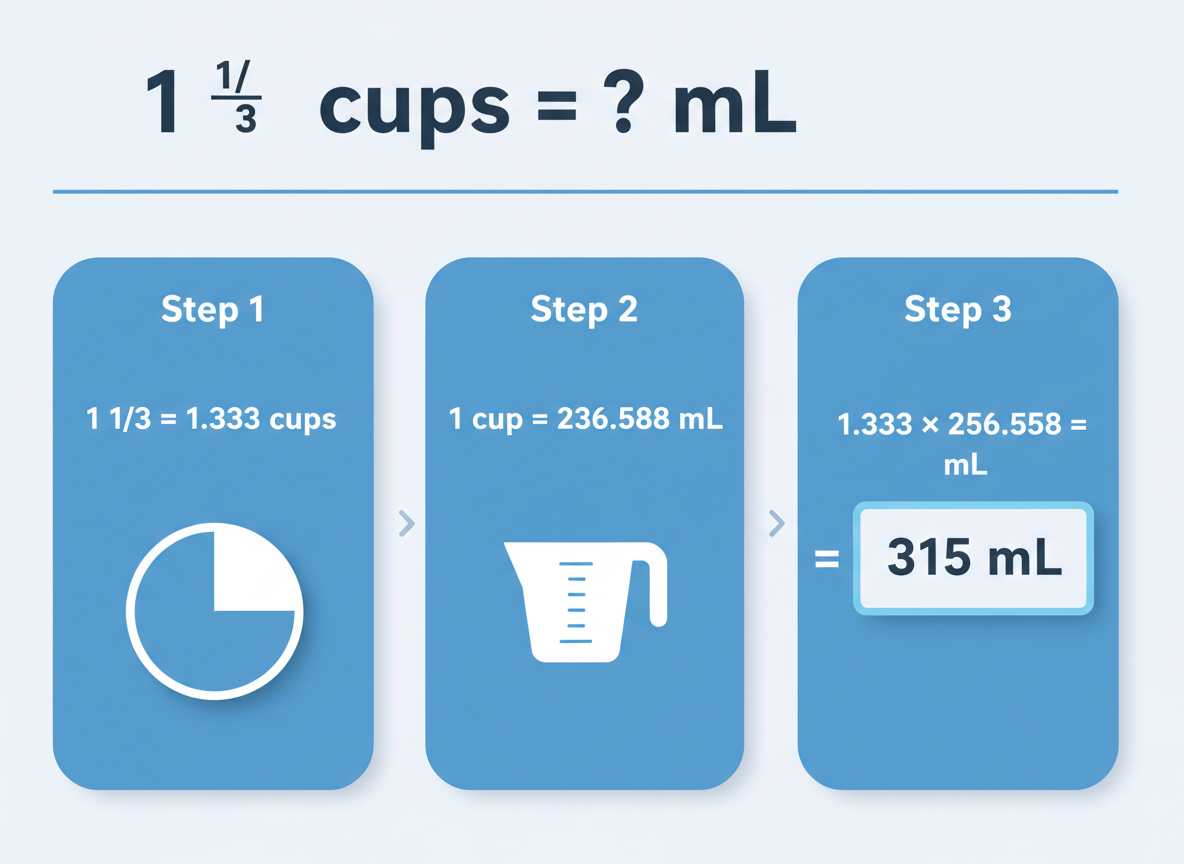
Let’s break down how to convert 1 1/3 cup into milliliters using the basic formula.
The foundation is simple: 1 US cup equals 236.588 mL. That’s the magic number you’ll need for any cup-to-mL conversion.
First, convert 1 1/3 into a decimal. That’s 1.333… cups (the 3s repeat forever, but 1.333 works perfectly for cooking).
Now multiply: 1.333 × 236.588 = 315.45 mL
You’ll often see this rounded to 315 mL, and here’s why that makes sense. In the kitchen, measuring down to a tenth of a milliliter doesn’t change your results. Your measuring tools aren’t that precise anyway, and recipes have built-in flexibility. Whether you use 315 mL or 315.45 mL, your cake will turn out just fine.
Manual conversion without a calculator:
1. Start with 236.588 mL for one cup
2. Divide by 3 to get one-third: 236.588 ÷ 3 ≈ 79 mL
3. Add them together: 236.588 + 79 = 315.588 mL
4. Round to 315 mL for practical use
This same approach works for all volume conversions. If you’re working with larger quantities or need to understand other volume measurements, check out our 1 Liter Conversion Guide for more practical examples.
Different Cup Measurement Standards Explained
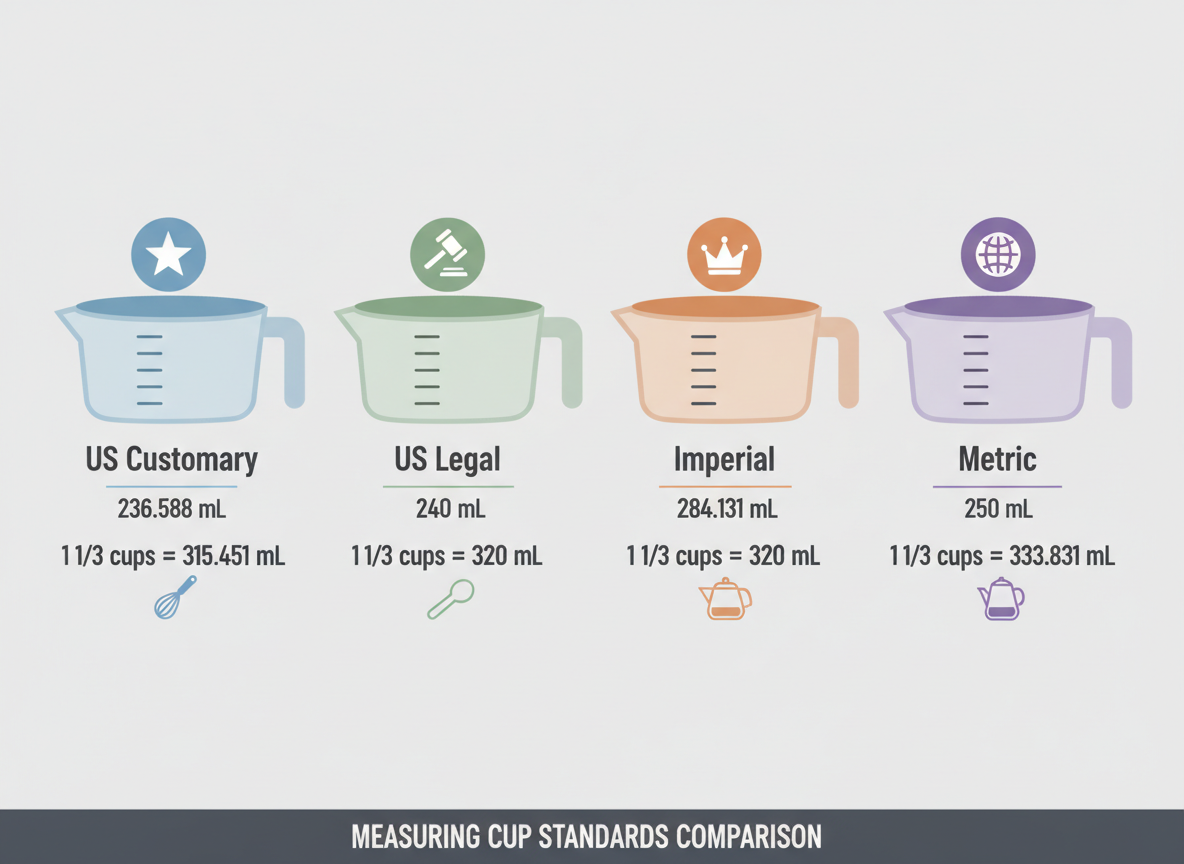
Here’s where things get interesting—not all cups are created equal. If you’ve ever wondered why your grandmother’s British recipe turned out differently than expected, this might be why.
US Customary Cup: 236.588 mL – This is what you’ll find in most North American recipes. When a cookbook just says “cup,” this is usually what they mean. So 1 1/3 cups equals approximately 315.45 mL.
US Legal Cup: 240 mL – You’ll see this on nutrition labels and food packaging. It’s a rounded version that makes calculations easier for manufacturers. Here, 1 1/3 cups equals exactly 320 mL.
Imperial Cup: 284.131 mL – Found in older UK and Commonwealth recipes, this larger cup means 1 1/3 cups equals about 378.17 mL. That’s a significant difference!
Metric Cup: 250 mL – Australia, New Zealand, and many Asian countries use this standardized measurement. In this system, 1 1/3 cups equals 333.33 mL.
The key? Check your recipe’s origin. American recipes almost always use the US Customary cup. If you’re working with various volume measurements and need quick conversions, our liter to cups calculator can help you navigate between systems.
Common Fractional Cup Conversions to mL
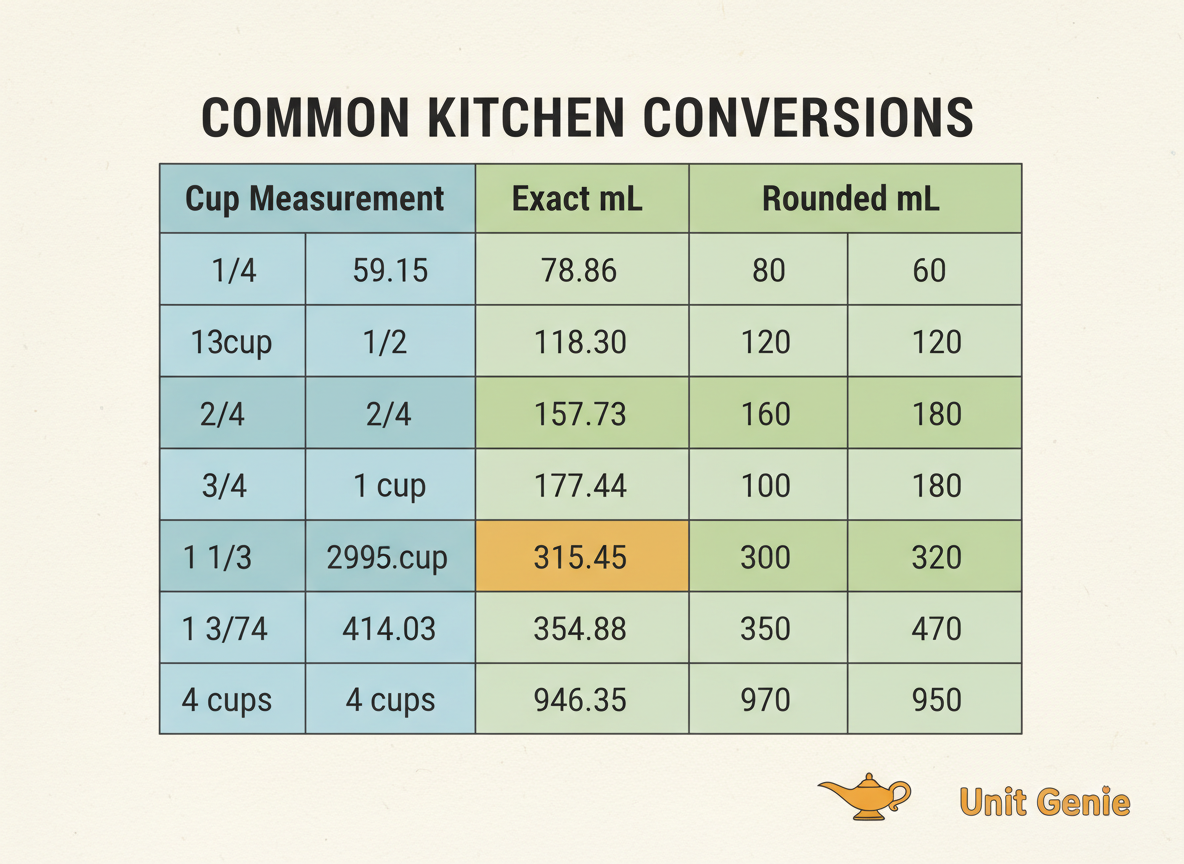
Here’s your go-to conversion table for the most common fractional cup measurements. Save this for quick kitchen reference:
| Cup Measurement | Exact mL | Rounded mL |
|—————-|———-|————|
| 1/4 cup | 59.147 mL | 60 mL |
| 1/3 cup | 78.863 mL | 79 mL |
| 1/2 cup | 118.294 mL | 118 mL |
| 2/3 cup | 157.725 mL | 158 mL |
| 3/4 cup | 177.441 mL | 177 mL |
| 1 cup | 236.588 mL | 237 mL |
| 1 1/4 cups | 295.735 mL | 296 mL |
| 1 1/3 cups | 315.451 mL | 315 mL |
| 1 1/2 cups | 354.882 mL | 355 mL |
| 2 cups | 473.176 mL | 473 mL |
Notice how 1 1/3 cups equals 315 mL—perfect for scaling recipes or working with metric measurements. If you’re dealing with larger volumes, check out our guide on 1 1/2 Cups to Liters for converting beyond milliliters.
Practical Kitchen Applications for 1 1/3 Cups
You’ll find this measurement popping up more often than you’d expect. Chocolate chip cookie recipes frequently call for 1 1/3 cups of chocolate chips, while many bread recipes use this amount for milk or warm water. It’s also common in homemade soup stocks and creamy sauce bases.
International recipes make this conversion essential. If you’re following a European baking blog that lists ingredients in milliliters, you’ll want that 315 mL figure handy. Same goes for Japanese or Australian recipes.
Here’s the easiest way to measure 1 1/3 cups accurately: fill your 1-cup measure once, then add a separate 1/3 cup measure. Don’t eyeball it by filling to the “1” mark and guessing the extra third—that’s asking for trouble.
Precision matters differently depending on what you’re making. Baking demands accuracy since chemical reactions are involved, so hit that 315 mL mark precisely. For a pot of chili or pasta sauce? Being off by 10-20 mL won’t ruin dinner. Similar principles apply when you’re working with larger volumes, like converting 1 1/2 liter to cups for batch cooking.
Tips for Accurate Measurement Conversions
Getting your measurements right makes all the difference in cooking and baking. Always use dry measuring cups for flour and sugar, and liquid measuring cups (with spouts) for water and milk. Level off dry ingredients with a straight edge—never shake or tap the cup, which packs ingredients and throws off your measurements.
For liquids, place your measuring cup on a flat surface and read at eye level. That meniscus (the curved liquid surface) can trick you if you’re looking from above or below.
Here’s something people often miss: 1 1/3 cups of water and 1 1/3 cups of honey won’t behave the same way, even though the volume’s identical. Density matters when pouring and mixing.
Don’t have a 1/3 cup measure? Use your 1/4 cup four times, plus 1 tablespoon and 1 teaspoon (equals 1/3 cup exactly).
Room temperature liquids measure most accurately, though small temperature variations won’t ruin most recipes. For precise work with larger volumes, like when you’re converting 1 1/2 quarts to liters, temperature becomes more important.
Frequently Asked Questions
How many mL is 1 1/3 cups exactly?
The exact conversion is 315.45 mL, though you’ll typically round this to 315 mL for practical kitchen use. That tiny difference won’t affect your recipes.
Is 1 1/3 cups the same in all countries?
Not quite. The US cup measures 236.588 mL, while metric countries sometimes use 250 mL cups. Canada and Australia use metric cups, so always check which standard your recipe follows. When precision matters—like in scientific work where you might need to convert between different measurement systems (similar to converting liters to kiloliters)—knowing your cup standard is essential.
How do I measure 1 1/3 cups without a 1/3 cup measure?
Fill one full cup, then add 5 tablespoons plus 1 teaspoon. Alternatively, if you’ve got a measuring jug with mL markings, just measure out 315 mL directly.
Can I use 300 mL instead of 315 mL?
For casual cooking? Sure, that 15 mL difference won’t ruin most dishes. But for baking—especially bread or pastries—stick to 315 mL. Precision counts when chemistry’s involved.
How do I convert other fractional cups to mL?
Simple: multiply any cup measurement by 236.588. For 2/3 cup, that’s 0.667 × 236.588 = 158 mL. Or just use Unit Genie for instant conversions without the math headaches.