
Quick Answer: 1 1/2 Cups Equals How Many Liters?
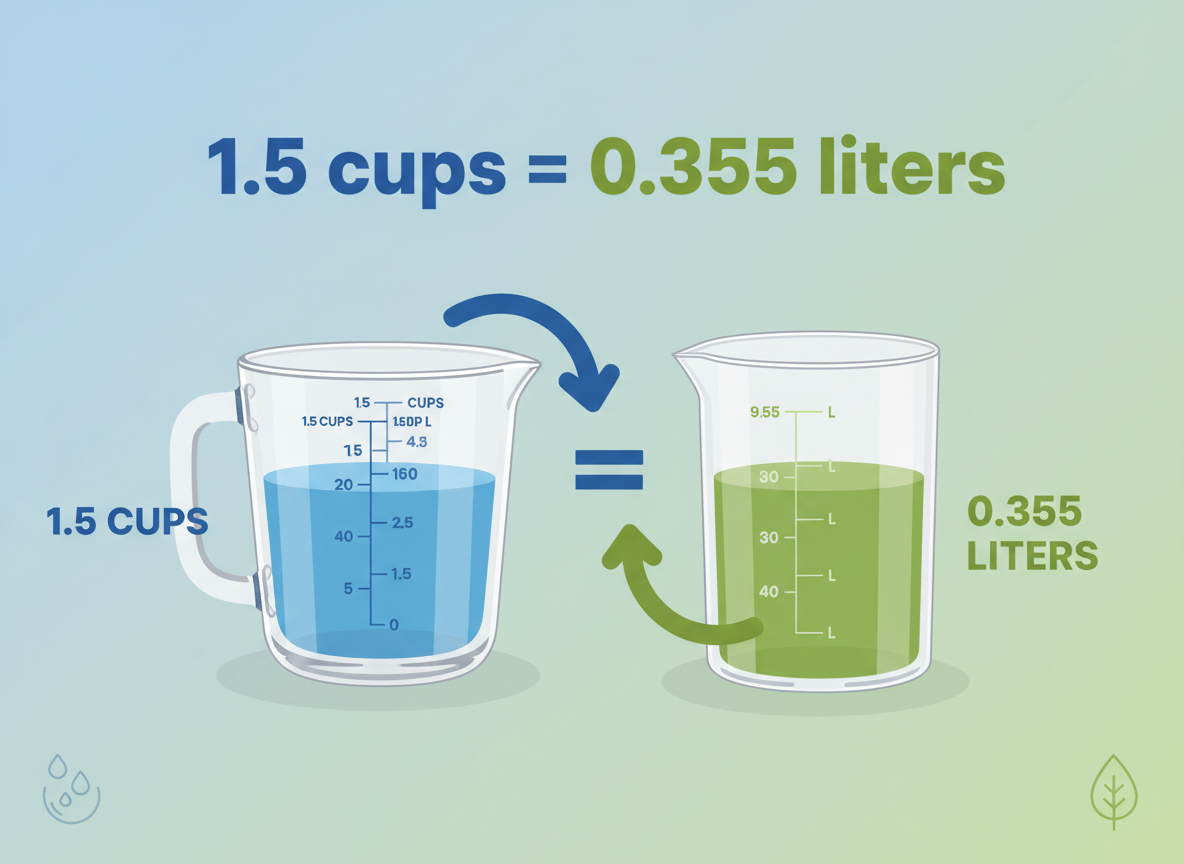
1.5 US cups equals 0.35488 liters (or approximately 0.355 L). This conversion comes up frequently when you’re working with American recipes but need metric measurements for your kitchen tools or international cooking. The calculation uses the standard US cup measurement of 236.588 mL. In this guide, we’ll walk you through the conversion formula, share practical baking examples, and give you helpful tips for switching between cups and liters. Need to convert other volume measurements? We’ve got you covered there too.
Understanding the Conversion Formula
Converting 1½ cups to liters is straightforward once you know the formula: cups × 0.236588 = liters. For our calculation, that’s 1.5 × 0.236588 = 0.35488 liters.
Why 0.236588? One US cup equals exactly 236.588 milliliters (remember, 1,000 milliliters make a liter). When you’re actually cooking, you don’t need to be that precise. Round it to 0.35 liters or 355 mL—your recipes won’t suffer from those tiny differences. This simpler number is much easier to remember when you’re measuring ingredients.
Fractional Cup Conversions at a Glance
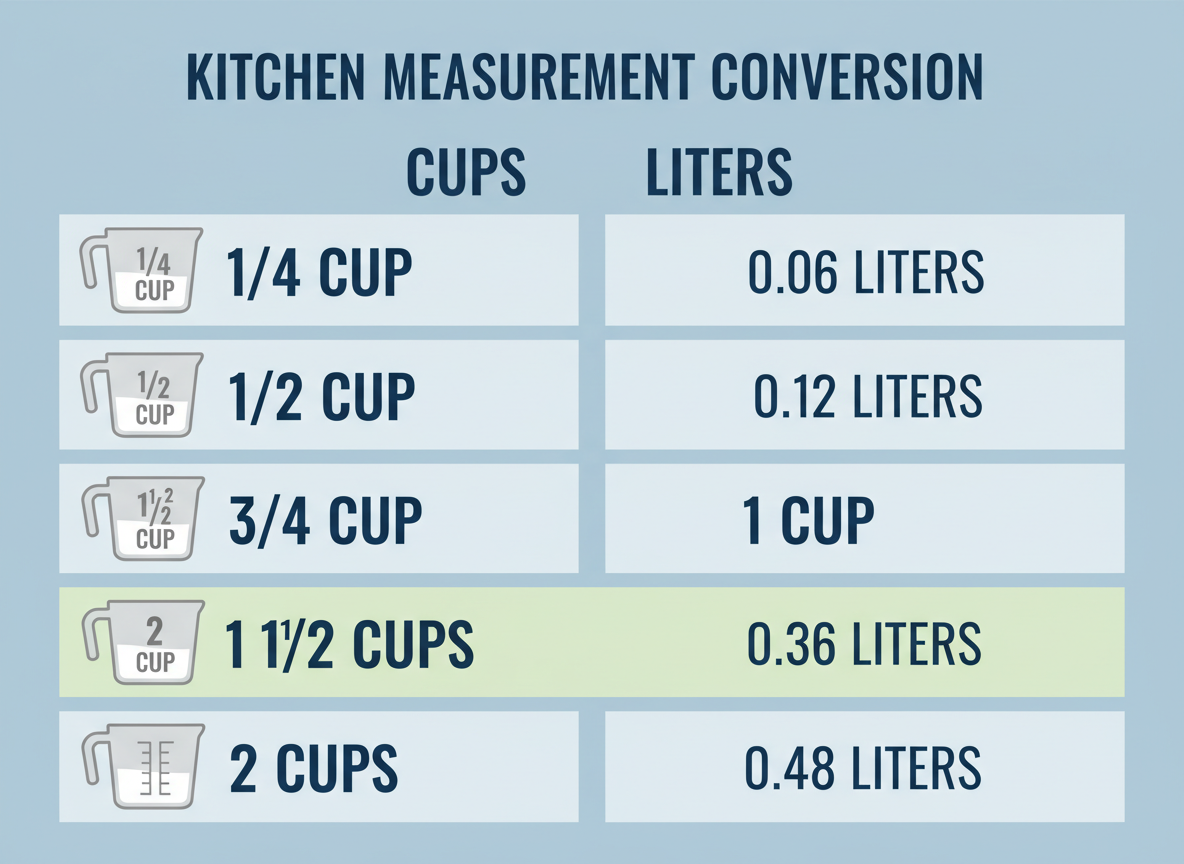
Here’s your quick reference for converting common measurements:
-
1/4 cup = 0.059 liters (59 mL)
-
1/2 cup = 0.118 liters (118 mL)
-
3/4 cup = 0.177 liters (177 mL)
-
1 cup = 0.237 liters (237 mL)
-
1 1/2 cups = 0.355 liters (355 mL)
-
2 cups = 0.473 liters (473 mL)
Remember, US cups differ from metric cups (250 mL). For precise volume conversions across different systems, these distinctions matter—especially when following international recipes.
Real-World Cooking Examples Using 1.5 Cups
You’ll often see 1.5 cups in recipes calling for flour in pancakes, where that measurement creates the perfect batter consistency. It’s also common for rice dishes—think pilaf or risotto—where you need just enough grain for four servings.
When following European recipes or working with metric kitchen scales, converting becomes necessary. Your grandmother’s American cookie recipe might clash with your new German measuring cup set.
For accuracy, level off dry ingredients with a straight edge and check liquids at eye level. When precision matters (hello, macarons!), using a conversion tool like Unit Genie ensures you’re getting exactly 0.355 liters every time. Small differences can affect texture and rise in delicate baked goods.
US Cups vs Metric Cups: Key Differences
Here’s where things get interesting: not all cups are created equal. A US cup holds 236.588 mL, while a metric cup contains 250 mL—that’s a 13.4 mL difference per cup. For 1.5 metric cups, you’d get 0.375 liters instead of 0.354 liters. This gap matters when precision counts, especially in baking. How do you know which system a recipe uses? Check the author’s location or look for other measurements. American recipes typically include ounces and Fahrenheit, while metric recipes use grams and Celsius. When in doubt, a volume converter helps you adapt any recipe to your measuring tools.
Frequently Asked Questions
How many milliliters is 1 1/2 cups?
It’s 354.88 mL, though most cooks round to 355 mL without any issues.
Is 1.5 cups the same as 1 1/2 cups?
Yes, they’re identical. Just different ways of writing the same measurement.
How do I measure 1.5 cups if I only have a 1-cup measure?
Fill your measuring cup completely once, pour it into your mixing bowl, then fill the same cup halfway and add that too.
Why do American and European recipes use different measurement systems?
The U.S. stuck with customary units (cups, ounces) while most countries adopted the metric system in the 1970s. It’s purely historical—neither system is “better” for cooking, just different.
Can I use 350 mL instead of exactly 354.88 mL in recipes?
Absolutely. That 5 mL difference won’t affect most recipes. Baking tends to be more precise than cooking, but even then, you’d need to be making something extremely delicate for those few milliliters to matter. For everyday cooking and baking, 350 mL works fine.
Need help with other conversions? Check out Unit Genie’s categories for quick conversion tools across volume, weight, temperature, and more.

[…] with 1 + 1/8, which equals 1.125 ounces. Think of it like measuring ingredients when you’re converting between cups and liters—the principle of handling fractions stays the […]