
Understanding 100 cm to m Conversion
Here’s the quick answer: 100 cm equals exactly 1 meter. This conversion sits at the heart of the metric system’s beauty—it’s built on powers of ten, making calculations straightforward. Whether you’re measuring furniture for your living room, tracking your child’s growth chart, or working on engineering projects, understanding this relationship unlocks effortless conversions throughout the metric system. Once you grasp how centimeters relate to meters, you’ll find other metric conversions (like converting 0.97m to dm) become second nature.
The Quick Answer: 100 cm = 1 m
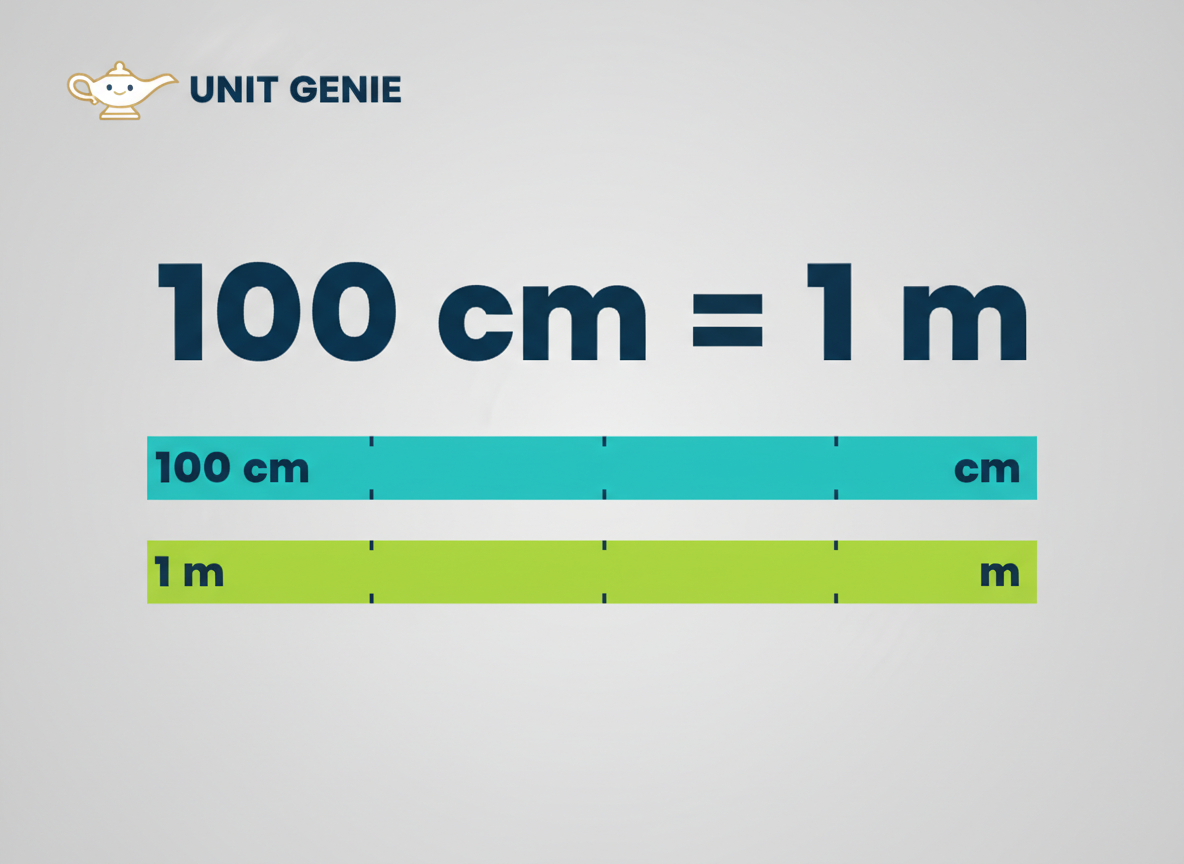
Here’s what you need to know: 100 cm equals exactly 1 meter. This isn’t a rounded figure or approximation—it’s the foundational relationship that defines the metric system. Think of it as the building block for all centimeter-to-meter conversions. Understanding this 100:1 ratio makes converting any measurement between these units straightforward, whether you’re working with 50 cm (0.5 m) or 250 cm (2.5 m).
Conversion Formula Explained
The formula’s refreshingly simple: meters = centimeters ÷ 100. For our example, that’s 100 cm ÷ 100 = 1 m.
Here’s why it works: “centi” literally means one-hundredth. So one centimeter equals 1/100th of a meter. When you’ve got 100 centimeters, you’re dividing by 100 to find how many whole meters you have.
Need to go the other direction? Just flip it: cm = m × 100. This reverse formula’s handy when you’re working with different measurements (similar to how you’d tackle precise conversions like 0.1 inch to mm).
Real-World Examples of 100 cm (1 Meter)
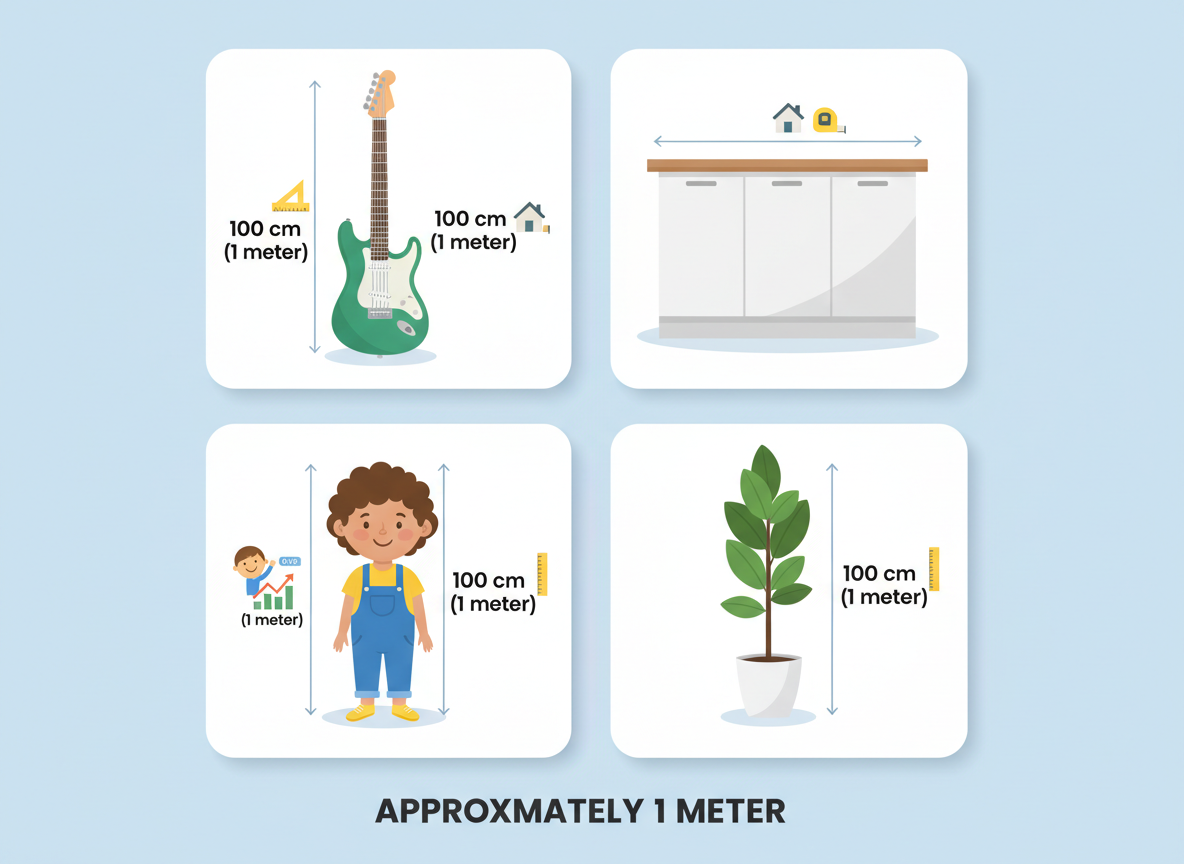
You’ll find one-meter measurements everywhere once you start looking. An acoustic guitar stretches just about a meter from top to bottom, while most kitchen countertops sit roughly one meter high—perfect for meal prep without hunching over. Baseball bats hover around this length too, though they’re typically a bit shorter.
This measurement pops up constantly in practical situations. When you’re buying fabric at the store, clerks often cut by the meter. Furniture dimensions frequently use it as a reference point, and parents love tracking it since many kids hit the one-meter milestone around age three or four.
In sports, track hurdles stand about one meter tall for certain events, and you’ll see this distance marked on diving boards. Understanding that 100 cm equals exactly one meter helps you instantly visualize these familiar references.
Why the Metric System Uses 100
The metric system’s brilliance lies in its decimal foundation—everything works in multiples of 10. The prefix “centi-” means one hundredth, so 100 centimeters equals exactly 1 meter. This pattern repeats across the system: “deci-” represents one tenth, “milli-” means one thousandth, and “kilo-” signals one thousand (like when converting 1000 liters to kiloliters). Unlike imperial measurements—where 12 inches make a foot and 3 feet make a yard—metric conversions simply move the decimal point.
When to Use Centimeters vs Meters
Choose centimeters when measuring smaller objects like phone screens (15.24 cm), clothing dimensions, or precise mechanical parts. Meters work better for room sizes, building heights, running tracks, and property boundaries. Scientists often use centimeters in lab work, while architects and engineers default to meters for construction plans. The rule of thumb? If it fits in your hand, centimeters make sense. If you’re measuring a space you can walk through, reach for meters instead.
Frequently Asked Questions (FAQ)
Is 100 cm exactly 1 meter?
Yes, 100 centimeters equals precisely 1 meter. There’s no rounding or approximation involved—this is an exact conversion by definition. The metric system was designed this way, making centimeters one-hundredth of a meter. Think of it like pennies and dollars: just as 100 pennies make exactly one dollar, 100 centimeters make exactly one meter.
How many centimeters are in a meter?
There are 100 centimeters in 1 meter. This consistent relationship makes metric conversions straightforward. Whether you’re measuring height, fabric length, or classroom dimensions, you’ll always use this same conversion factor. It’s one of those numbers worth memorizing—you’ll use it constantly in everyday life.
How do I convert cm to m in my head?
The quickest mental trick? Move the decimal point two places to the left. So 250 cm becomes 2.50 m (or simply 2.5 m). Alternatively, divide by 100 if you prefer. For example, 75 cm ÷ 100 = 0.75 m. With a bit of practice, you won’t even need a calculator. Just like converting between milliliters and liters, the pattern becomes second nature.
What’s the difference between cm and m?
The main difference is scale. Centimeters work best for smaller measurements—smartphone screens, book widths, hand spans. Meters suit larger dimensions like room sizes, tree heights, or swimming pool lengths. You wouldn’t describe your phone as 0.15 meters tall (that’s awkward), just as you wouldn’t say a basketball court is 2800 cm long (too unwieldy). Pick the unit that makes your number easy to grasp.
Why is the metric system based on 100?
The metric system uses base 10 (decimal) because we have ten fingers, making it intuitive for calculations. You don’t need to remember that 12 inches equal a foot or 5,280 feet equal a mile. Instead, everything moves in clean multiples of 10. This simplicity reduces errors, speeds up conversions, and explains why scientists, engineers, and most countries worldwide prefer the metric system. It’s math that actually makes sense.