
0.1 mL to Microliter Conversion: Quick Answer
Here’s the straightforward answer: 0.1 mL equals 100 microliters (μL). This conversion matters more than you’d think, especially when precision counts in lab pipetting, pharmaceutical dosing, or chemical experiments. Unit Genie’s conversion tool delivers this answer instantly, eliminating calculation errors that could compromise your work. In this guide, you’ll master the mL-to-μL relationship, understand when each unit makes sense, and discover practical applications across medical and scientific fields. We’ll also show you how this conversion relates to larger volume conversions like 0.1 mL to liters.
Understanding Milliliters and Microliters
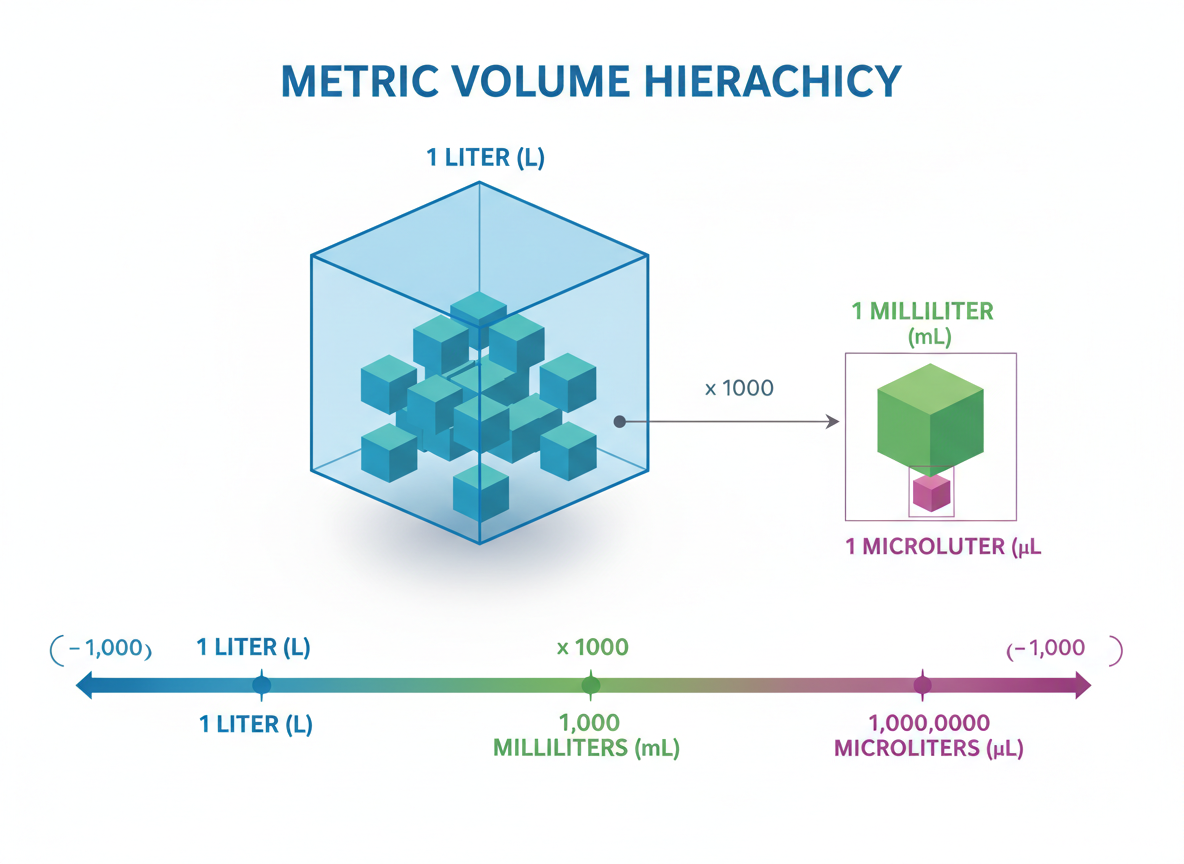
Let’s break down what we’re actually working with here. A milliliter (mL) represents one-thousandth of a liter—basically a tiny cube that’s 1 centimeter on each side. Now, a microliter (μL) is even smaller: it’s one-millionth of a liter. Think of it this way: 1 mL equals exactly 1,000 μL.
The metric system makes this relationship straightforward. The prefix “milli-” means one-thousandth, while “micro-” means one-millionth. So when you’re converting 0.1 mL to microliter, you’re simply multiplying by 1,000.
These units aren’t just academic—they’re essential in labs, hospitals, and pharmacies. Scientists pipette microliters when analyzing DNA samples, while nurses measure medication doses in milliliters. The precision matters tremendously when you’re dealing with concentrated substances or expensive materials. For context on how milliliters relate to larger volumes, check out our guide on converting 0.1 mL to liters.
The 0.1 mL to Microliter Conversion Formula
Converting milliliters to microliters is surprisingly straightforward. The basic formula is mL × 1,000 = μL. That’s it—multiply any milliliter value by 1,000 to get microliters.
For our specific case, here’s the calculation: 0.1 mL × 1,000 = 100 μL.
Why 1,000? Because the metric prefix “micro” means one-millionth. So 1 milliliter contains 1,000 microliters, just like the relationship you’d see in other metric conversions (similar to converting centimeters to meters).
Here’s a mental math shortcut: to convert any decimal milliliter amount, simply move the decimal point three places to the right. So 0.1 becomes 100—no calculator needed!
Real-World Applications of 0.1 mL to Microliter Conversion
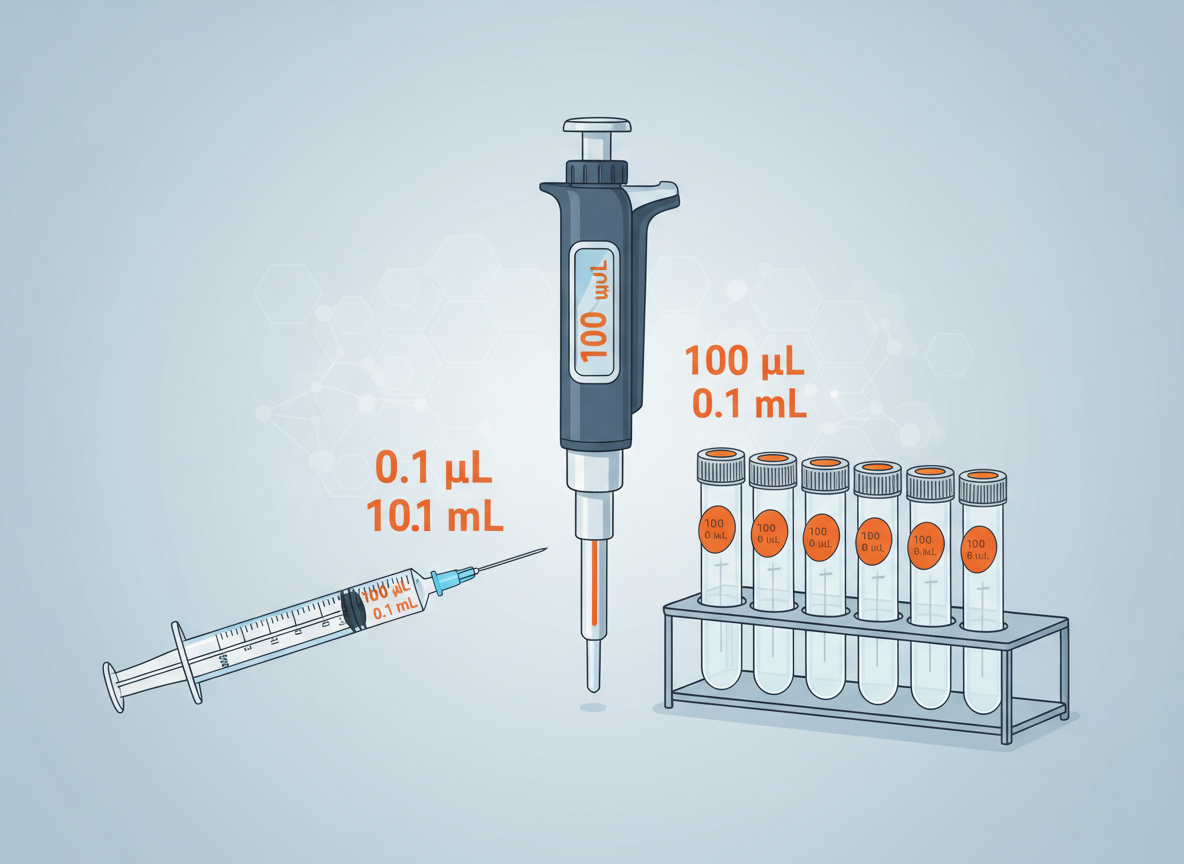
The 100 μL mark (0.1 mL) shows up constantly in professional settings. Lab techs reach for P100 pipettes dozens of times daily when preparing reagents or diluting samples. Pharmaceutical compounders rely on this exact volume for pediatric formulations where precision prevents dosing errors.
In molecular biology, 100 μL is the standard PCR reaction volume—ask any researcher and they’ll tell you it’s practically muscle memory. Quality control teams in drug manufacturing use this measurement for analytical testing, ensuring each batch meets specifications.
Medical settings use 0.1 mL measurements for precision medications like insulin (where one unit equals 0.01 mL) and vaccine preparations. Similar to how you might convert between different volume measurements like 1 1/2 liter to cups for everyday tasks, healthcare professionals convert between mL and microliters for accurate patient care.
Common Conversion Mistakes to Avoid
The most frequent error? Multiplying when you should divide (or vice versa). When converting 0.1 mL to microliters, you multiply by 1,000—but going the other direction, you’d divide. Decimal placement trips up many people too. It’s easy to write 1,000 μL as 0.001 mL instead of 0.1 mL when you’re rushed.
Another pitfall: rounding mid-calculation. If you’re working through multi-step conversions (like those found in our 0.1 inch to mm guide), always keep extra decimal places until the final answer.
Quick verification tip: ask yourself if the result makes sense. Microliters are smaller units, so the number should be larger than your milliliter value.
Precision and Significant Figures in Volume Conversions
When converting 0.1 ml to microliter, precision matters more than you’d think. While the math is straightforward (100 µL), real-world measurements aren’t always perfect. Standard pipettes typically measure to ±2-3%, meaning your “0.1 mL” might actually be 0.098-0.102 mL.
For research and pharmaceutical work, maintain appropriate significant figures. If your source measurement is 0.10 mL (two sig figs), report your result as 1.0 × 10² µL, not 100.000 µL. General applications don’t need this level of scrutiny.
Report converted values matching your instrument’s precision. A basic graduated cylinder can’t compete with a calibrated micropipette. When working with larger volumes, similar principles apply—check out our 1000 L to kL conversion guide for scaling up. Your final answer should reflect reality, not false precision.
Quick Reference: mL to μL Conversion Table
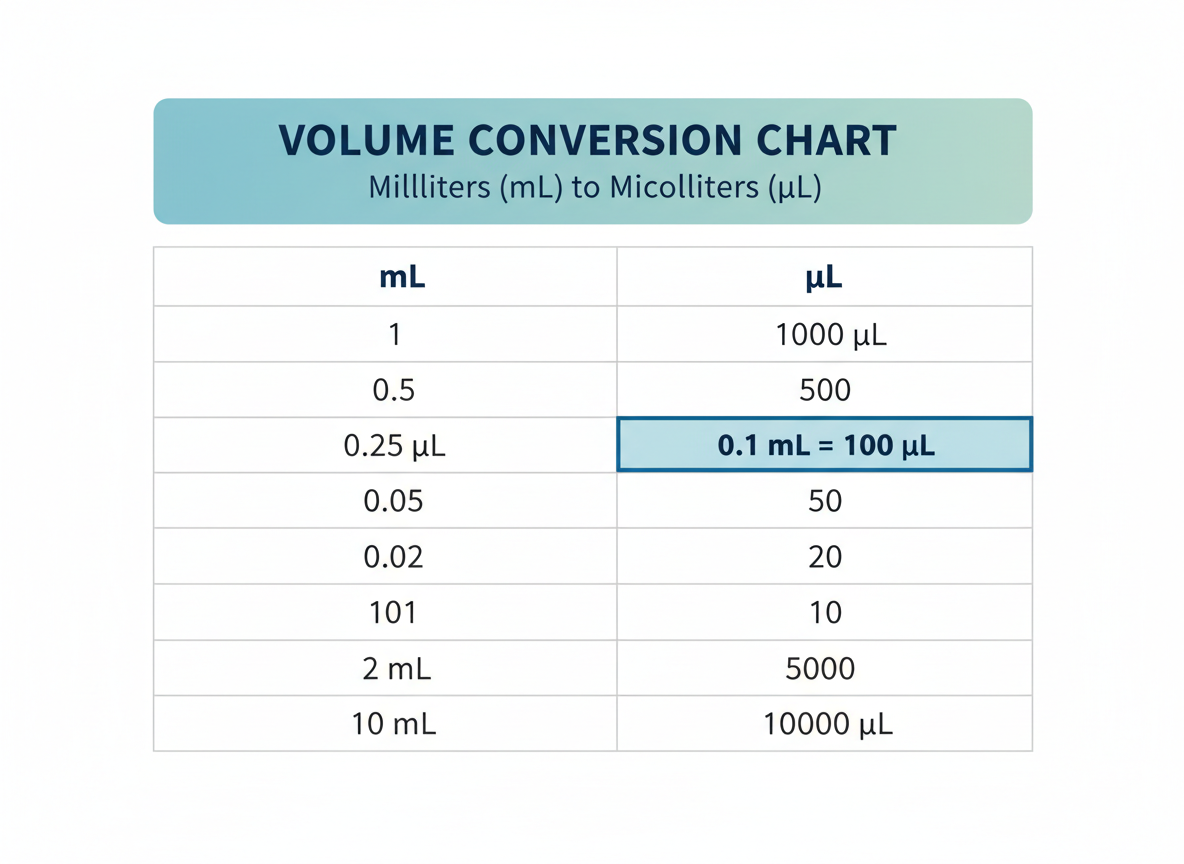
Here’s a handy conversion table you can bookmark for instant reference. Notice how 0.1 mL equals exactly 100 μL—that’s the sweet spot for many laboratory applications.
| Milliliters (mL) | Microliters (μL) |
|——————|——————|
| 0.01 mL | 10 μL |
| 0.05 mL | 50 μL |
| 0.1 mL | 100 μL |
| 0.2 mL | 200 μL |
| 0.5 mL | 500 μL |
| 0.75 mL | 750 μL |
| 1 mL | 1,000 μL |
Whether you’re measuring reagents in a lab or converting volumes for cooking (like when you need to convert 1 1/2 cups to liters), Unit Genie’s got your back with precise conversions every time.
Why Use Unit Genie for Your mL to Microliter Conversions
Unit Genie transforms conversions like 0.1 mL to microliter into a breeze. You’ll get instant, precise results without fumbling through formulas or waiting for page loads. The interactive visualizations help you actually understand what those numbers mean, while real-world comparisons put measurements into perspective. It’s completely free and ad-free—no distractions, just conversions. With multi-language support, anyone can access accurate calculations whether you’re converting storage units like 100,000 KB to GB or working with volume measurements. Ready to simplify your conversions? Give the calculator a try.
Frequently Asked Questions
How many microliters are in 0.1 mL?
There are exactly 100 microliters (μL) in 0.1 milliliters. This conversion works every time because 1 mL always equals 1,000 μL.
What is the formula to convert mL to μL?
Multiply the milliliter value by 1,000. So for any volume: μL = mL × 1,000. It’s straightforward math that works for any conversion between these units.
Is 100 μL the same as 0.1 mL?
Yes, they’re identical volumes. Think of it like saying “half dollar” versus “50 cents”—different terms for the same amount.
What laboratory equipment measures 0.1 mL or 100 μL?
Micropipettes are the gold standard for this volume range. You’ll also find P100 or P200 pipettes, graduated transfer pipettes, and microliter syringes in most labs.
Why do scientists use microliters instead of milliliters?
Microliters eliminate awkward decimal points. Writing “50 μL” beats “0.050 mL” for clarity and reduces measurement errors during experiments.
How do I convert microliters back to milliliters?
Divide by 1,000: mL = μL ÷ 1,000. Just like converting millimeters back to inches, it’s the reverse operation.
What’s the difference between μL and uL notation?
They’re the same—”uL” is simply the keyboard-friendly alternative when you can’t type the Greek letter mu (μ).
Can I use a regular measuring cup for 0.1 mL measurements?
No. Kitchen measuring tools lack the precision needed for such tiny volumes. You’ll need laboratory-grade equipment for accurate 100 μL measurements.