

Understanding 1.1 kW to HP Conversion
Here’s the quick answer: 1.1 kW equals approximately 1.47 metric horsepower (hp), or 1.48 mechanical horsepower. This conversion matters when you’re comparing motor specifications, evaluating vehicle performance, or selecting industrial equipment across different markets. You’ll encounter metric horsepower (often labeled PS or CV) in European specs, while mechanical horsepower appears in American equipment ratings. Understanding both types helps you make informed decisions, whether you’re buying a treadmill, choosing a water pump, or reviewing generator specs. Just like converting between centimeters and meters (check out our 100 cm to m guide for another practical example), this power conversion bridges regional differences in how we measure engine and motor output. We’ll show you the exact formulas, walk through real-world examples, and provide an instant calculator to handle any kilowatt-to-horsepower conversion you need.
The Conversion Formula: kW to HP
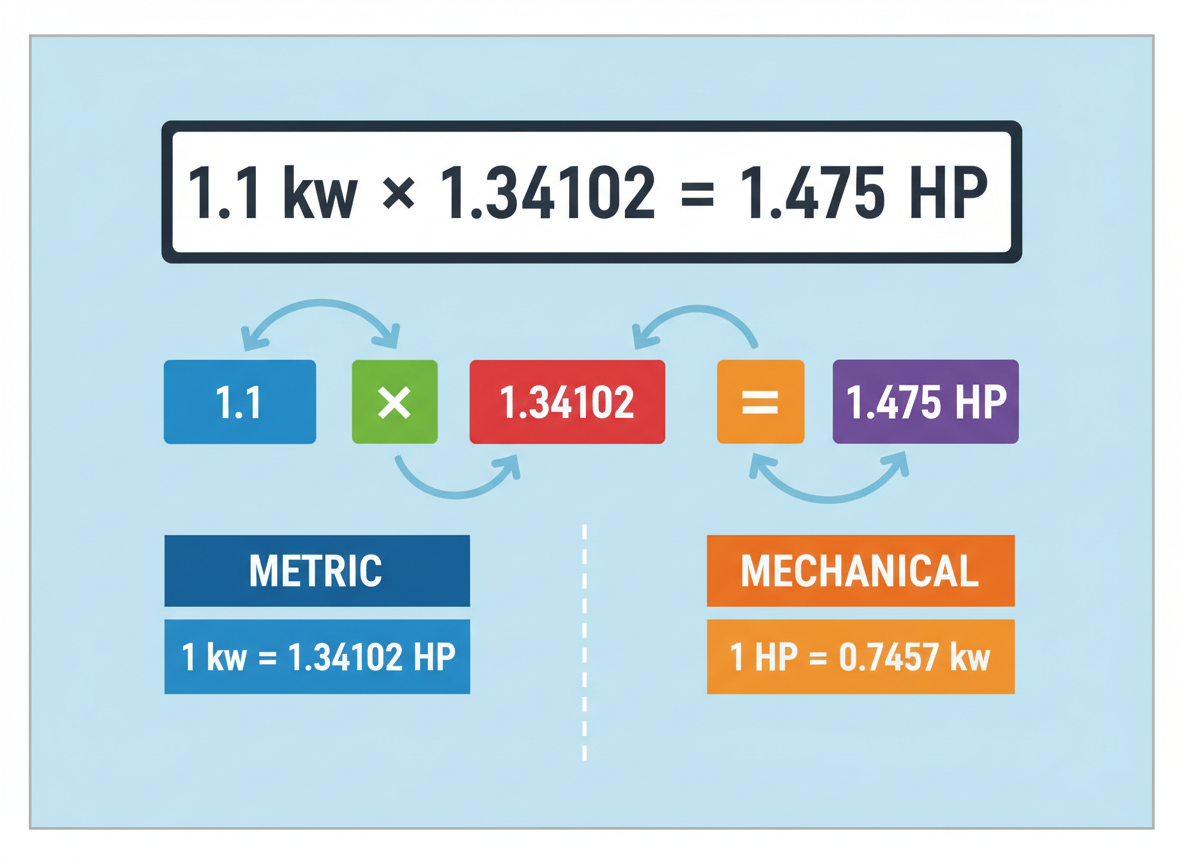
Converting kilowatts to horsepower is straightforward once you know which formula to use. For metric horsepower (the most common standard), multiply kilowatts by 1.34102:
HP (metric) = kW × 1.34102
Let’s calculate 1.1 kW:
1.1 × 1.34102 = 1.475122 HP
If you need mechanical horsepower (used mainly in North America), the multiplier changes slightly:
HP (mechanical) = kW × 1.34048
This gives you: 1.1 × 1.34048 = 1.474528 HP
The difference is tiny—only about 0.0006 HP—but it matters in technical specifications. Use metric HP for European motors and vehicles, and mechanical HP for American applications. Just like choosing the right conversion for liquid measurements, picking the correct formula ensures accuracy. For instant, error-free results, Unit Genie’s calculator handles both standards automatically.
Real-World Examples of 1.1 kW Power
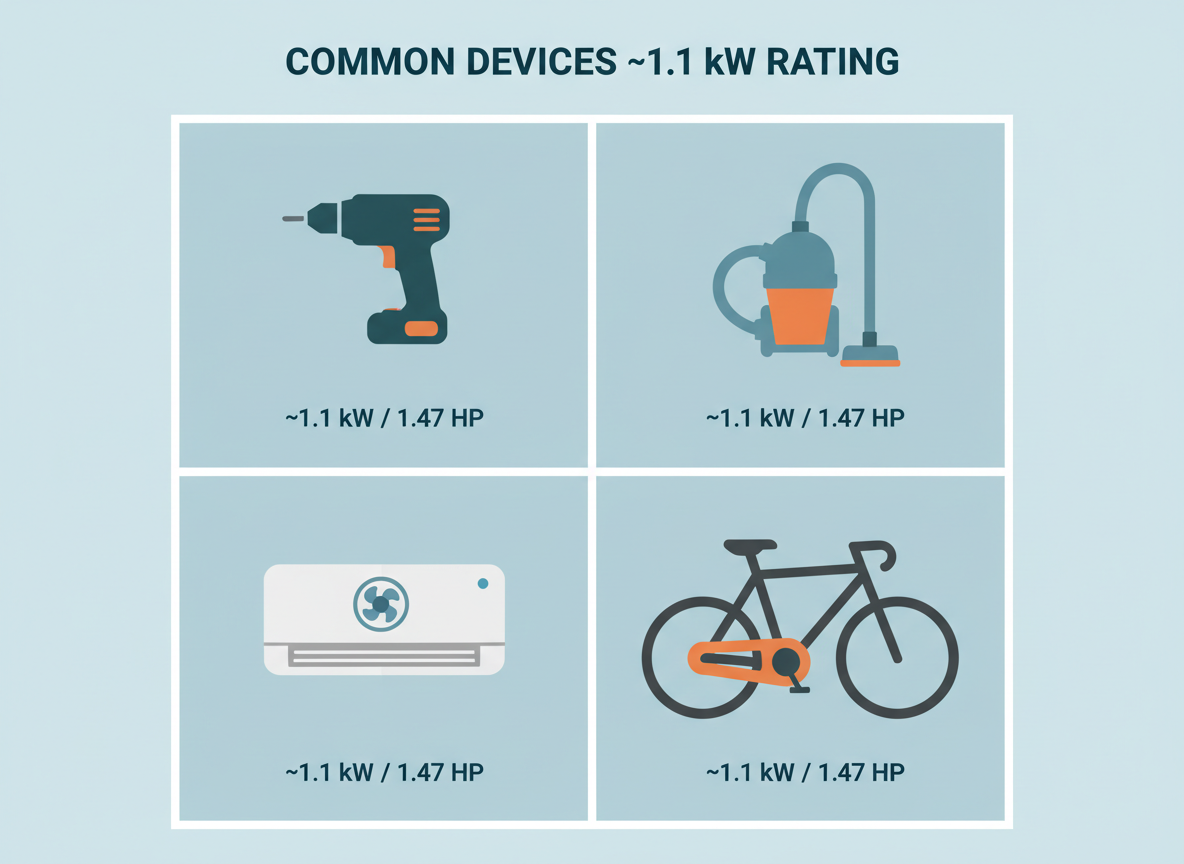
You’ll find 1.1 kW motors everywhere in daily life. Hair dryers and vacuum cleaners typically run at this power level, delivering enough oomph for household tasks without overwhelming your electrical circuit. Many power tools like circular saws and angle grinders operate around 1.1 kW, making them perfect for DIY projects and light construction work.
Small window air conditioners often use this amount of power to cool individual rooms. E-bike motors frequently sit in this range too, providing that extra pedal-assist boost. In industrial settings, you’ll see 1.1 kW motors driving conveyor belts and small pumps. Understanding these everyday applications—much like knowing data storage conversions for your devices—helps you grasp what 1.47 horsepower actually means in practical terms.
Quick Reference: kW to HP Conversion Table
Here’s a handy table for common kW values you’ll encounter. Whether you’re sizing a motor or comparing specifications, this makes conversions a snap.
| kW | Metric HP (PS) | Mechanical HP |
|——|—————-|—————|
| 0.5 | 0.680 | 0.670 |
| 0.6 | 0.816 | 0.805 |
| 0.7 | 0.952 | 0.939 |
| 0.8 | 1.088 | 1.073 |
| 0.9 | 1.224 | 1.207 |
| 1.0 | 1.360 | 1.341 |
| 1.1 | 1.496 | 1.475 |
| 1.2 | 1.632 | 1.609 |
| 1.3 | 1.768 | 1.743 |
| 1.4 | 1.904 | 1.877 |
| 1.5 | 2.039 | 2.012 |
| 1.6 | 2.175 | 2.146 |
| 1.7 | 2.311 | 2.280 |
| 1.8 | 2.447 | 2.414 |
| 1.9 | 2.583 | 2.548 |
| 2.0 | 2.719 | 2.682 |
Need a different value? Unit Genie handles any conversion instantly—just like converting 1000 L to kL or thousands of other units.
Common Mistakes to Avoid When Converting kW to HP
Don’t confuse kilowatts (kW) with kilowatt-hours (kWh)—one measures power, the other measures energy consumption over time. Another frequent error? Using mechanical HP when you need metric HP, or vice versa. Regional standards matter here.
Rounding too early in manual calculations throws off your final numbers, and forgetting efficiency losses means your theoretical conversion won’t match real-world performance. Mixing imperial and metric units in complex conversions—like converting milliliters alongside power units—creates compounding errors that are tough to trace.
Unit Genie handles these precision challenges automatically, ensuring accurate conversions every time without the guesswork.
Frequently Asked Questions (FAQ)
How many horsepower is 1.1 kilowatts exactly?
1.1 kW equals 1.475 mechanical horsepower (hp) or 1.495 metric horsepower (PS). The slight difference comes from the two horsepower standards used worldwide.
What’s the difference between metric horsepower and mechanical horsepower?
Metric horsepower (PS or CV) equals 735.5 watts, while mechanical horsepower (hp) equals 745.7 watts. Mechanical hp is about 1.4% stronger. European manufacturers typically use metric hp, while American specs use mechanical hp.
Can I use this conversion for electric motors and gas engines?
Absolutely. The conversion works for any power source—electric motors, gasoline engines, diesel generators, or even hydraulic systems. Power is power, regardless of the source.
How do I convert HP back to kW?
Use this formula: kW = HP × 0.7457. So if you’ve got a 2 hp motor, that’s 2 × 0.7457 = 1.49 kW. Just like converting between other units (similar to how 0.1 mL to liter conversions work with volume), the math stays consistent.
Why do some sources show different conversion values?
You’ll see variations because some use metric horsepower (0.7355 factor) instead of mechanical horsepower (0.7457 factor). Always check which standard the source is using.
Is 1.1 kW enough power for a home workshop?
It depends on your tools. A 1.1 kW (1.5 hp) motor handles most small bench grinders, drill presses, and portable saws just fine. You’d need more juice for table saws or planers.