

Understanding 0.1 Bar to PSI Conversion
Converting 0.1 bar gives you exactly 1.45038 PSI—a measurement you’ll encounter more often than you’d think. This low-pressure range matters in everyday situations like checking tire pressure on bicycles, calibrating espresso machines, or monitoring aquarium air pumps. Medical equipment, HVAC systems, and pool filters also operate in this zone.
Unlike converting larger pressure values, getting 0.1 bar right makes a real difference in precision applications. A small error here can mean the difference between perfectly pulled espresso and bitter coffee. Throughout this guide, we’ll walk you through the conversion math, show you practical examples, and help you understand when these measurements matter most. You’ll leave knowing exactly how to handle low-pressure conversions with confidence—similar to mastering precise small-volume measurements.
What is Bar? (Pressure Unit Explained)
A bar is a metric pressure unit widely used across Europe and in engineering fields. Here’s what makes it practical: 1 bar sits remarkably close to atmospheric pressure at sea level (it’s actually about 99% of standard atmospheric pressure). This makes conversions intuitive for everyday scenarios. When you’re working with 0.1 bar, you’re dealing with just 10% of atmospheric pressure—a relatively low pressure you’d encounter in light vacuum applications or gentle pressurization systems. Meteorologists use bars for weather forecasting, while engineers rely on them for tire pressure specs, hydraulic systems, and industrial equipment throughout European markets and beyond.
What is PSI? (Pounds Per Square Inch)
PSI stands for pounds per square inch, the standard pressure unit in American and imperial measurement systems. It measures how much force (in pounds) is distributed over one square inch of area. You’ll find PSI everywhere in the United States—from tire pressure gauges showing 32 PSI to pressure washers rated at 2,000 PSI. Industries like automotive, manufacturing, and HVAC rely heavily on PSI measurements, which is why converting between bar and PSI comes up so often in technical work and everyday situations.
The Conversion Formula: 0.1 Bar to PSI
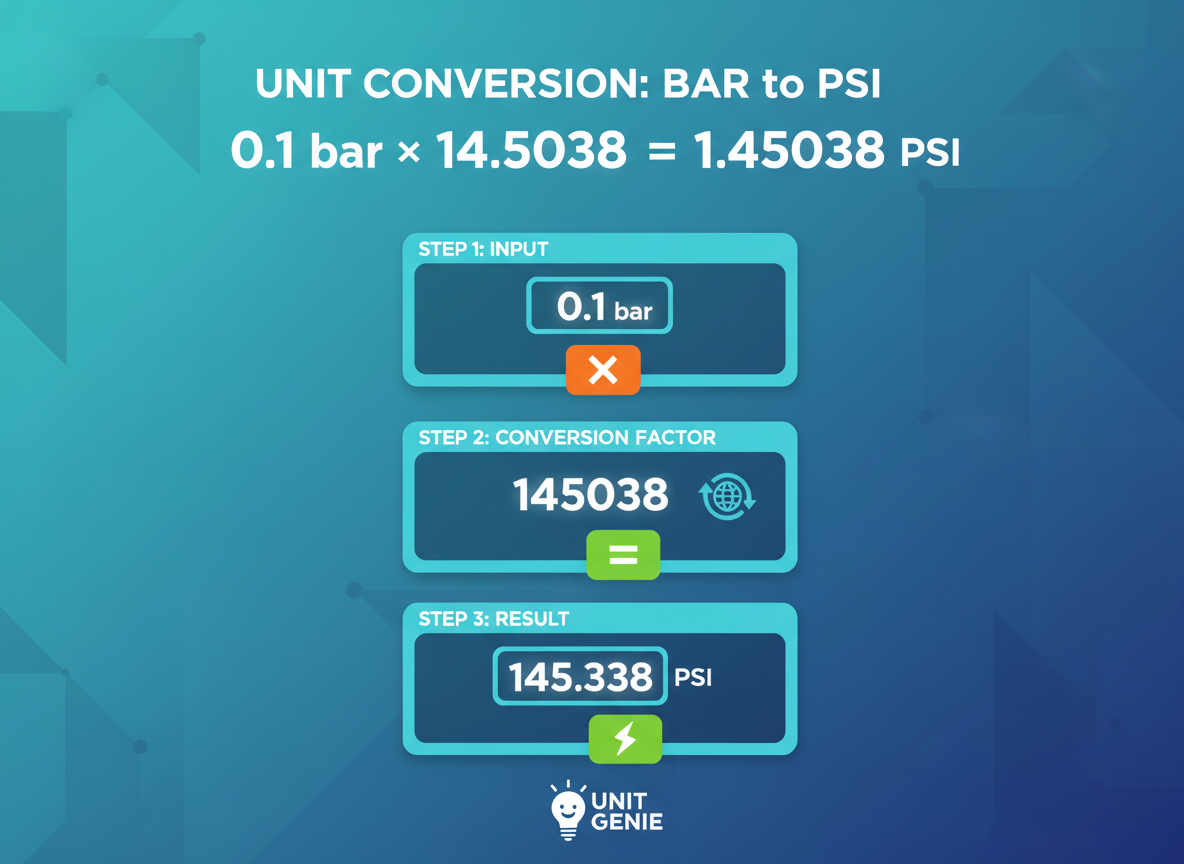
Converting bar to PSI is straightforward once you know the magic number: 1 bar equals 14.5038 PSI. For 0.1 bar, you’ll multiply 0.1 × 14.5038, giving you 1.45038 PSI.
When should you round? For everyday applications like checking tire pressure, 1.45 PSI works perfectly. But if you’re working with precision instruments or scientific calculations, stick with 1.45038 PSI. Similar to how we approach power conversions like kW to HP, context matters.
Need to go the other way? Divide PSI by 14.5038 to get bar. So 1.45 PSI ÷ 14.5038 = 0.1 bar.
Real-World Applications of 0.1 Bar Pressure
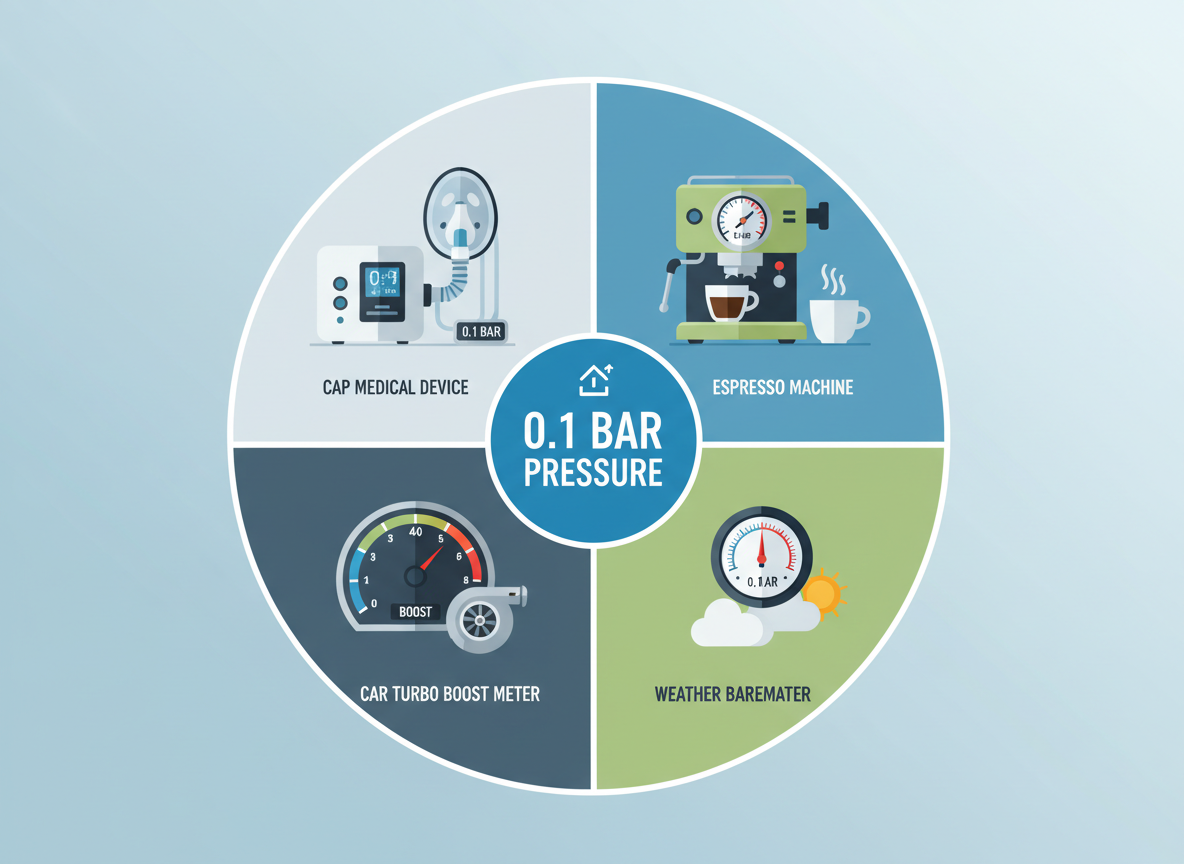
You’ll find 0.1 bar (1.45 PSI) pressure in more places than you’d think. Weather forecasts track barometric pressure drops of this magnitude when low-pressure systems move in—that slight change signals incoming storms. CPAP machines operate around these pressures during initial therapy settings, gently keeping airways open during sleep. Espresso enthusiasts know that low-pressure pre-infusion at roughly 0.1 bar wets coffee grounds before the main extraction, preventing channeling. HVAC technicians measure ductwork resistance in this range to ensure proper airflow. Even your car’s turbo system idles near this pressure before you hit the gas. Lab researchers working with controlled vacuum environments frequently calibrate equipment at these low-pressure thresholds for experiments requiring precise atmospheric control.
Quick Reference: 0.1 Bar Conversion Table
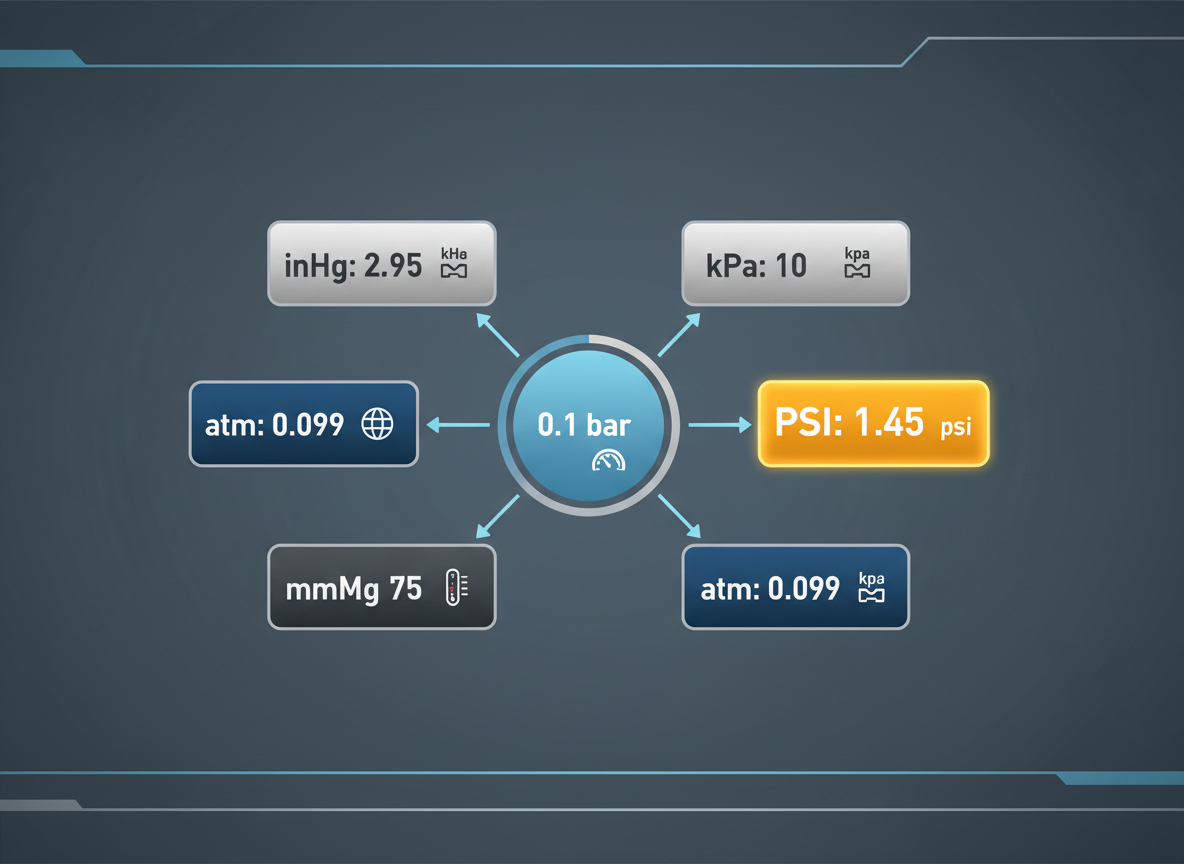
Here’s your at-a-glance conversion chart for 0.1 bar across the most commonly used pressure units:
| Unit | Value | Typical Use |
|——|——-|————-|
| PSI | 1.45 | Tire pressure, HVAC systems |
| kPa | 10 | Weather forecasts, scientific work |
| atm | 0.0987 | Chemistry labs, diving calculations |
| mmHg | 75.01 | Blood pressure measurements |
| inHg | 2.953 | Aviation altimeter settings |
The PSI conversion matters most for everyday applications—you’ll find it on pressure gauges, equipment specs, and maintenance manuals throughout North America. Meanwhile, scientists prefer kPa for its clean base-10 math, and medical professionals stick with mmHg since that’s what their equipment displays.
Common Conversion Mistakes to Avoid
The most frequent error? Confusing bar with millibar (mbar). Remember, 0.1 bar equals 100 mbar—not 0.1 mbar. Another pitfall is rounding too early. If you’re converting 0.1 bar through multiple calculations, keep full precision until the final step. Many folks also flip the conversion direction, multiplying by 14.5038 when they should divide (or vice versa). Always double-check you’re using the correct conversion factor: 1 bar = 14.5038 PSI. Similar to unit conversions in laboratory work, precision matters. A quick sanity check helps: does your PSI result seem reasonable for the application? If 0.1 bar becomes 145 PSI instead of 1.45 PSI, you’ve likely made a decimal error.
Frequently Asked Questions (FAQ)
Is 0.1 bar equal to 1.45 PSI?
Yes, 0.1 bar converts to exactly 1.45038 PSI. Most people round this to 1.45 PSI for everyday use.
How do you convert 0.1 bar to PSI manually?
Multiply 0.1 by 14.5038. The formula is: PSI = bar × 14.5038. It’s straightforward once you remember the conversion factor—similar to how you’d convert 150 grain to mg using a consistent multiplier.
What does 0.1 bar pressure feel like?
It’s quite low—about 10% of normal atmospheric pressure at sea level. You’d experience something like this at high altitudes or in vacuum-related applications.
Is 0.1 bar considered low or high pressure?
That’s definitely low pressure in most contexts, whether you’re looking at tire pressure, industrial systems, or weather readings.
What tools can measure 0.1 bar accurately?
Digital manometers and precision pressure gauges work best. They’ll give you reliable readings at this lower pressure range.
Can I use 1.45 PSI instead of 1.45038 PSI?
Absolutely. For nearly all practical applications, rounding to 1.45 PSI works perfectly fine.