
Understanding 1.1 Bar to PSI Conversion
When you need to convert 1.1 bar to PSI, you’re looking at exactly 15.95377 PSI. This conversion pops up more often than you’d think—checking your car’s tire pressure after visiting a European gas station, calibrating equipment with mixed unit specifications, or verifying pressure ratings on imported tools. Understanding this relationship helps you work confidently across different measurement systems. In this guide, you’ll learn the conversion formula, see practical applications, and discover how Unit Genie simplifies these calculations instantly. Whether you’re dealing with smaller values like 0.1 bar or need quick conversions on the go, we’ve got you covered.
The Quick Answer: 1.1 Bar Equals 15.95 PSI
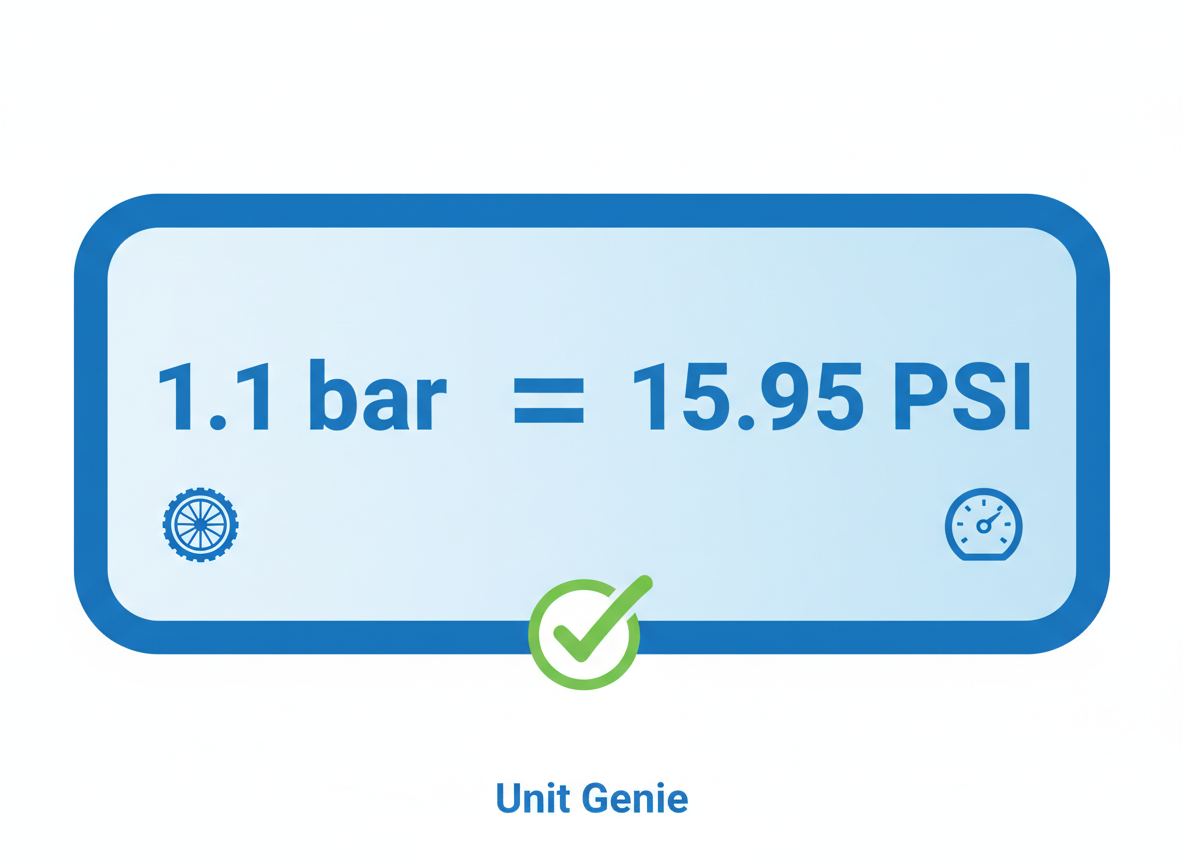
Here’s what you need to know: 1.1 bar converts to 15.953773773 PSI. In everyday use, you’ll typically round this to 15.95 PSI or even 16 PSI—nobody’s measuring their bicycle tire pressure to nine decimal places!
This pressure level shows up more often than you’d think. Many bicycle tires run around this range, and you’ll find it in certain low-pressure industrial applications too. Need to convert other pressure values? Unit Genie’s instant calculator handles these conversions in seconds. And if you’re curious about smaller increments, check out our guide on 0.1 bar to PSI conversions.
Bar to PSI Conversion Formula Explained
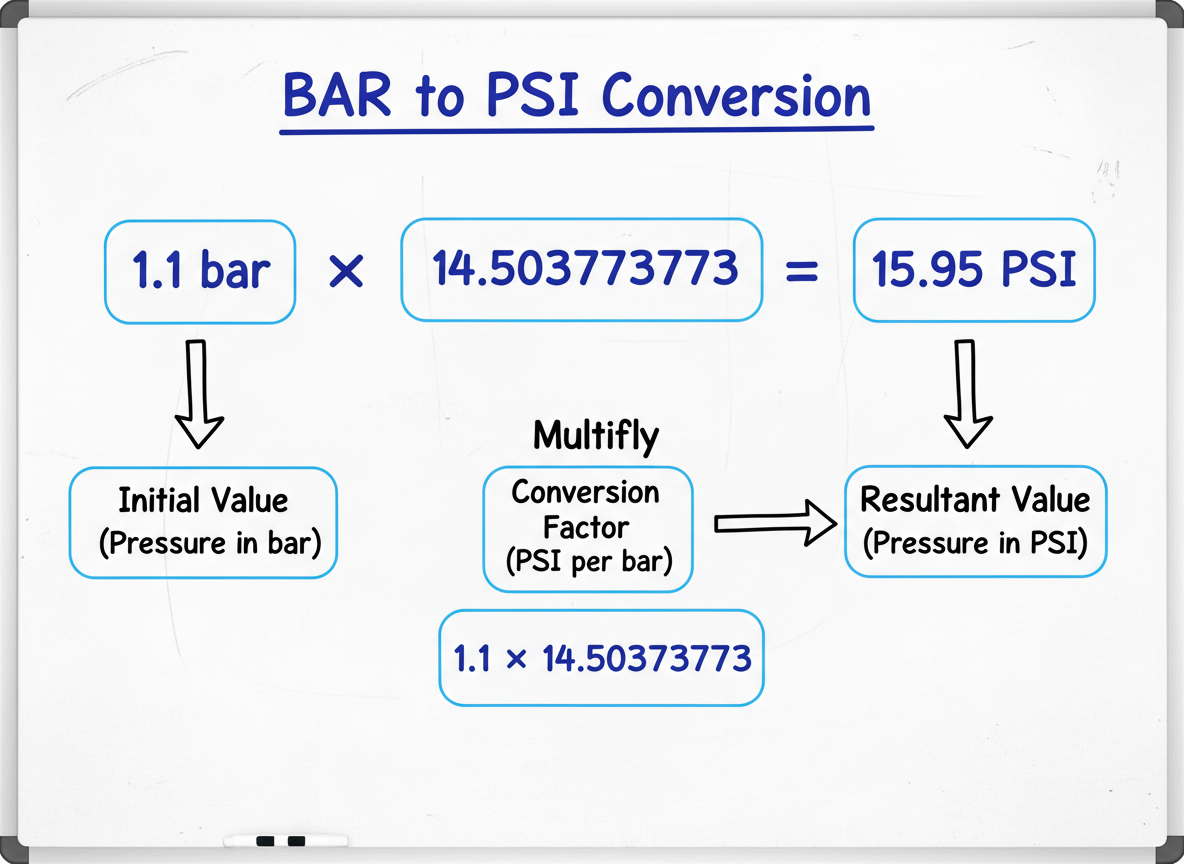
The conversion formula is straightforward: PSI = bar × 14.503773773
Let’s walk through converting 1.1 bar:
1.1 × 14.503773773 = 15.953773773 PSI
Why this specific number? One bar equals 100,000 pascals (metric), while one PSI equals approximately 6,894.76 pascals (imperial). Dividing these gives us our conversion factor of 14.503773773.
For everyday use, rounding to 14.5 or 14.504 works perfectly fine—you’ll only be off by a tiny fraction. Engineering applications might need three or four decimal places, while checking your bike tires? Two decimals is plenty. Similar to converting 1.1 kW to HP, knowing when precision matters saves you time without sacrificing accuracy.
Real-World Applications of 1.1 Bar Pressure

You’ll encounter 1.1 bar (about 16 PSI) more often than you might think. Many bicycle tires run at this pressure for comfortable city riding—enough to prevent pinch flats without making the ride feel harsh. Inflatable paddleboards and pool floats typically operate around this range, providing firm support without risking a burst seam.
Low-pressure pneumatic tools and hydraulic systems often work at these levels, especially in manufacturing settings where gentle force matters. Some medical equipment, like blood pressure cuffs and respiratory devices, operates within this pressure zone too.
For context, 1.1 bar sits comfortably between atmospheric pressure (1 bar) and typical car tire pressure (2.2-2.5 bar). It’s similar to how 1 1/2 quarts relates to everyday cooking measurements—a familiar measurement that bridges casual and precise applications.
Understanding Bar and PSI Units
Bar is a metric pressure unit equal to 100,000 pascals. It’s handy because one bar sits close to Earth’s atmospheric pressure at sea level, making it intuitive for everyday use.
PSI (pounds per square inch) measures force in the imperial system. It tells you how many pounds of force press against each square inch of surface area.
You’ll find bar dominates in Europe, Asia, and countries using metric measurements. Meanwhile, PSI remains the go-to unit across the United States and some industries worldwide, regardless of location.
These different units emerged from separate measurement systems that developed independently. Engineers created bar in the early 1900s as a practical metric alternative, while PSI evolved naturally from British imperial standards.
Choose bar when working with European equipment or international standards. Stick with PSI for American machinery, tire pressure in the U.S., or when collaborating with U.S.-based manufacturers. Similar to how metric and imperial measurements coexist, knowing both units helps you work seamlessly across borders.
Quick Reference: Bar to PSI Conversion Table
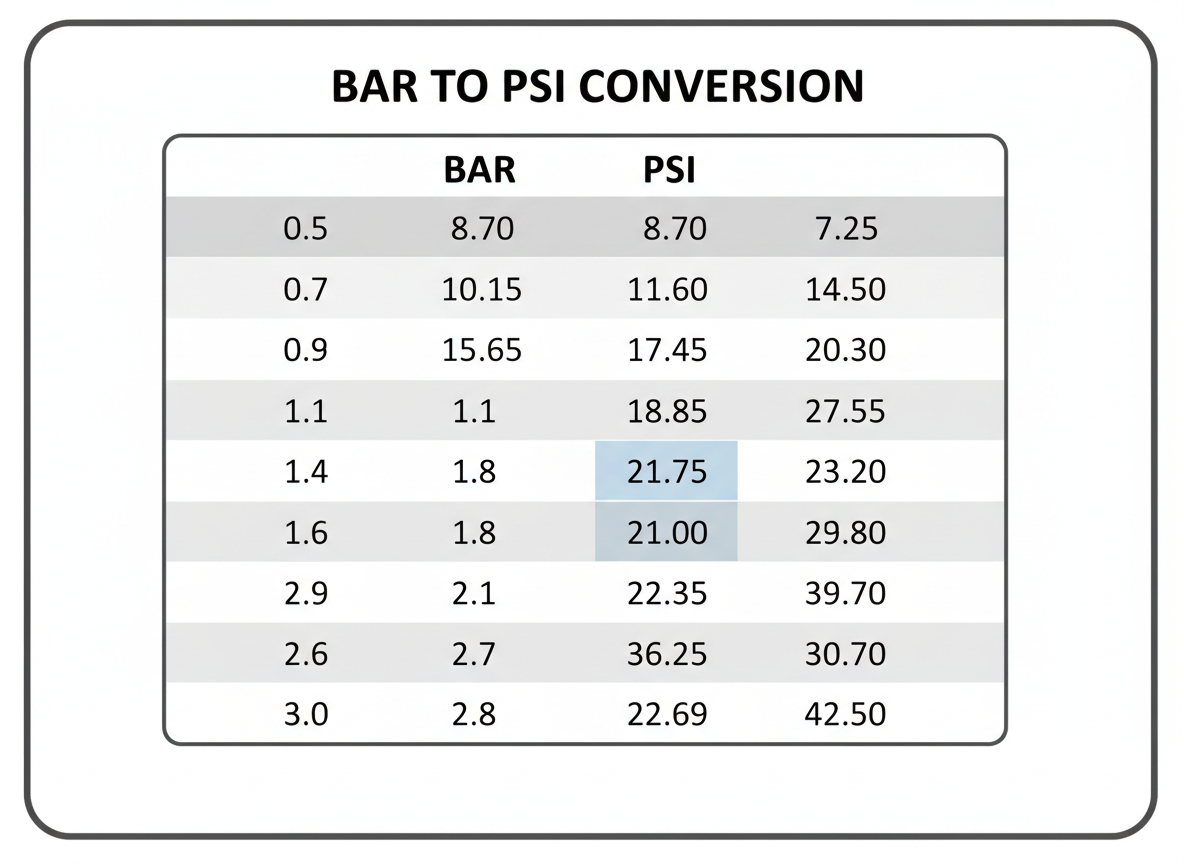
Here’s a handy reference table showing common bar values and their PSI equivalents:
| Bar | PSI (Precise) | PSI (Rounded) |
|—–|—————|—————|
| 0.5 | 7.252 | 7.3 |
| 0.6 | 8.702 | 8.7 |
| 0.7 | 10.153 | 10.2 |
| 0.8 | 11.603 | 11.6 |
| 0.9 | 13.053 | 13.1 |
| 1.0 | 14.504 | 14.5 |
| 1.1 | 15.954 | 16.0 |
| 1.2 | 17.404 | 17.4 |
| 1.3 | 18.855 | 18.9 |
| 1.4 | 20.305 | 20.3 |
| 1.5 | 21.756 | 21.8 |
| 1.6 | 23.206 | 23.2 |
| 1.7 | 24.656 | 24.7 |
| 1.8 | 26.107 | 26.1 |
| 1.9 | 27.557 | 27.6 |
| 2.0 | 29.008 | 29.0 |
| 2.5 | 36.259 | 36.3 |
| 3.0 | 43.511 | 43.5 |
Need a different value? Use Unit Genie for instant conversions of any bar value to PSI—no manual calculations required. Whether you’re converting pressure units or working with other measurements like volume conversions, you’ll get accurate results every time.
Common Mistakes to Avoid When Converting Pressure
The biggest slip-up? Confusing bar with kPa or atmospheres—they’re close in value but not identical. Rounding too early throws off your calculations, especially when precision matters. Many pressure gauges show multiple scales simultaneously, so double-check you’re reading the right one. Don’t forget the difference between gauge pressure (what most gauges show) and absolute pressure (which includes atmospheric pressure). For conversions requiring similar accuracy—like when you’re working with precise measurements across different unit systems—always use the complete conversion factor (14.5038 instead of just 14.5) and round only your final answer. When in doubt, Unit Genie’s calculator handles these nuances automatically.
Frequently Asked Questions
What is 1.1 bar in PSI exactly?
1.1 bar equals 15.953773773 PSI, though it’s commonly rounded to 15.95 or 16 PSI for practical use.
Is 1.1 bar high or low pressure?
It’s relatively low pressure—barely above atmospheric pressure (1 bar). Think of it as just slightly more than what’s naturally around you.
How do I convert bar to PSI without a calculator?
Simply multiply the bar value by approximately 14.5. So 1.1 × 14.5 ≈ 16 PSI. Quick mental math when you need it!
Why is the conversion factor 14.503773773?
It stems from the relationship between imperial and metric pressure definitions—pounds per square inch versus bars based on atmospheric pressure.
What’s the difference between bar and PSI?
Bar is metric (European standard), while PSI is imperial (commonly used in the US). Just like how milliliters and liters relate differently, as shown in Unit Genie’s ML to L conversions.
Can I use 1.1 bar pressure for car tires?
No, that’s too low. Car tires typically need 2.0-2.5 bar (29-36 PSI).
Where is 1.1 bar pressure commonly used?
You’ll see it in bicycle tires, inflatable toys, pool floats, and other low-pressure applications.