

Understanding 0.1 mL to L Conversion
0.1 mL equals 0.0001 liters. That’s one ten-thousandth of a liter, if you’re keeping track. This tiny measurement matters more than you’d think—precision at this level is essential in medical dosing, laboratory work, and even high-end cooking. When you’re measuring insulin, preparing chemical solutions, or crafting cocktails, getting 0.1 mL wrong isn’t an option. Need to convert larger or smaller volumes? Unit Genie’s mL to L calculator delivers instant, accurate results every time.
The Simple Formula: Converting 0.1 mL to Liters
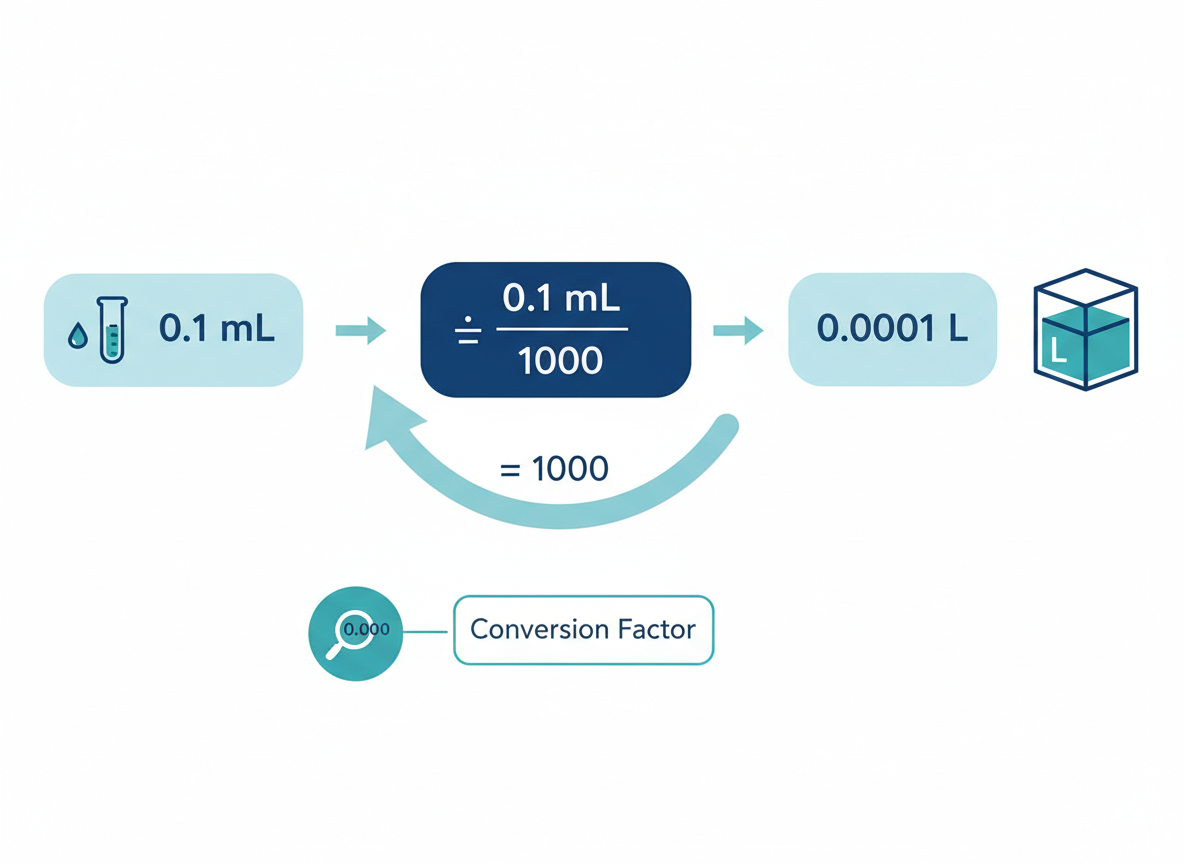
Here’s what you need to know: 1 liter equals 1,000 milliliters. That’s your foundation. The conversion formula is straightforward—divide your milliliters by 1,000 to get liters. So for 0.1 mL, you’d calculate 0.1 ÷ 1,000 = 0.0001 L. Notice how the decimal point shifts three places to the left? That’s because you’re dividing by 1,000. When working with tiny measurements like this, precision matters. Keep all those zeros—they’re telling you exactly how small this volume really is. Understanding this relationship works both ways, which helps when you need to convert liters to milliliters too.
Real-World Applications of 0.1 mL Measurements
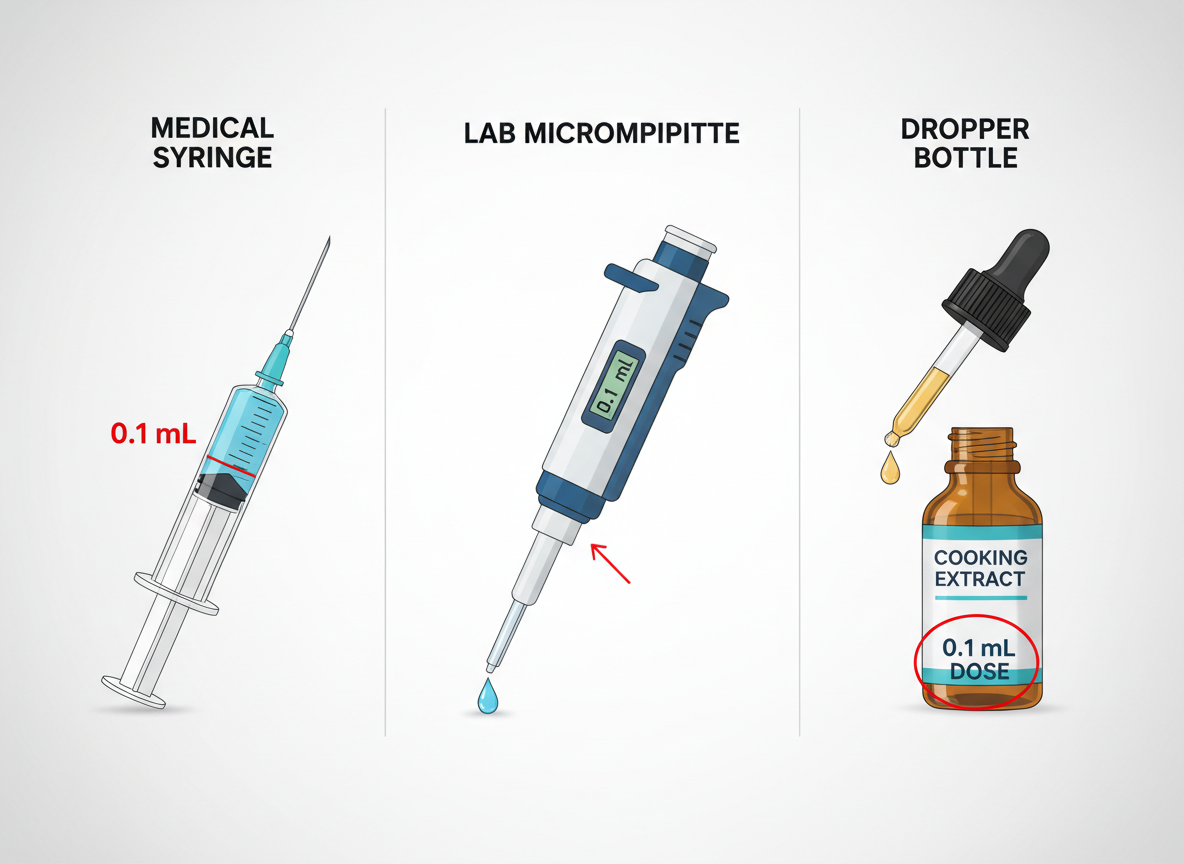
You’ll find 0.1 mL measurements everywhere precision matters. Doctors rely on this tiny volume for insulin dosing and pediatric medications, where even slight variations could affect treatment outcomes. In labs, researchers pipette exactly 0.1 mL for chemical reactions and sample preparation—accuracy here isn’t optional.
Baristas and mixologists measure flavor extracts and essential oils in tenths of a milliliter because three drops too many can overpower a drink. Even converting between units like ml to oz requires understanding these small-scale measurements.
At this scale, being off by just 0.05 mL represents a 50% error. That’s why vaccine administrators, chemists, and culinary professionals treat these measurements with such care.
Visualizing 0.1 mL: Size Comparisons
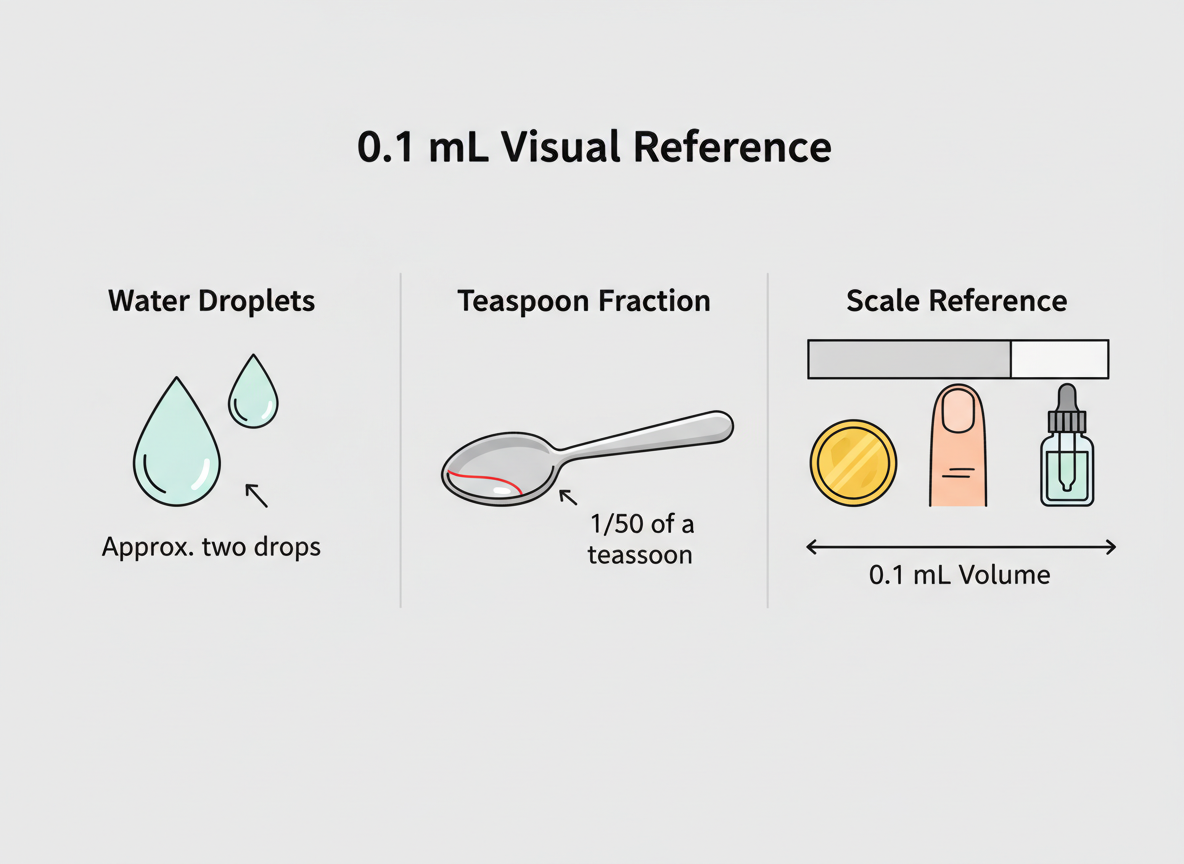
Picture this: 0.1 mL is roughly two tiny drops of water. That’s incredibly small—about 1/50th of a teaspoon. To put it another way, you’d need ten of these measurements just to fill a single milliliter. It’s the kind of precision you’d see in eye drops or diluted medicine samples, where even the smallest amounts matter.
Quick Reference: 0.1 mL Conversion Table
Here’s your go-to table for converting 0.1 mL and other common small volumes. Bookmark this for quick access whenever you need it.
| Volume (mL) | Liters (L) | Fluid Ounces (fl oz) | Drops (approx.) | Teaspoons (tsp) | |————-|————|———————-|—————–|—————–| | 0.1 mL | 0.0001 L | 0.0034 fl oz | 2 drops | 0.02 tsp | | 0.2 mL | 0.0002 L | 0.0068 fl oz | 4 drops | 0.04 tsp | | 0.5 mL | 0.0005 L | 0.017 fl oz | 10 drops | 0.1 tsp | | 1.0 mL | 0.001 L | 0.034 fl oz | 20 drops | 0.2 tsp | | 5.0 mL | 0.005 L | 0.169 fl oz | 100 drops | 1 tsp |
Need to work backward? Check out our l to ml converter for quick calculations in the opposite direction. These conversions come in handy when you’re working with medicine droppers, essential oils, or precision chemistry measurements.
Tools for Measuring 0.1 mL Accurately
Getting 0.1 mL just right requires the proper tools. Medical syringes with fine graduations are your best bet for everyday use—they’re marked in 0.1 mL increments and widely available. In lab settings, micropipettes deliver exceptional precision, though they’re pricier. Calibrated droppers can work in a pinch, but they’re less reliable since drop size varies with liquid density and surface tension. Here’s a tip: always read measurements at eye level to avoid parallax errors. The biggest mistake? Using kitchen measuring spoons for tiny volumes like 0.1 mL—they simply weren’t designed for that precision. If you’re working with larger conversions too, check out our liters to gallons guide.
Frequently Asked Questions
How many liters is 0.1 mL?
0.1 mL equals 0.0001 L (or 1 × 10⁻⁴ liters). To get there, simply move the decimal point three places to the left, since there are 1,000 mL in one liter. It’s a tiny amount—roughly the size of two grains of rice combined.
Is 0.1 mL the same as 1 drop?
Not quite. While people often say “a drop” equals about 0.05 mL, it varies wildly depending on the liquid’s thickness, surface tension, and the dropper you’re using. Water drops from a standard medicine dropper average 0.04-0.05 mL, so you’d need roughly 2 drops to hit 0.1 mL. Oil or alcohol? They’ll form different-sized drops entirely. If precision matters, always use a calibrated syringe or pipette instead of eyeballing drops.
How do you measure 0.1 mL without special equipment?
Honestly, it’s tough. A 1 mL oral syringe (available at most pharmacies) works best—just fill to the 0.1 mark. In a pinch, you could use very small measuring spoons marked in fractions (0.1 mL is about 1/50th of a teaspoon), but accuracy drops significantly. For anything important like medication, don’t guess. Get the right tool.
What happens if I round 0.1 mL conversions?
It depends on what you’re doing. For cooking? Rounding 0.0001 L probably won’t wreck your recipe. But in laboratory work or medicine, rounding can create serious problems. If someone needs 0.1 mL of a potent medication and you round up to 0.15 mL, that’s a 50% dosing error. Always maintain precision when stakes are high.
What is 0.1 mL in other common units?
Here’s the breakdown:
-
Teaspoons: Approximately 0.02 teaspoons (or 1/50th)
-
Fluid ounces (US): About 0.0034 fl oz
-
Tablespoons: Roughly 0.0068 tablespoons
-
Cups: About 0.00042 cups
-
Microliters: Exactly 100 µL
These conversions matter when you’re working across different measurement systems. Just like converting between larger volumes (think gallons to liters), understanding the relationships helps you work confidently.
Why is 0.1 mL precision important in medicine?
Because tiny volumes pack a big punch. Many medications—especially for infants, children, or potent drugs like insulin—are dosed in tenths of a milliliter. A 0.1 mL error might seem insignificant, but it could mean the difference between therapeutic and toxic levels. Medical syringes are calibrated to these precise measurements for exactly this reason: patient safety depends on getting the dose right every single time.
[…] 0.236588? One US cup equals exactly 236.588 milliliters (remember, 1,000 milliliters make a liter). When you’re actually cooking, you don’t need to be that precise. Round it to 0.35 […]
[…] this specific measurement comes into play. For a broader understanding, check out our comprehensive 0.1 mL to L conversion guide with practical […]