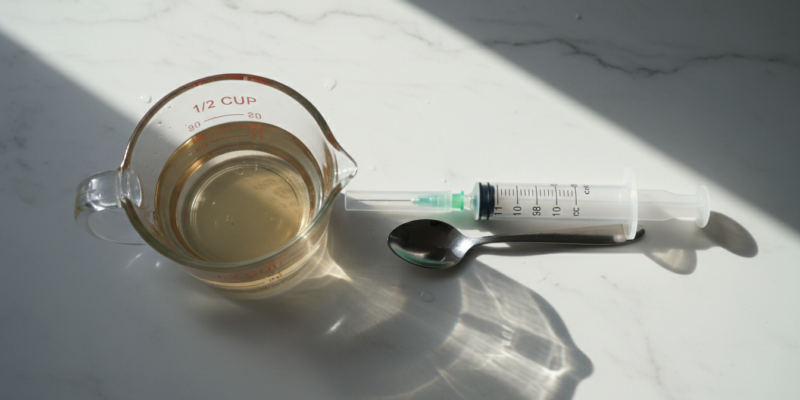
Quick Answer: 1/2 Cup Equals 118.294 cc
1/2 US cup equals exactly 118.294 cubic centimeters (cc). That’s your instant answer.
Now, what’s a cc? It stands for cubic centimeter, and here’s something handy: 1 cc equals 1 milliliter (ml). They’re interchangeable, which makes conversions pretty straightforward once you know the numbers.
This conversion matters more than you’d think. Bakers need precise measurements when scaling European recipes. Medical professionals rely on cc for dosing medications and measuring fluids. Engineers and scientists use it constantly in technical work. Whether you’re converting a recipe from grandma’s American cookbook for your metric kitchen scale or calculating liquid volumes for a school project, getting this right makes everything easier.
This guide will walk you through the conversion formula, show you real-world applications, and help you understand when to use cups versus cc. If you’re also curious about converting 1/2 cup to liters, we’ve got you covered there too.
Understanding the Conversion Formula
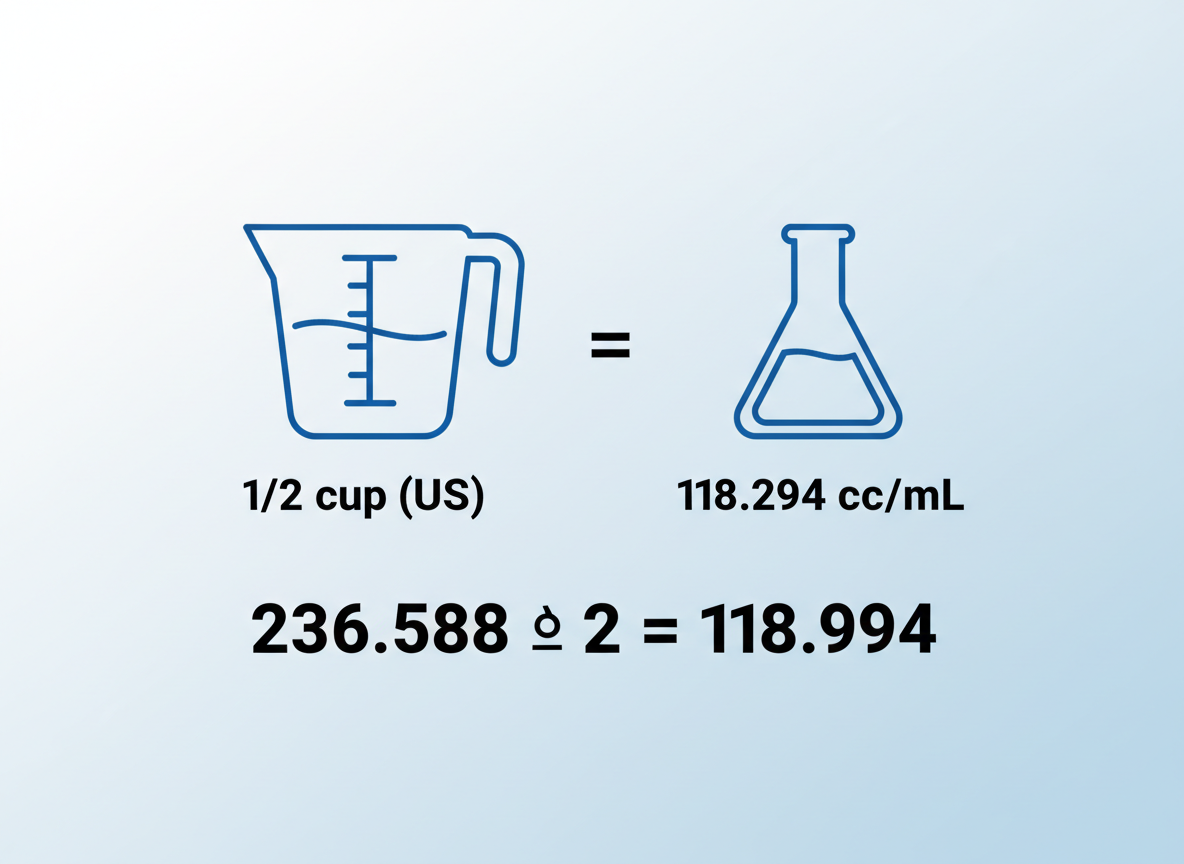
The math behind converting 1/2 cup to cc is straightforward. One US cup equals 236.588 cc, so you’re simply dividing that number by two:
236.588 ÷ 2 = 118.294 cc
That’s your exact answer. Here’s what makes this conversion handy: cc (cubic centimeters) and milliliters are identical. When a recipe or medical instruction calls for 118.294 cc, you can measure that as 118.294 mL. They’re interchangeable terms for the same volume.
Now, should you use 118.294 or round to 118? It depends on your situation. Baking cookies? Rounding to 118 cc works perfectly fine. Mixing medication or conducting a lab experiment? Stick with the precise 118.294 cc figure. The difference is tiny, but precision matters in technical work.
If you’re working with other measurements, like converting 1 1/3 cup to milliliters, the same principle applies—just adjust the calculation based on the cup fraction you’re working with.
Quick Reference: Common Fractional Cup to CC Conversions
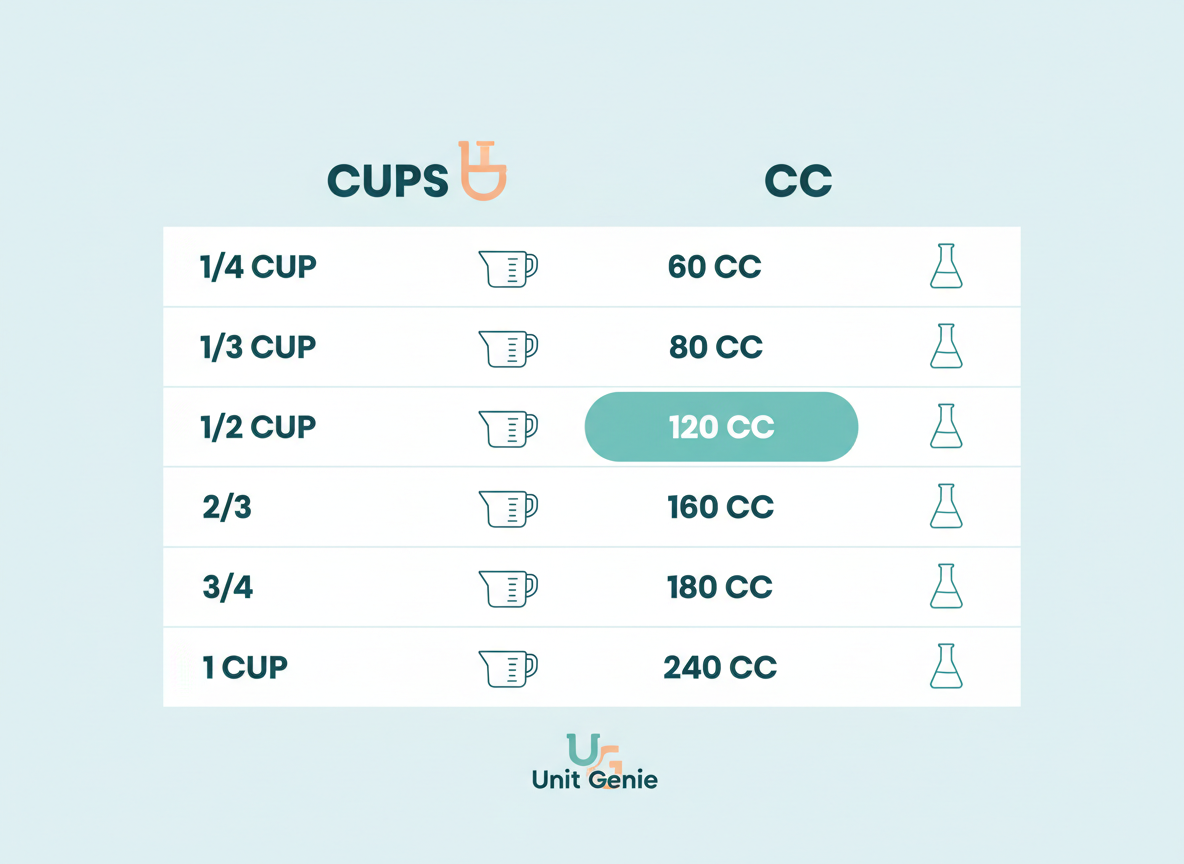
Here’s your go-to table for converting cups to cc. We’ve included both precise measurements and rounded numbers you’ll actually use in practice:
| Cup Measurement | Exact CC | Rounded CC |
|—————-|———-|————|
| 1/4 cup | 59.147 cc | 59 cc |
| 1/3 cup | 78.863 cc | 79 cc |
| 1/2 cup | 118.294 cc | 118 cc |
| 2/3 cup | 157.725 cc | 158 cc |
| 3/4 cup | 177.441 cc | 177 cc |
| 1 cup | 236.588 cc | 237 cc |
These conversions use the standard US cup (236.588 mL). Keep in mind that metric cups—common in Australia and New Zealand—equal 250 mL, so your conversions will differ slightly. For related liquid measurements, check out our guide on 1/2 Cup in Liters for broader context on volume conversions.
Practical Applications: When You Need This Conversion
You’ll find the cup-to-cc conversion surprisingly useful across several scenarios. International recipes often list ingredients in milliliters or cc, so knowing that 1/2 cup equals 118.294 cc helps you follow along without guesswork.
Medical contexts rely heavily on cc measurements. If your doctor prescribes 120cc of liquid medication daily, you’ll know that’s just slightly more than half a cup—making measuring at home straightforward.
Laboratory work demands precision. Whether you’re conducting chemistry experiments or quality control testing, accurate volume conversions prevent costly errors. For broader measurement needs, check out our 1 Liter Conversion Guide to understand different volume scales.
Recipe scaling becomes manageable when you understand these measurements. Doubling a batch that calls for 240cc? That’s two half-cups. Your coffee maker’s instruction manual lists 120cc per serving? You’re looking at a standard half-cup measure. These conversions bridge the gap between different measurement systems in your everyday routines.
Tips for Accurate Measuring in Cups and CC
Getting precise measurements starts with proper technique. When measuring 1/2 cup, fill your measuring cup and level it with a straight edge—a butter knife works perfectly. Always read at eye level to avoid parallax errors, where viewing from an angle throws off your measurement.
For cc measurements, graduated cylinders give you the best accuracy, though medical syringes work well for smaller volumes. Metric measuring cups are another solid option if you’re working in the kitchen.
Watch out for these common slip-ups: US cups differ from metric cups (250 mL), so know which you’re using. Don’t eyeball the leveling—that extra heap can add 10-15% more than you need. And remember, cc measures volume regardless of whether you’re working with liquids or dry ingredients.
Precision matters most for baking, scientific experiments, and medical applications. For everyday cooking? A slight variance won’t hurt your soup recipe. Need more conversions? Check out our 1 1/8 cup to mL guide for similar measuring tips.
Frequently Asked Questions
Is 1/2 cup the same as 120 cc?
Not exactly. Half a cup equals 118.294 cc precisely, but many recipes and medical professionals round to 120 cc for convenience. The difference is less than 2 cc, which won’t affect most applications.
What does cc stand for and why is it used?
CC means cubic centimeter. It’s the standard measurement in medical and scientific fields because it provides precise, standardized dosing regardless of location. One cc represents the volume of a cube that’s 1 cm on each side.
Can I use mL instead of cc?
Absolutely. They’re identical: 1 cc = 1 mL. Medical professionals often prefer cc for medication dosing, but they’re interchangeable.
How many cc are in a full cup?
A full US cup contains 236.588 cc (or about 237 cc when rounded).
Are US cups and metric cups the same?
No. US cups hold 236.588 mL, while metric cups equal 250 mL. This 13.4 mL difference matters in precise baking. If you’re working with larger volumes like converting 1 1/2 liters to cups, these distinctions become even more important.
Why do recipes use cups while medical dosing uses cc?
It’s about convention. American cooking embraced cups for their simplicity, while medicine requires the precision and international standardization that cc provides.