
Quick Answer: 0.1 μm to nm Conversion
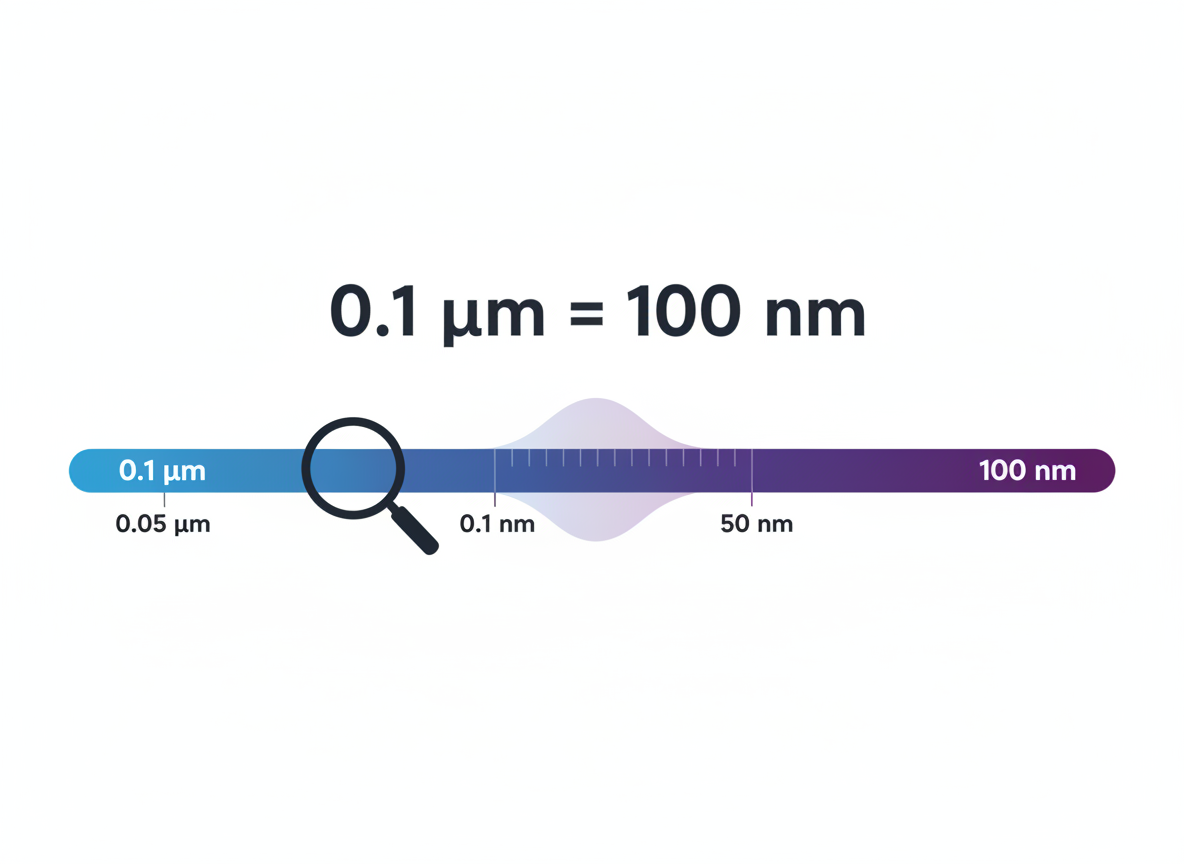
0.1 micrometers equals exactly 100 nanometers.
The math here is straightforward: since 1 micrometer contains 1,000 nanometers, you simply multiply 0.1 by 1,000 to get your answer. Think of it like converting dollars to cents—just shift the decimal point three places to the right.
This conversion pops up constantly in scientific work. Microbiologists use it when measuring bacteria, semiconductor engineers rely on it for chip design, and materials scientists need it for nanoparticle research. You’ll even find it in air quality reports, where particulate matter gets measured at these tiny scales.
Whether you’re studying cell structures, working with optical wavelengths, or analyzing pollution data, understanding this relationship between micrometers and nanometers matters. And if you’re working with even smaller measurements, like converting 0.1 nm to meters, the same principles apply.
Ready to make these conversions effortless? We’ve built a calculator and complete reference guide to help you work confidently at the nanoscale.
Understanding Micrometers and Nanometers
Before we jump into conversions, let’s get clear on what we’re actually working with here.
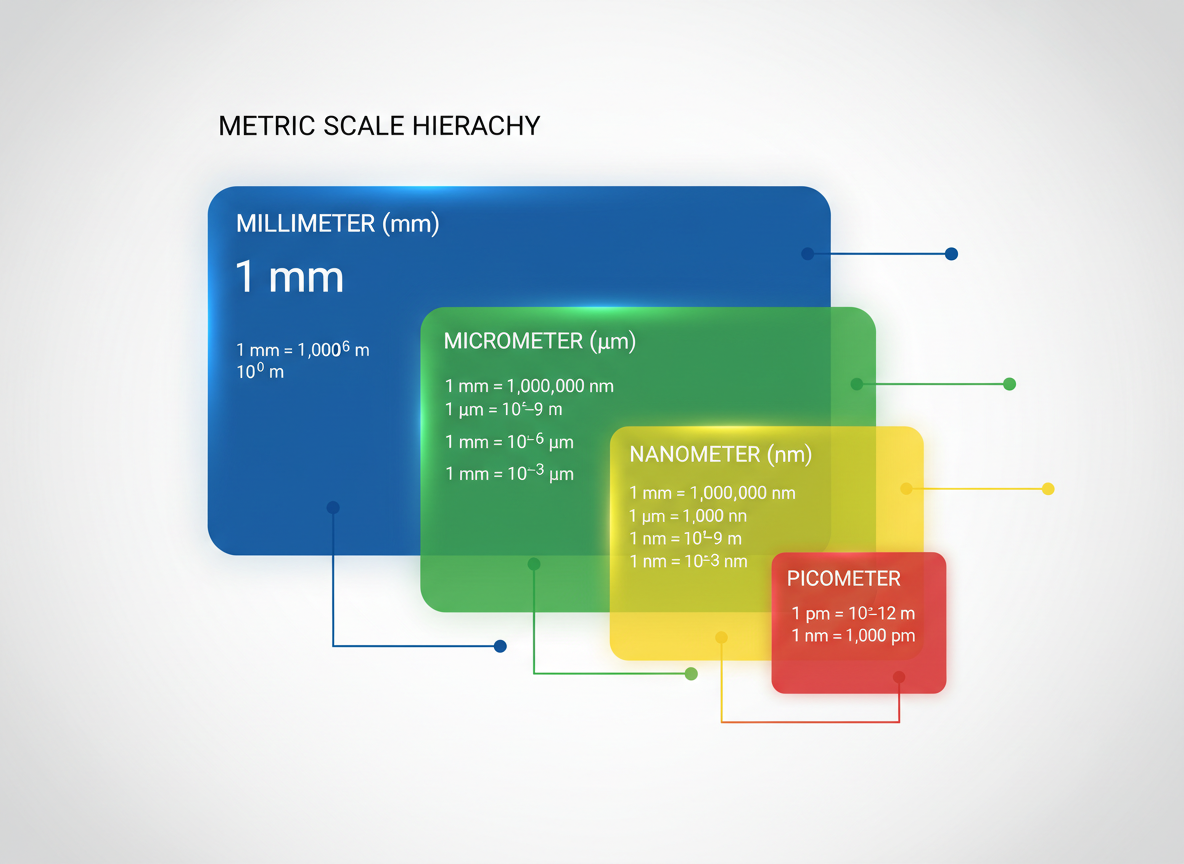
A micrometer (μm), sometimes called a micron, equals one millionth of a meter (0.000001 m). In scientific notation, that’s 1 × 10⁻⁶ m. To put it in perspective, a typical human hair measures about 70 micrometers wide—incredibly thin, yet still visible to the naked eye.
Now, a nanometer (nm) takes things even smaller. It’s one billionth of a meter (0.000000001 m), or 1 × 10⁻⁹ m in scientific notation. We’re talking about dimensions where you’d need powerful microscopes to see anything at all. Molecules, viruses, and the wavelengths of visible light all operate in the nanometer range.
Here’s the key relationship you need to remember: 1 micrometer equals exactly 1,000 nanometers. Think of it like currency conversion—one dollar equals 100 cents. Similarly, when you move from micrometers to nanometers, you’re multiplying by 1,000.
This means 0.1 μm (our focus today) converts to 100 nm. The math is straightforward: 0.1 × 1,000 = 100.
If you’re curious about conversions in the other direction, like moving from millimeters to micrometers, check out our guide on 0.1 mm in Microns. It’s all about understanding the scale relationships between different metric units.
The Conversion Formula: μm to nm
Converting micrometers to nanometers is refreshingly straightforward. Here’s the basic formula you’ll need:
micrometers × 1,000 = nanometers
Let’s walk through the calculation for 0.1 μm specifically:
0.1 μm × 1,000 = 100 nm
That’s it! You simply multiply by 1,000 because there are exactly 1,000 nanometers in every micrometer.
Why 1,000? Think of it like nested boxes. A micrometer is one-millionth of a meter (10⁻⁶ m), while a nanometer is one-billionth of a meter (10⁻⁹ m). The difference between these two scales is three orders of magnitude—hence the factor of 1,000.
Need to go the other direction? The reverse conversion is just as simple:
nanometers ÷ 1,000 = micrometers
So if you’ve got 100 nm and want to express it in micrometers, you’d divide: 100 ÷ 1,000 = 0.1 μm.
This same scaling principle applies across metric units. For instance, when you’re converting between millimeters and micrometers (like in our 0.1 mm to micron conversion guide), you’re again dealing with a 1,000× relationship.
Real-World Context: What Measures 0.1 μm (100 nm)?
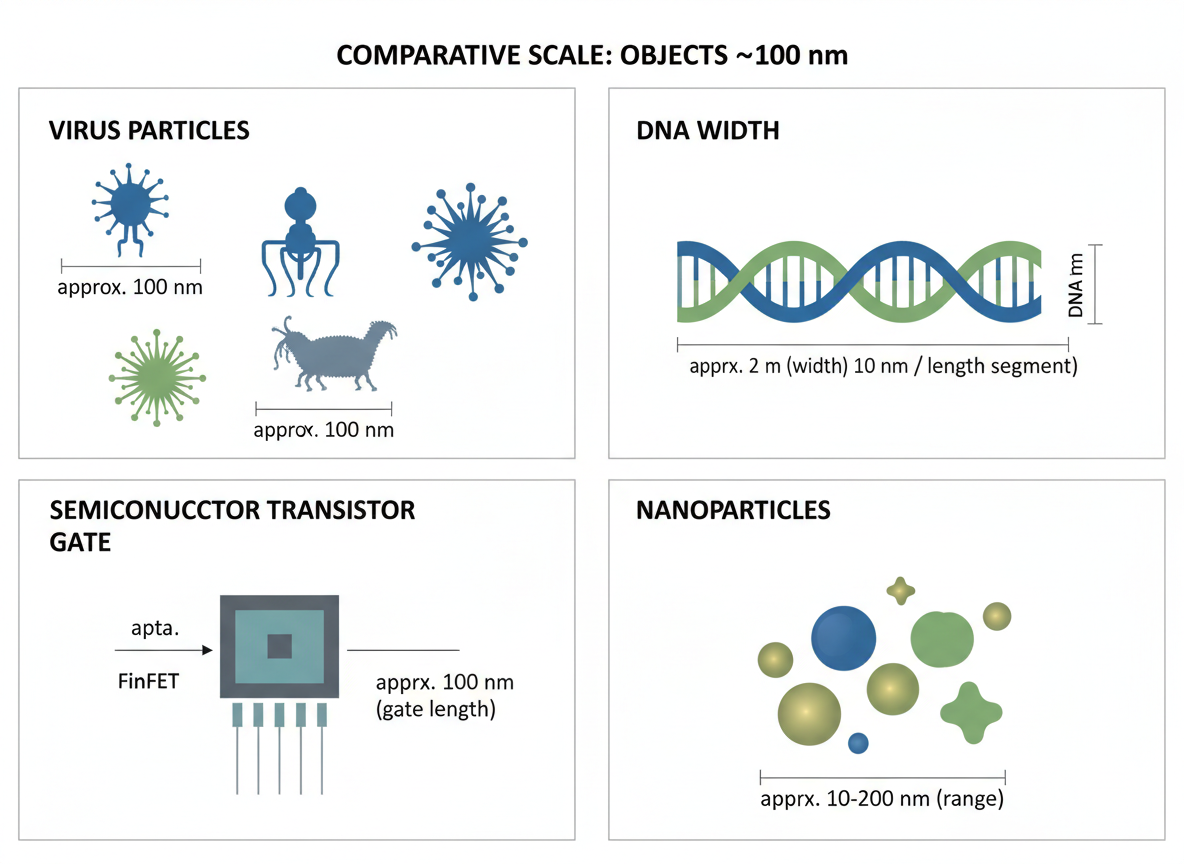
Understanding 100 nanometers becomes easier when you see what actually exists at this scale. You’re looking at a dimension where biology and technology meet in fascinating ways.
In the biological world, many large viruses hang out right around this size. The influenza virus, for instance, measures roughly 80-120 nm—making 0.1 μm a perfect reference point. Some bacterial structures, like pili (the tiny hair-like appendages bacteria use to attach to surfaces), also fall into this range.
Technology operates heavily at this scale. Modern semiconductor features often measure around 100 nm or smaller. The thin film coatings on your eyeglasses or smartphone screen? They’re typically in this neighborhood too. These coatings can be just 100 nm thick yet dramatically change how light interacts with surfaces.
Material scientists work with nanoparticles and polymer chains that frequently measure 0.1 μm. Silver nanoparticles used in antimicrobial applications often cluster around this size, while certain polymer chain segments stretch to similar dimensions.
For perspective, 100 nm sits about 1,000 times smaller than the width of a human hair. It’s roughly 500 times smaller than a red blood cell. If you’re curious about visualizing larger microscopic measurements, check out our guide on converting 0.1 mm to mils—it bridges the gap between nanoscale and everyday measurements nicely.
Common Micrometer to Nanometer Conversions
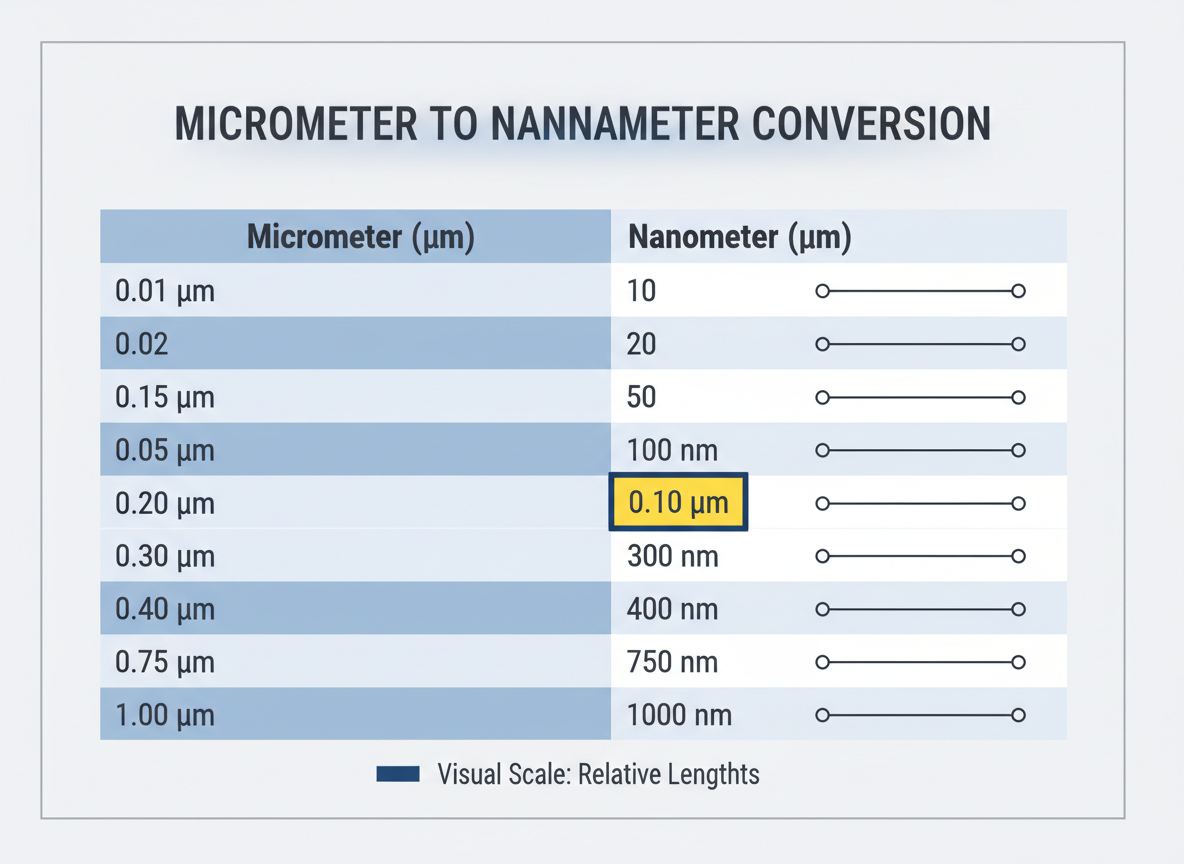
Here’s a quick reference table for the most frequently used conversions in lab and manufacturing settings:
| Micrometers (μm) | Nanometers (nm) | Common Application |
|——————|—————–|——————-|
| 0.01 μm | 10 nm | Virus particles, protein structures |
| 0.05 μm | 50 nm | Gold nanoparticles, quantum dots |
| 0.1 μm | 100 nm | Bacteria size threshold, semiconductor features |
| 0.2 μm | 200 nm | Sterile filtration membranes |
| 0.5 μm | 500 nm | Cell organelles, optical wavelengths |
| 1.0 μm | 1,000 nm | Red blood cells, microchip features |
The 0.1 μm to 100 nm conversion sits right in that sweet spot between cellular biology and materials science. You’ll see this value constantly when working with filtration systems (those 0.1 μm filters catch most bacteria), semiconductor manufacturing, and microscopy work.
Manufacturing teams rely on these conversions daily. A 0.2 μm filter won’t let bacteria through, while a 0.5 μm measurement helps optical engineers understand light behavior. Need to convert other common measurements? Check out our guide on 0.1 mL to liter conversions for similar precision work with volume units.
Applications in Science and Industry
Converting 0.1 μm to nm (100 nm) matters across countless scientific and industrial applications where precision at the nanoscale makes all the difference.
In nanotechnology and materials engineering, this measurement range sits right at the sweet spot. Researchers working with nanoparticles, quantum dots, and carbon nanotubes constantly operate at this scale. A 100 nm particle behaves fundamentally different from a 1 μm particle—changing everything from surface reactivity to optical properties.
Semiconductor manufacturing relies heavily on this conversion. Modern chip designers work with features as small as 5-7 nm, but understanding the full range from 100 nm to smaller scales helps engineers optimize circuit layouts and troubleshoot manufacturing defects. Even slight miscalculations here can mean millions in wasted production.
Microscopy and imaging techniques depend on accurate nanometer measurements. Whether you’re using scanning electron microscopy (SEM) or atomic force microscopy (AFM), you’ll switch between micrometers and nanometers constantly. That 0.1 μm bacterium? It’s exactly 100 nm wide—critical info when selecting the right magnification or resolution settings.
In pharmaceutical and biotechnology research, drug delivery systems often use nanoparticles between 50-200 nm. Converting 0.1 μm helps researchers design carriers that slip past biological barriers while carrying therapeutic payloads effectively. Similar precision matters in measuring cellular structures and protein complexes.
Finally, quality control and precision manufacturing use these measurements for surface finish analysis, coating thickness verification, and particle contamination monitoring. Just as precision matters when measuring volumes (like our 0.1 mL to microliter conversions), nanometer-level accuracy ensures products meet exacting specifications.
Precision Considerations and Best Practices
When converting 0.1 μm to nm, you’ll always get exactly 100 nm—but real-world measurements aren’t always this clean-cut.
Significant figures matter. If your original measurement is 0.10 μm (two sig figs), your answer should be 100 nm, not 100.0 nm. The precision of your input determines the precision of your output. A measurement of 0.100 μm (three sig figs) converts to 100. nm or 1.00 × 10² nm.
Rounding depends on context. For quick estimations, rounding to whole numbers works fine. But in semiconductor manufacturing or biological research? You might need to maintain precision down to several decimal places. A pharmaceutical researcher measuring nanoparticles would keep 0.127 μm as 127.0 nm rather than rounding to 127 nm.
Measurement uncertainty grows at the nanoscale. Your equipment’s limitations affect accuracy. An electron microscope might measure ±2 nm, so reporting 100.00 nm falsely implies precision you don’t actually have.
Scientific notation prevents errors. Writing 1.0 × 10⁻¹ μm = 1.0 × 10² nm makes calculations clearer, especially when dealing with multiple conversions. Similar precision concerns apply when working with time conversions like milliseconds to seconds.
Common mistakes? Forgetting that 1 μm = 1000 nm (not 100 nm), mixing up prefixes, and over-reporting precision. Double-check your multiplication factor every time.
Using Unit Genie for μm to nm Conversions
Unit Genie makes converting 0.1 μm to nm completely hassle-free. You’ll get instant results without wading through annoying ads or pop-ups—just pure, accurate conversions when you need them.
The platform shines with its interactive visualization features. Instead of just seeing “100 nm,” you can actually explore what that measurement means at different scales. It’s particularly handy when you’re comparing microscopic structures or explaining concepts to colleagues.
Working in the field or moving between lab benches? The mobile-friendly interface adapts beautifully to any device. You won’t be squinting at tiny buttons or dealing with clunky layouts on your phone.
Global teams will appreciate the multi-language support, making Unit Genie accessible whether you’re in Tokyo or Toronto. Plus, if you’re converting between different units—say you need to switch from volume to length measurements like converting 0.1 mL to microliters—everything’s available in one convenient place.
Frequently Asked Questions (FAQ)
How many nanometers are in 0.1 micrometers?
There are exactly 100 nanometers (nm) in 0.1 micrometers (μm). This conversion is straightforward because micrometers and nanometers differ by a factor of 1,000.
What is the formula to convert μm to nm?
Multiply the micrometer value by 1,000. The formula is: nm = μm × 1,000. For 0.1 μm, you’d calculate: 0.1 × 1,000 = 100 nm. It’s that simple.
Why is the nanometer scale important in technology?
Nanometers define the world of semiconductors, viruses, and advanced materials. Modern computer chips use transistors measuring just a few nanometers. The 100 nm scale (0.1 μm) represents a transition point where many biological and technological features exist—from large virus particles to optical wavelengths.
Can I convert 0.1 nm back to micrometers?
Yes! Divide by 1,000: 0.1 nm ÷ 1,000 = 0.0001 μm. That’s a considerably smaller measurement than what we started with.
What measurement tools work at the 0.1 μm / 100 nm scale?
Scanning electron microscopes (SEM), atomic force microscopes (AFM), and specialized optical instruments can measure at this scale. Standard optical microscopes typically max out around 200 nm resolution, so you’re right at the edge of what light-based methods can resolve.
Is 0.1 μm the same as 100 nm?
Absolutely. They’re identical measurements expressed in different units. Think of it like saying 1 foot or 12 inches—same distance, different labels.
What’s the difference between micrometer and micron?
Nothing. “Micron” is the informal name for micrometer, just like “meter” sometimes gets shortened in conversation. Both refer to one-millionth of a meter (μm). Scientists and engineers use these terms interchangeably, though “micrometer” is technically more correct in formal writing.
How do I write 0.1 μm in scientific notation?
In scientific notation, 0.1 μm becomes 1 × 10⁻⁷ meters or 1 × 10⁻¹ μm. When converting between units like this, precision matters significantly—especially in scientific and medical applications where small measurement errors can have big consequences.