
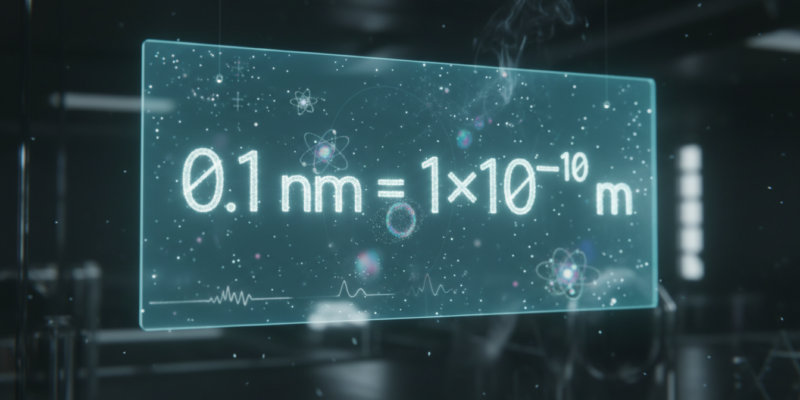
Quick Answer: 0.1 Nanometers to Meters
0.1 nanometers equals 1×10⁻¹⁰ meters (or 0.0000000001 m). That’s right—we’re talking about one ten-billionth of a meter, a distance so tiny it’s measured at the atomic scale. To put this in perspective, 0.1 nm is roughly the diameter of a single hydrogen atom.
Working with measurements this small can feel abstract, but Unit Genie makes these conversions instant and accurate. Whether you’re studying atomic physics, working in nanotechnology, or just curious about the quantum realm, understanding how nanometers translate to meters helps you grasp the true scale of microscopic structures.
In this guide, you’ll discover exactly how to convert nanometers to meters, see real-world examples of what exists at 0.1 nm, and understand when you’d actually need to work with measurements this small. We’ll also explore how this fits into the broader world of metric conversions—from tiny micron measurements to everyday distances. By the end, you’ll confidently navigate the atomic scale with practical tools and clear context.
Understanding Nanometers and Meters
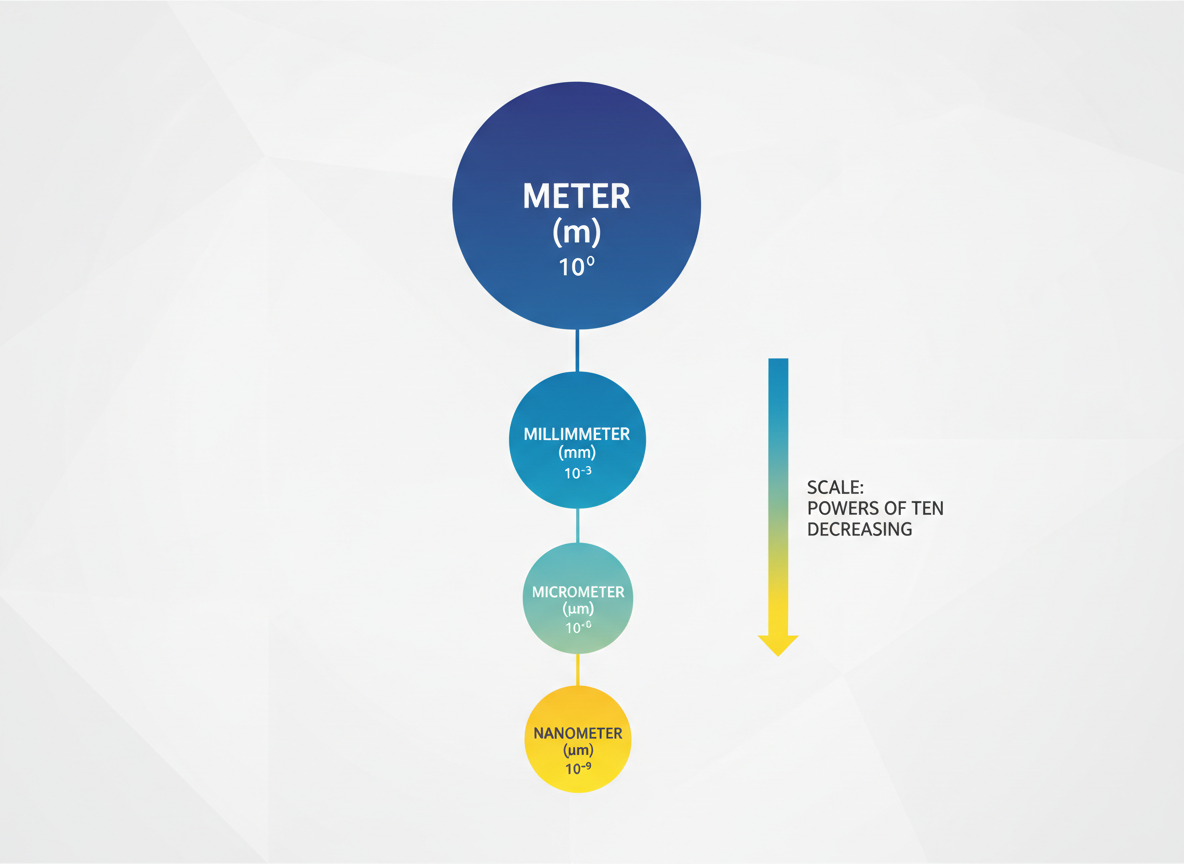
Let’s break down what we’re actually dealing with when we convert 0.1 nanometers to meters.
A meter is the SI base unit for length—the fundamental measurement we use for everything from room dimensions to athletic tracks. Think of it as your baseline reference point in the metric system.
A nanometer (nm), on the other hand, is incredibly tiny. It’s one billionth of a meter, or 10⁻⁹ m. That’s 0.000000001 meters written out in decimal form. To put this in perspective, a single strand of human DNA is about 2 nanometers wide.
The prefix “nano-” comes from the Greek word nanos, meaning dwarf. In the metric system, it consistently means one billionth, whether you’re talking about nanoseconds, nanograms, or nanometers. You’ll find similar prefixes throughout the metric system—just like millimeters and microns represent different scales of measurement.
Why nanometers matter: Scientists didn’t start using nanometers just to make numbers look impressive. This scale is essential for nanotechnology, where materials are engineered at the atomic level. It’s also how we measure wavelengths of visible light (roughly 400-700 nm) and describe viruses, proteins, and cellular structures in molecular biology.
The term “nanometer” gained scientific traction in the 1960s, though the concept of measuring at this scale existed earlier. By the 1980s, as electron microscopy and semiconductor technology advanced, nanometer measurements became standard in materials science and electronics. Today, when chip manufacturers talk about “5 nanometer processors,” they’re referencing features built at this molecular-level precision.
The Conversion Formula Explained
Converting 0.1 nm to m is straightforward once you know the basic formula: meters = nanometers × 10⁻⁹. Let’s walk through it step by step.
Starting with 0.1 nanometers, multiply by 10⁻⁹:
0.1 × 10⁻⁹ = 0.0000000001 m
That’s the decimal notation—ten zeros after the decimal point. You can also express this as 1×10⁻¹⁰ m in scientific notation, which is much cleaner and easier to read.
Why does scientific notation matter? When you’re dealing with incredibly tiny measurements like atomic radii or X-ray wavelengths, writing out all those zeros gets messy fast. Scientific notation keeps things precise without the visual clutter. Similar to how 0.1 ms converts to 0.0001 seconds, working with scientific notation helps you avoid errors and communicate measurements clearly.
For the reverse conversion, the formula flips: nanometers = meters × 10⁹. So if you had 1×10⁻¹⁰ m and wanted to get back to nanometers, you’d multiply by 10⁹ to get 0.1 nm.
The key takeaway? That “nano” prefix means you’re dividing by one billion (10⁹), which is why these numbers get so small so quickly.
What Exists at the 0.1 Nanometer Scale?
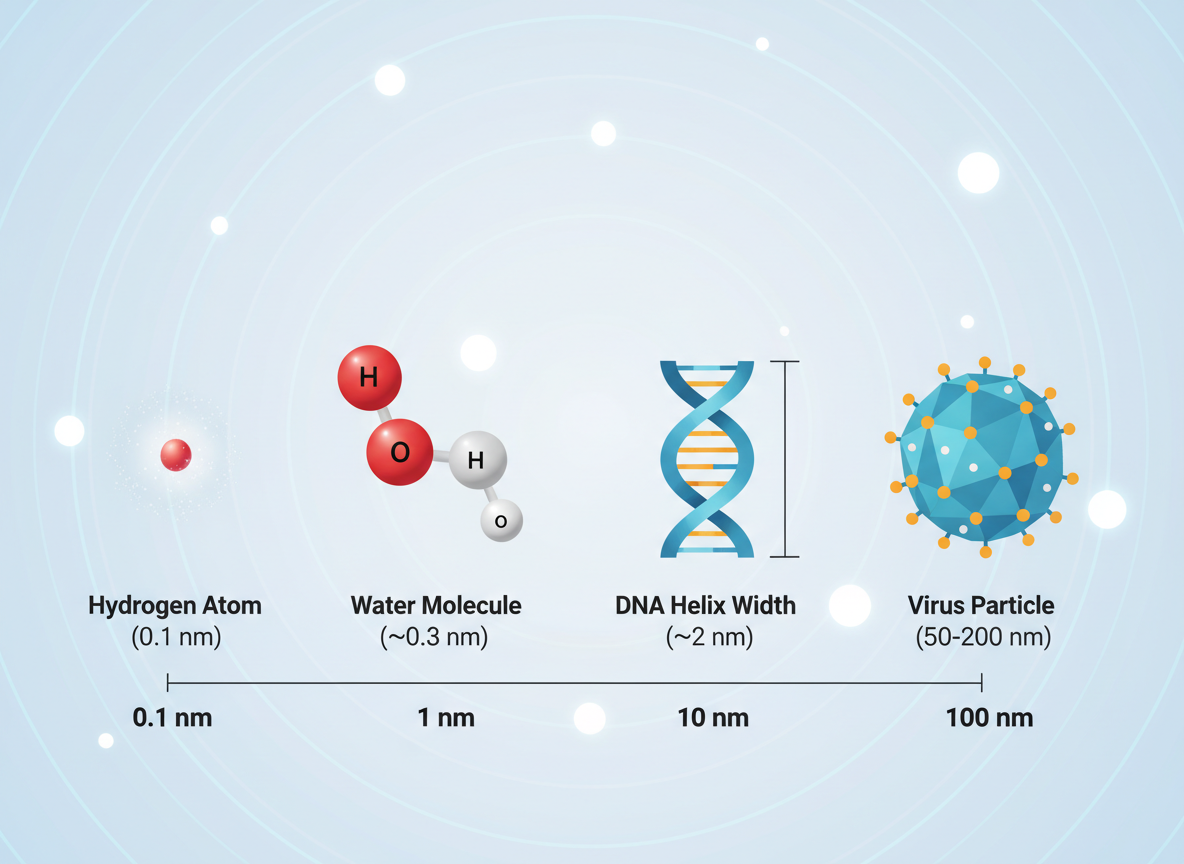
At 0.1 nanometers, you’re looking at something roughly the size of a hydrogen atom’s diameter. To put this in perspective, a hydrogen atom measures about 0.12 nm across, making 0.1 nm one of the smallest meaningful measurements in chemistry and physics.
This scale sits right in the heart of atomic dimensions. Most chemical bonds stretch between 0.1 and 0.2 nm—carbon-carbon bonds, for instance, measure around 0.154 nm. When chemists talk about bond lengths or when materials scientists examine crystal structures, they’re working precisely in this range.
X-rays with wavelengths around 0.1 nm fall into what scientists call “hard X-rays.” These particular wavelengths can probe atomic structures directly, which is why they’re essential for techniques like X-ray crystallography. That’s how researchers figured out DNA’s double helix structure back in the 1950s.
At this tiny scale, quantum mechanics stops being theoretical and becomes unavoidable. Electrons don’t orbit atoms like planets around the sun—they exist as probability clouds. The Heisenberg uncertainty principle matters here because measuring an electron’s exact position affects its momentum. Classical physics simply doesn’t apply anymore.
Why does 0.1 nm matter so much? Modern semiconductor manufacturing pushes toward features measured in just a few nanometers. Understanding what happens at the 0.1 nm scale helps engineers design better transistors, catalysts, and nanomaterials. When you’re developing new alloys, pharmaceuticals, or electronic components, atomic-level precision isn’t optional—it’s the entire ballgame.
Materials scientists use scanning tunneling microscopes and transmission electron microscopes to visualize structures at this scale. These tools have transformed our ability to manipulate individual atoms, opening doors to nanotechnology applications that seemed like science fiction just decades ago.
Practical Applications of Nanometer to Meter Conversions
Understanding 0.1 nm to m conversions isn’t just academic exercise—it’s essential across multiple cutting-edge fields.
Semiconductor Manufacturing
When designing microchips, engineers work with transistor gate widths around 3-5 nm. Converting these measurements helps teams coordinate with equipment calibrated in meters. A 0.1 nm precision error at this scale can mean the difference between a functioning processor and a failed batch.
X-ray Crystallography
Researchers analyzing protein structures deal with X-ray wavelengths typically between 0.1-1.0 nm. They’ll convert these to meters when calculating diffraction patterns or comparing results with spectroscopy data measured in different units.
Atomic Force Microscopy
Materials scientists scanning surface topography at atomic resolution measure features as small as 0.1 nm. They convert to meters when presenting findings alongside macroscale material properties or when calibrating instruments that use meter-based positioning systems.
Pharmaceutical Development
Drug designers examining molecular interactions work at the 0.1-10 nm scale—the size range of most drug molecules and binding sites. Converting between nanometers and meters helps when comparing molecular measurements with clinical dosing volumes or formulation parameters. Similar precision requirements exist in precision measurement across different industries, where accuracy determines product quality.
Academic Settings
Physics, chemistry, and engineering students regularly encounter nanometer measurements in quantum mechanics, spectroscopy, and nanotechnology courses. They’ll convert to meters when solving problems involving scientific notation or when working with equipment specifications that use SI base units.
Quick Reference: Nanometer to Meter Conversion Table
Here’s your go-to table for converting nanometers to meters. We’ve highlighted 0.1 nm so you can spot it instantly, and included both scientific notation and decimal format for whatever works best for you.
| Nanometers (nm) | Meters (Scientific) | Meters (Decimal) | Real-World Reference |
|—————–|———————|——————|———————-|
| 0.1 nm | 1 × 10⁻¹⁰ m | 0.0000000001 m | Hydrogen atom radius |
| 0.5 nm | 5 × 10⁻¹⁰ m | 0.0000000005 m | Small molecule size |
| 1 nm | 1 × 10⁻⁹ m | 0.000000001 m | DNA helix diameter |
| 5 nm | 5 × 10⁻⁹ m | 0.000000005 m | Modern semiconductor transistor |
| 10 nm | 1 × 10⁻⁸ m | 0.00000001 m | Large protein molecule |
| 50 nm | 5 × 10⁻⁸ m | 0.00000005 m | Small virus particle |
| 100 nm | 1 × 10⁻⁷ m | 0.0000001 m | HIV virus, extreme UV wavelength |
Quick Conversion Pattern
Once you see the pattern, it becomes second nature. Every nanometer equals 10⁻⁹ meters, so you’re just moving the decimal point nine places left. For 0.1 nm specifically, you’re looking at 1 × 10⁻¹⁰ m—that’s one ten-billionth of a meter.
The reference points aren’t random. They’ll help you visualize what you’re actually measuring. When someone mentions 0.1 nm, you’ll now know they’re talking about distances on the atomic scale, roughly the size of a hydrogen atom’s radius.
Want to convert values not listed here? The formula stays the same: multiply your nanometer value by 0.000000001 (or 10⁻⁹). Simple as that.
Why Use Unit Genie for Nanometer Conversions?
Unit Genie makes converting 0.1 nm to m effortless—no ads, just instant accuracy every time.
You’ll get your conversion in seconds, with visual comparisons that actually make sense. We’re talking real-world context, not just numbers on a screen. Whether you’re measuring atomic structures or comparing wavelengths, you’ll see exactly how your values stack up against familiar objects.
The platform’s completely free. No hidden charges, no subscription walls, and definitely no annoying pop-ups interrupting your work. Students pulling all-nighters, engineers running calculations, and scientists analyzing data all use the same clean interface.
What sets it apart? Interactive visualizations turn abstract measurements into something tangible. When you convert nanometers to meters, you’ll see how that measurement compares to everyday items—from atoms to viruses to human hair thickness.
Need conversions beyond length? Unit Genie handles everything from volume measurements like 0.1 mL to liters to temperature, pressure, and more. It’s your all-in-one conversion toolkit.
Multi-language support means you can work in your preferred language, making technical conversions accessible worldwide. The calculator adapts to your needs, whether you’re checking homework, designing semiconductor components, or analyzing spectroscopy data.
Simple, fast, and accurate—that’s what you get every time.
Frequently Asked Questions (FAQ)
How many meters is 0.1 nanometers?
0.1 nm equals 0.0000000001 meters, or 1×10⁻¹⁰ m in scientific notation. That’s one ten-billionth of a meter—an incredibly tiny distance that sits squarely in the atomic realm.
What is the formula to convert nm to m?
The conversion is straightforward: divide the nanometer value by 1,000,000,000 (or multiply by 10⁻⁹). So for any value in nm, just shift the decimal point nine places to the left. For 0.1 nm, that gives you 0.0000000001 m.
What can be measured at 0.1 nanometers?
At this scale, you’re looking at distances between atoms in molecules, the diameter of small atomic nuclei, and wavelengths of high-energy X-rays. It’s roughly the size of a hydrogen atom’s nucleus. Scientists use this scale when working with electron orbitals, chemical bond lengths, and crystallographic studies.
Why do scientists use nanometers instead of meters?
Writing 0.0000000001 m over and over gets tedious fast. Nanometers keep the numbers manageable and relatable within their field. A DNA helix is about 2 nm wide—much easier to work with than 0.000000002 m. It’s similar to how you might express small volumes differently depending on context, like converting 0.1 mL to microliters for lab precision work.
How do you write 0.1 nm in scientific notation?
Converting 0.1 nm to meters in scientific notation gives you 1×10⁻¹⁰ m. Here’s the breakdown: 0.1 is the same as 1×10⁻¹, and since 1 nm = 10⁻⁹ m, you multiply the exponents: 10⁻¹ × 10⁻⁹ = 10⁻¹⁰. The coefficient stays at 1.
Is 0.1 nm smaller than an atom?
Yes and no—it depends on the atom. A hydrogen atom measures about 0.1 nm in diameter, so 0.1 nm matches its size. However, larger atoms like carbon (0.14 nm) or oxygen (0.12 nm) are bigger. For most elements, 0.1 nm sits right at or slightly below atomic diameter, though it’s definitely larger than atomic nuclei, which measure just a few femtometers (0.001-0.01 nm).