Quick Answer: How Many Seconds in 1 Day?
1 day equals exactly 86,400 seconds.
Whether you’re coding a timer, calculating workout intervals, or solving a physics problem, this conversion comes up more than you’d think. This article breaks down the simple formula behind it, offers a handy calculator, and explores real-world scenarios where knowing this number matters. For a deeper dive into the math, check out our comprehensive step-by-step conversion guide. Unit Genie makes these conversions instant and accurate—no mental math required.
Understanding the Conversion: Why 86,400 Seconds?
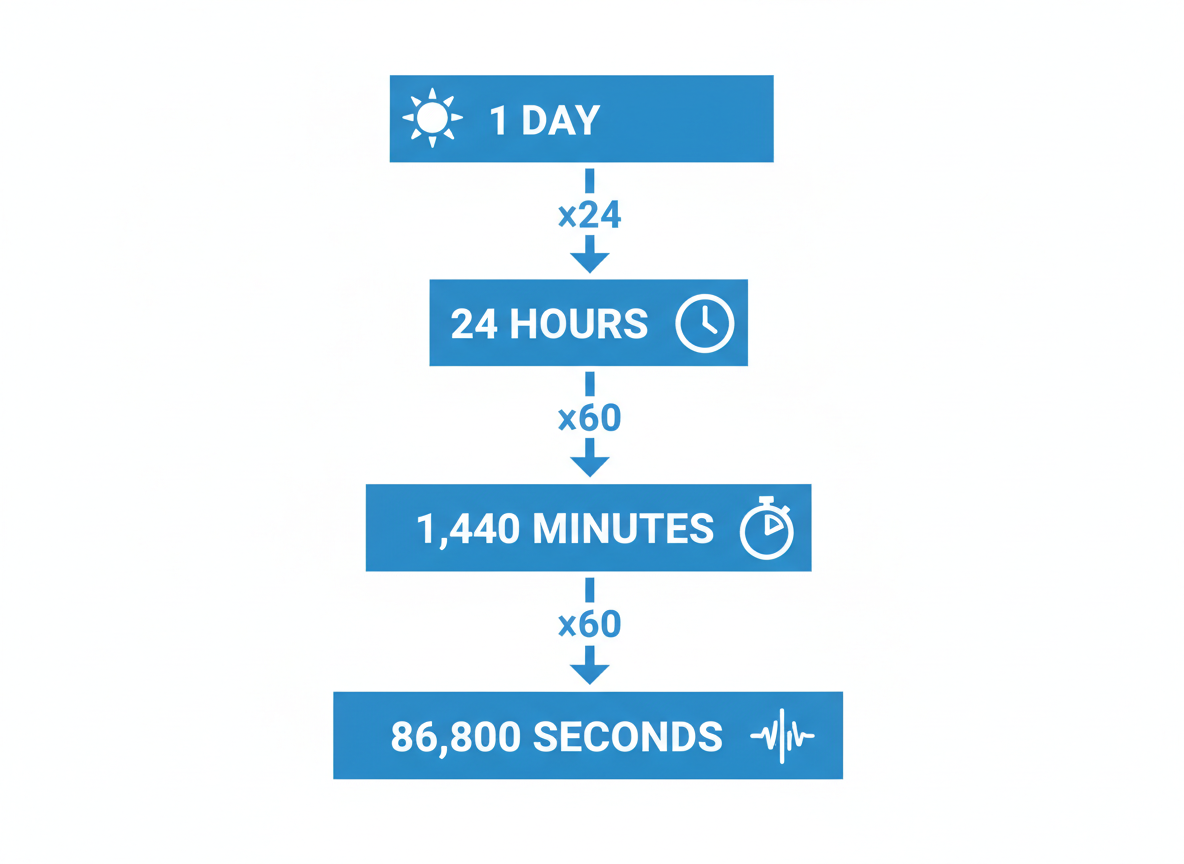
The math behind this conversion is straightforward once you break it down. A standard day contains 24 hours, and each hour has 60 minutes. That gives us 24 × 60 = 1,440 minutes in a day (check out our detailed breakdown on 1 day to minutes if you’re curious).
Now, since each minute contains 60 seconds, we multiply again: 1,440 × 60 = 86,400 seconds. That’s your answer.
This calculation is based on the internationally recognized 24-hour day definition. Here’s something that surprises people: time zones don’t change this conversion at all. Whether you’re in New York or Tokyo, a day’s duration remains 86,400 seconds. Time zones only shift when that day occurs, not how long it lasts. The same principle applies when converting 1 day to hours—the duration stays constant regardless of your location.
The Simple Conversion Formula
Here’s the magic formula: Days × 86,400 = Seconds. That’s it. Multiply any number of days by 86,400, and you’ll get your answer in seconds.
Let’s try a few examples. Half a day (0.5 days) equals 43,200 seconds. Two days? That’s 172,800 seconds. A full week (7 days) converts to 604,800 seconds.
The math’s straightforward, but who wants to grab a calculator every time? Unit Genie handles this conversion instantly—just enter your number and get your result. No manual multiplication needed, whether you’re working with whole days, partial days, or even longer time periods.
Real-World Applications: When You Need This Conversion
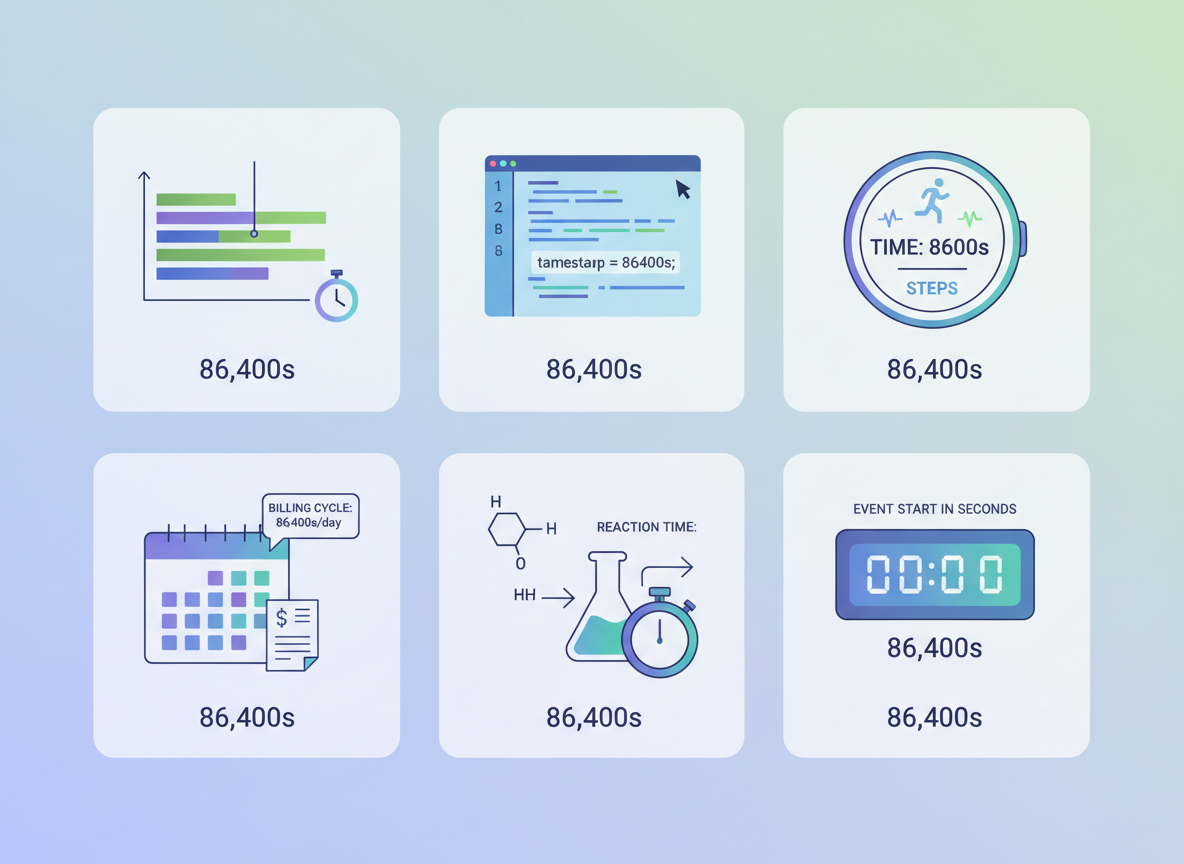
You’ll encounter this conversion more often than you’d think. Project managers use seconds to configure scheduling software that tracks task durations with precision down to the exact moment. If you’re building software, Unix timestamps rely on seconds since January 1, 1970—making this conversion essential for date calculations.
Fitness enthusiasts tracking workouts benefit too. That 30-day challenge? It’s 2,592,000 seconds of commitment. Subscription services often calculate billing cycles in various time units, and understanding these relationships helps you spot overcharges or plan cancellations strategically.
Scientists working with physics problems or astronomical calculations need standardized time units—seconds are that universal standard. Even event planners use this conversion for countdowns. Knowing your wedding is 86,400 seconds away feels different than “tomorrow,” doesn’t it?
From debugging code to timing chemical reactions, converting days to seconds bridges the gap between how we naturally think about time and how systems actually measure it.
Quick Reference: 1 Day Compared to Other Time Periods
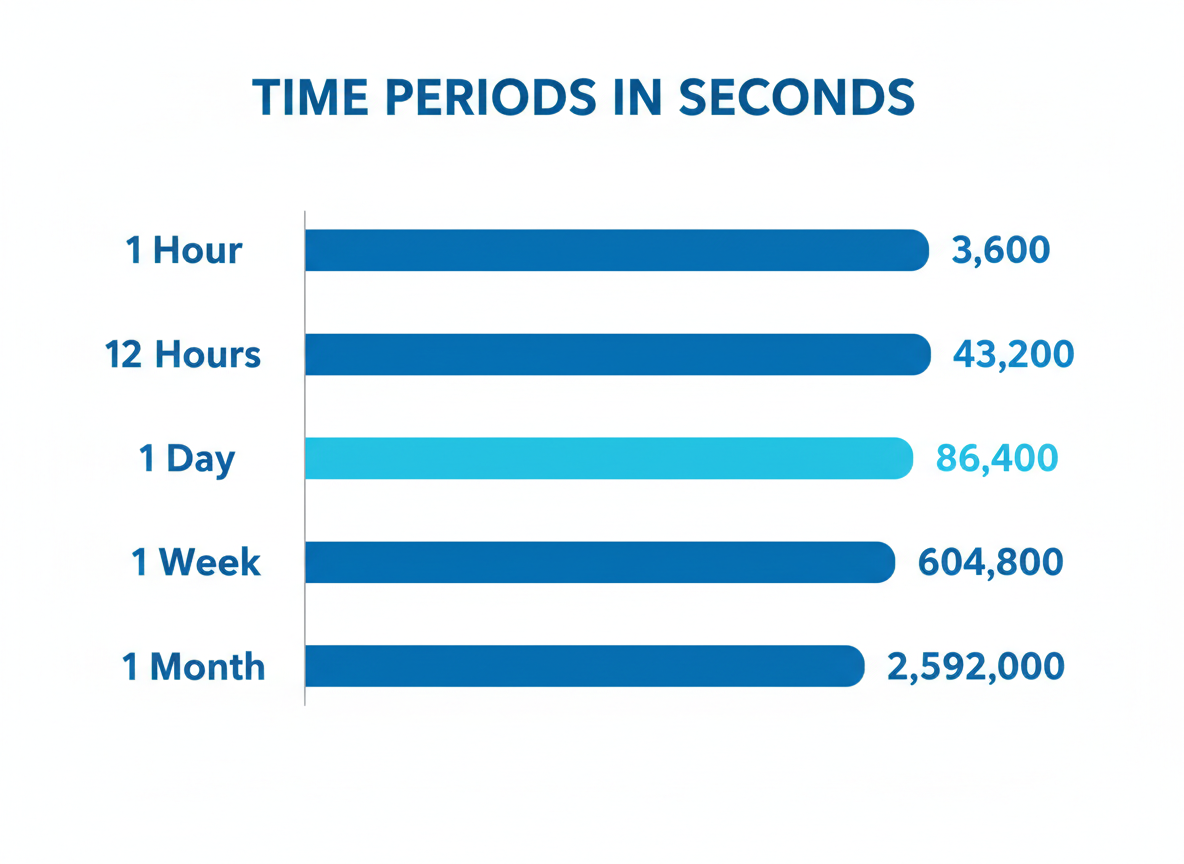
Sometimes you need to see the numbers side by side. Here’s a handy comparison to help you visualize where 86,400 seconds fits in:
| Time Period | Seconds | |————-|———| | 1 hour | 3,600 | | 12 hours | 43,200 | | 1 day | 86,400 | | 1 week | 604,800 | | 1 month (30 days) | 2,592,000 |
Notice how a full day sits right in the middle of this scale. It’s exactly 24 times larger than an hour, and you’d need seven full days to reach that week milestone. Bookmark this table for those moments when you’re comparing deadlines or calculating durations.
Common Mistakes to Avoid
When converting 1 day to seconds, watch out for these common pitfalls. Don’t confuse duration with time of day—86,400 seconds represents a time span, not 3 a.m. on your clock. For ultra-precise scientific work, remember that leap seconds occasionally add an extra second to maintain atomic clock accuracy. Also, this conversion applies to full 24-hour periods, not business days (which typically count only 8 hours). When dealing with partial days, rounding errors can creep in quickly—always keep extra decimal places during intermediate calculations. For best results, use a dedicated calculator to maintain precision throughout your work.
Frequently Asked Questions (FAQ)
How many seconds are in exactly 1 day?
There are 86,400 seconds in one day. This comes from multiplying 24 hours × 60 minutes × 60 seconds.
Why is a day 86,400 seconds and not a round number?
We inherited the base-60 system from ancient Babylonian timekeeping. They chose 60 because it’s divisible by many numbers (1, 2, 3, 4, 5, 6, 10, 12, 15, 20, 30, and 60), making calculations easier without fractions. That’s why we’ve got 60 minutes and 60 seconds instead of, say, 100.
Does this conversion account for leap seconds?
For everyday calculations, no—and you don’t need to worry about them. Leap seconds are occasionally added to keep atomic time synchronized with Earth’s rotation, but they’re only relevant for precision systems like GPS satellites and astronomical observations. Your typical day-to-second conversion always uses 86,400 seconds.
How do I convert partial days to seconds?
Use the formula: seconds = days × 86,400. So 0.5 days = 0.5 × 86,400 = 43,200 seconds (exactly 12 hours). Similarly, 1.5 days = 129,600 seconds.
Is there a difference between calendar days and 24-hour periods?
Yes, there’s a subtle distinction. A 24-hour period is always 86,400 seconds. A calendar day usually is too, but during Daylight Saving Time transitions, a calendar day might have 23 or 25 hours depending on your timezone. For time conversion math, we’re talking about the standard 24-hour period.
What programming languages can I use for day-to-second conversion?
Most languages make this easy:
-
Python: `seconds = days * 86400` or use `timedelta` from the datetime module
-
JavaScript: `seconds = days * 86400` or multiply Date objects by 1000 for milliseconds
-
Excel/Google Sheets: `=A1*86400` where A1 contains your day value
-
Java: Use `TimeUnit.DAYS.toSeconds(days)` from java.util.concurrent
For more technical details and conversion tools, check out our comprehensive guide on 1 day to seconds.