Quick Answer: 0.1 Milliseconds to Seconds
0.1 milliseconds equals 0.0001 seconds (or 1×10⁻⁴ s in scientific notation).
The conversion’s straightforward: since 1 millisecond equals 0.001 seconds, you just move the decimal point three places left. Simple math, but these tiny fractions pack serious importance in modern technology. Whether you’re debugging software latency, measuring high-speed camera shutters, or analyzing electrical signals, that tenth of a millisecond can make or break your results.
Much like understanding precision in volume conversions, getting time measurements right matters when accuracy counts.
Below, you’ll find our interactive calculator plus real-world examples that show exactly when this level of precision becomes essential.
Interactive 0.1 ms to Seconds Calculator
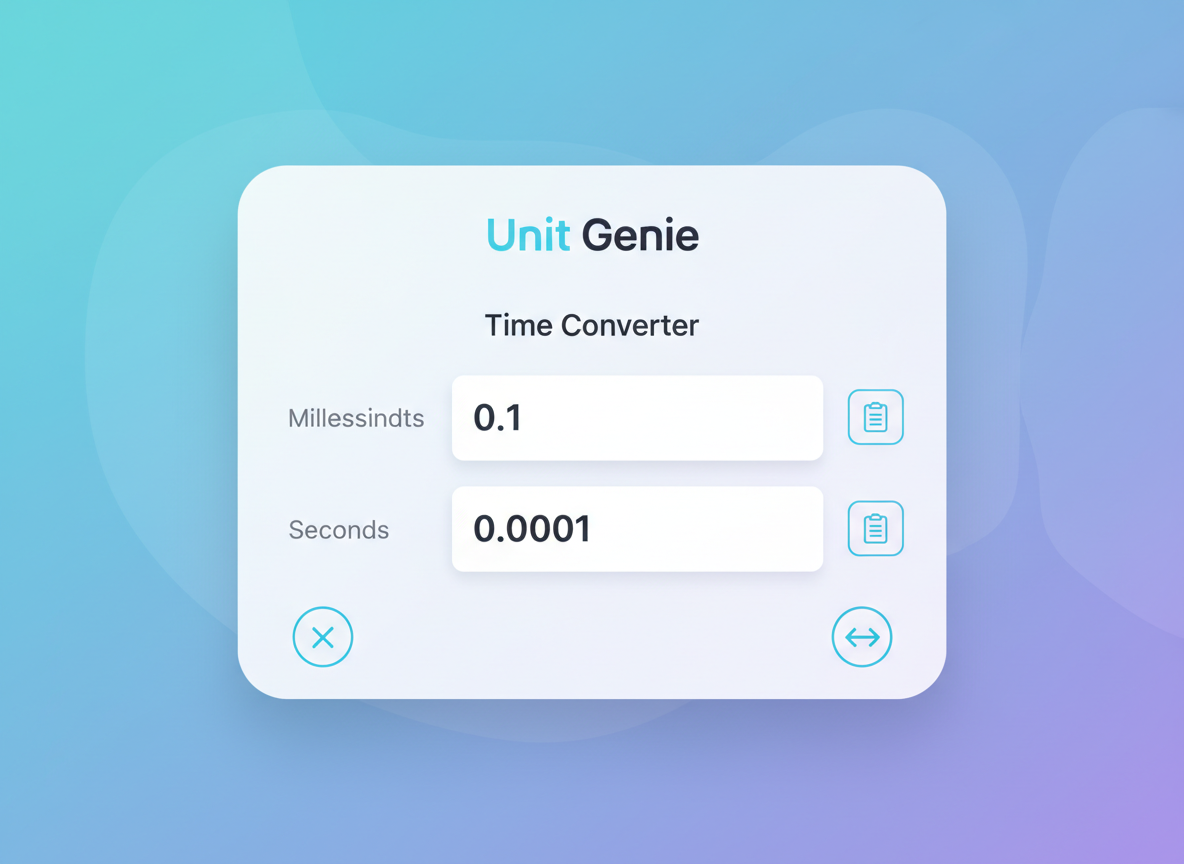
Unit Genie’s free calculator gives you instant millisecond-to-second conversions without the wait. Just enter your value and watch the results appear in real-time—no clicking “calculate” buttons or dealing with annoying ads. Copy results straight to your clipboard with one tap, whether you’re on desktop or mobile. Need to go the other way? The reverse conversion (seconds to milliseconds) works just as smoothly. We’ve built the same precision-first approach you’ll find in our 0.1 mm to microns calculator, with multi-language support that makes time conversions accessible worldwide.
The Conversion Formula Explained
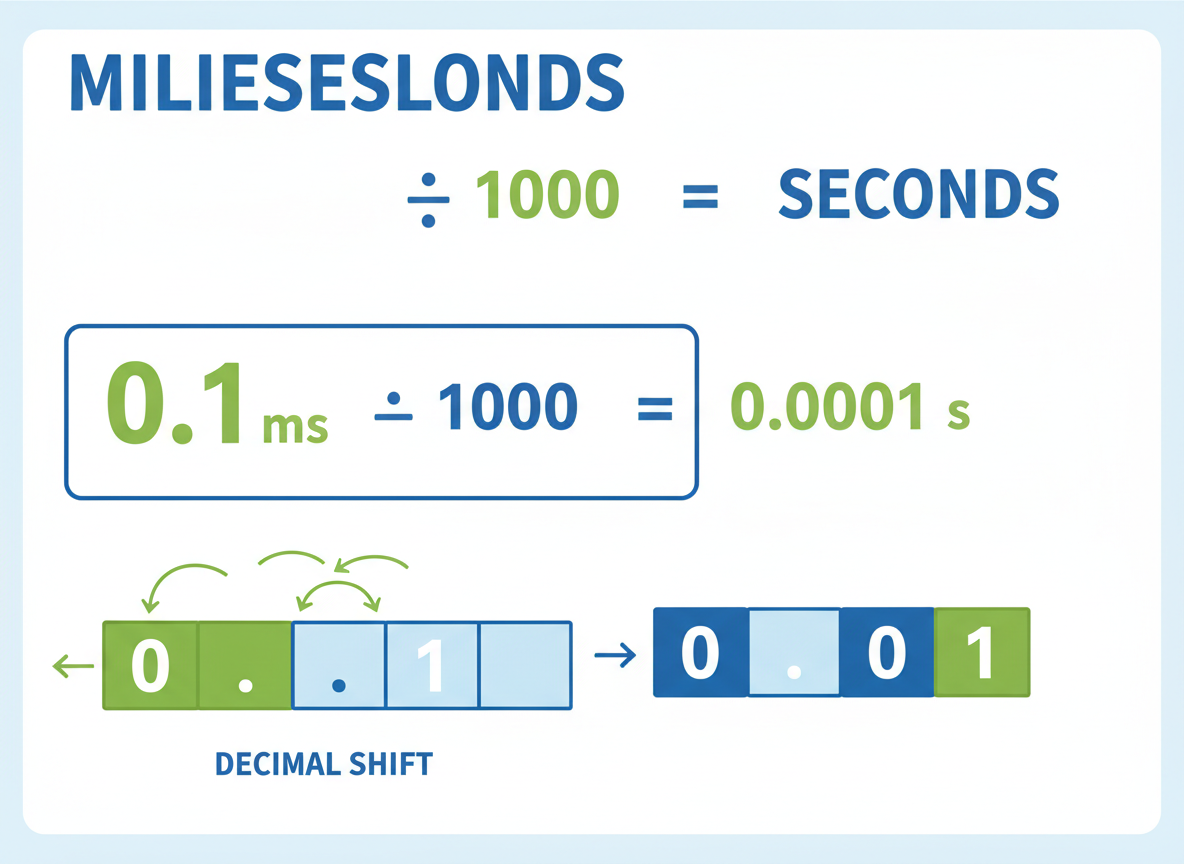
The formula’s straightforward: seconds = milliseconds ÷ 1000 (or multiply by 0.001 if you prefer). Here’s how it works for 0.1 ms:
0.1 ÷ 1000 = 0.0001 s
The “milli” prefix means one-thousandth, so there are 1,000 milliseconds in every second. You can also write this answer in scientific notation as 1×10⁻⁴ s.
Let’s look at a few more examples:
- 0.5 ms = 0.0005 s (or 5×10⁻⁴ s)
- 1 ms = 0.001 s (one-thousandth of a second)
- 10 ms = 0.01 s (one-hundredth of a second)
Once you’ve done this conversion a few times, it becomes second nature—just shift the decimal point three places left.
What Happens in 0.1 Milliseconds?
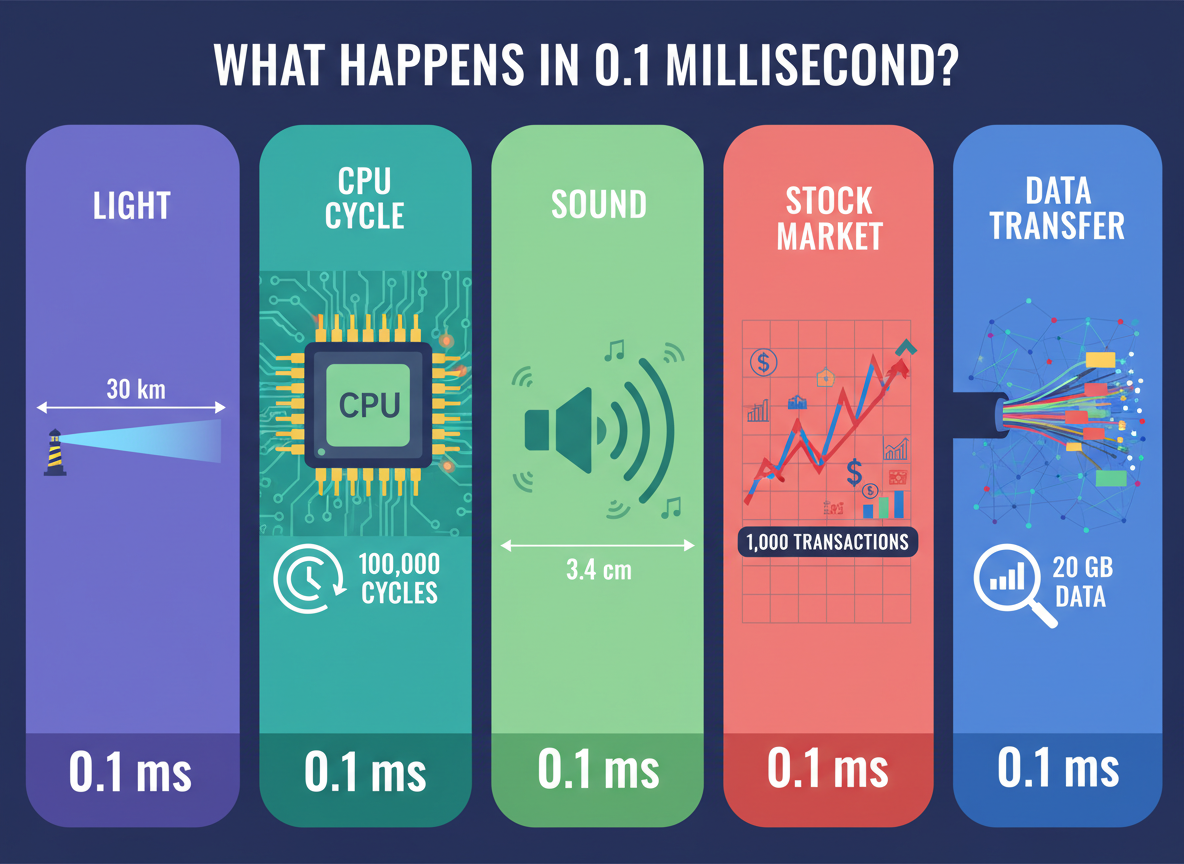
You might think 0.1 milliseconds is insignificantly short, but the universe stays plenty busy. Light races approximately 30 kilometers (18.6 miles) through space—enough to circle Manhattan several times. Meanwhile, sound barely crawls 3.4 centimeters (1.3 inches) through air, about the width of a golf ball.
Modern CPUs are sprinting through hundreds of thousands to millions of instruction cycles during this blink-and-you’ll-miss-it timeframe. High-frequency trading systems can process multiple buy and sell orders, where microseconds literally equal money. Network packets zip through significant stretches of fiber optic cables, connecting continents before you’ve finished reading this sentence.
When 0.1 Millisecond Precision Matters

That tiny 0.0001-second interval isn’t just a number—it’s the difference between winning and losing in competitive gaming. At 144Hz refresh rates, each frame renders in roughly 7 milliseconds, making sub-millisecond input lag critical for esports pros.
Audio engineers live in this realm too. Standard CD-quality audio at 44.1 kHz processes samples every 0.023 milliseconds. Any latency beyond a few milliseconds during live performances becomes noticeable to performers and audiences alike.
Network engineers measure packet timing and Quality of Service in these increments. Scientific researchers rely on sub-millisecond accuracy for high-speed photography and particle physics experiments. Medical diagnostic equipment requires precise timing for accurate readings and treatment delivery.
Software developers profile code performance at this level, hunting bottlenecks that cost mere fractions of a millisecond but compound into noticeable delays. Real-time systems can’t tolerate anything less.
Quick Reference: Milliseconds to Seconds Conversion Table
Here’s a handy reference table with commonly used millisecond values. Notice how 0.1 ms converts to 0.0001 s—our featured conversion sits right between the smallest and largest values you’ll typically encounter.
| Milliseconds (ms) | Seconds (decimal) | Seconds (scientific) |
|——————|——————-|———————|
| 0.01 ms | 0.00001 s | 1 × 10⁻⁵ s |
| 0.1 ms | 0.0001 s | 1 × 10⁻⁴ s |
| 0.5 ms | 0.0005 s | 5 × 10⁻⁴ s |
| 1 ms | 0.001 s | 1 × 10⁻³ s |
| 5 ms | 0.005 s | 5 × 10⁻³ s |
| 10 ms | 0.01 s | 1 × 10⁻² s |
| 50 ms | 0.05 s | 5 × 10⁻² s |
| 100 ms | 0.1 s | 1 × 10⁻¹ s |
| 500 ms | 0.5 s | 5 × 10⁻¹ s |
| 1000 ms | 1 s | 1 × 10⁰ s |
Bookmark this table for quick lookups. For similar precision-focused conversions, check out our 0.1 mm to micron guide—it follows the same straightforward approach.
Programming Examples for 0.1 ms Conversion
Developers often need millisecond conversions when working with timers, animations, or API response times. In Python, it’s straightforward: `seconds = 0.1 / 1000` returns `0.0001`. For JavaScript web apps, use `const seconds = 0.1 * 0.001` or `0.1 / 1000`. Watch out for floating-point quirks—storing time values as integers (like microseconds) before converting helps avoid precision errors that can mess up timing-sensitive code.
Understanding Precision and Rounding
The value 0.0001 seconds uses four decimal places, which matters when you’re tracking split-second events. You can also write this as 1×10⁻⁴ s in scientific notation—handy when dealing with multiple conversions or technical documentation. For everyday use, 0.0001 s is perfectly fine. But if you’re working with high-speed circuits or timing systems, you’ll want to maintain full precision without rounding. Generally, rounding to four decimal places works for most applications. However, programming languages handle floating-point arithmetic differently, so watch for tiny calculation errors when converting repeatedly.
Frequently Asked Questions
How do you convert 0.1 milliseconds to seconds?
Divide by 1,000: 0.1 ÷ 1,000 = 0.0001 seconds. You’re moving the decimal point three places left.
Is 0.1 ms the same as 0.0001 seconds?
Yes, absolutely. Both represent the exact same duration—one ten-thousandth of a second.
Why is 0.1 millisecond precision important?
It’s essential for high-speed trading, network latency monitoring, audio engineering, and medical diagnostics where microsecond timing affects outcomes.
Can humans perceive 0.1 millisecond differences?
No. We can’t consciously detect time differences below about 10-20 milliseconds. However, technical systems and scientific instruments need this precision.
What is 0.1 ms in scientific notation?
1×10⁻⁴ seconds. This format simplifies calculations in physics and engineering.
How many milliseconds are in 1 second?
Exactly 1,000 milliseconds. This base relationship makes conversions straightforward, similar to how 0.16 lb converts to ounces using fixed ratios.
What tools measure time in 0.1 millisecond increments?
Digital oscilloscopes, high-resolution timers, profiling software, and specialized lab equipment capture these tiny intervals.
How do I convert seconds back to milliseconds?
Multiply by 1,000. For example: 0.0001 seconds × 1,000 = 0.1 milliseconds.