0.1 MPa to Bar: Quick Answer
0.1 MPa equals exactly 1 bar. This straightforward conversion appears frequently across engineering, automotive diagnostics, and scientific research. Both units measure pressure but express it at different scales—megapascals (MPa) represent larger values while bar offers a more practical scale for everyday applications. Whether you’re checking tire pressure specifications or calibrating industrial equipment, this conversion matters. Unit Genie delivers instant, accurate calculations with clear explanations so you’ll understand not just the answer, but why it works. Need to convert further? Check out our 0.1 Bar to PSI conversion guide for related pressure measurements.
Understanding MPa and Bar Pressure Units
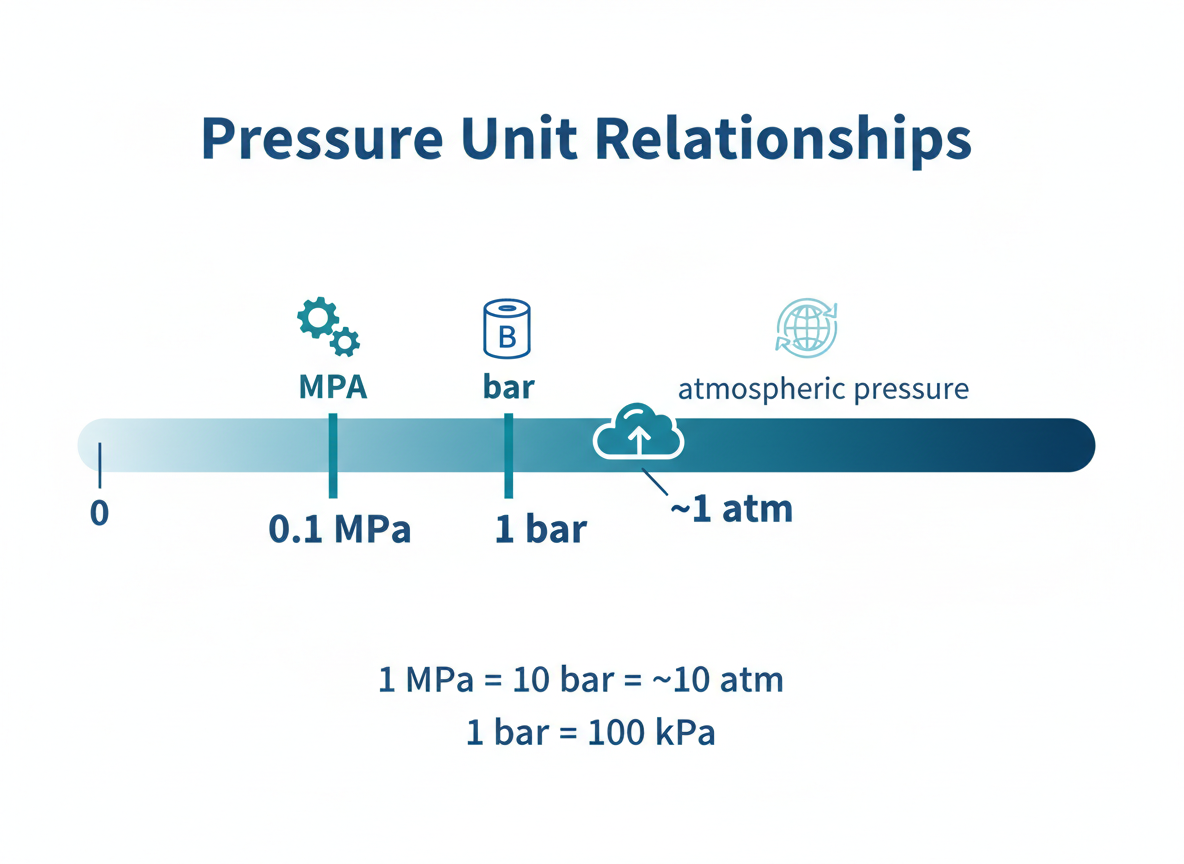
A Megapascal (MPa) represents one million pascals in the International System of Units, commonly used for measuring high-pressure systems like hydraulic equipment and concrete strength testing. Bar, on the other hand, is a metric unit that’s nearly identical to atmospheric pressure, making it intuitive for weather forecasting and tire pressure readings.
Here’s what makes 0.1 MPa to bar conversion so clean: 0.1 MPa equals exactly 1 bar. No messy decimals or complex math required.
Engineers typically favor MPa when dealing with material stress and structural calculations, while bars dominate automotive, HVAC, and meteorological applications. You’ll also find bars used extensively when measuring tire pressure conversions alongside PSI.
Since 1 bar sits just 2% below standard atmospheric pressure (1 atm), it’s become the go-to unit for everyday pressure measurements worldwide.
The Conversion Formula Explained
Converting MPa to bar couldn’t be simpler. Just multiply by 10: MPa × 10 = bar. Going backward? Divide by 10: bar ÷ 10 = MPa.
Why exactly 10? Both units stem from the Pascal. One MPa equals 1,000,000 Pascals, while one bar equals 100,000 Pascals. When you divide 1,000,000 by 100,000, you get 10.
Let’s convert 0.1 MPa step-by-step:
- Start with 0.1 MPa
- Multiply by 10
- 0.1 × 10 = 1 bar
That’s it. No complex math, no confusion—just a straightforward multiplication that delivers instant results.
Real-World Applications of 0.1 MPa (1 Bar)
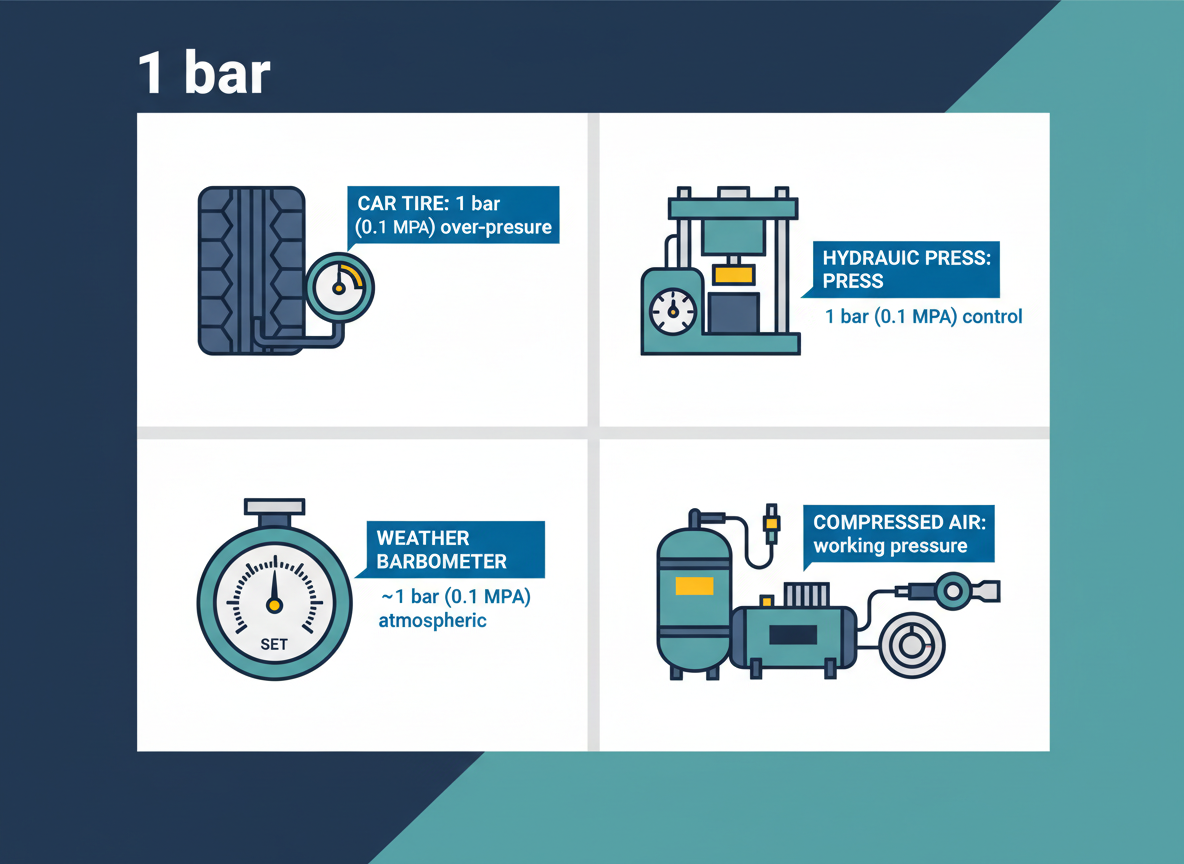
Understanding that 0.1 MPa equals 1 bar becomes practical when you encounter pressure in everyday situations. Your car tires typically run between 2-2.5 bar (0.2-0.25 MPa), making this conversion second nature for vehicle maintenance. Meteorologists reference barometric pressure around 1.013 bar as standard atmosphere, which explains why weather reports sometimes use this unit. Hydraulic systems in construction equipment and manufacturing plants operate at various bar levels, with technicians needing quick conversions for calibration. Material testing labs specify pressure thresholds in MPa for quality control, while compressed air systems in factories commonly display readings in bar. Engineers switch between these units constantly, so knowing that 0.1 MPa equals 1 bar simplifies specifications and troubleshooting across industries.
MPa to Bar Conversion Table
Here’s a handy reference table for converting MPa to bar. Notice that 0.1 MPa equals 1 bar—a conversion you’ll encounter frequently in pressure specifications.
| MPa | Bar |
|—–|—–|
| 0.01 | 0.1 |
| 0.05 | 0.5 |
| 0.1 | 1 |
| 0.2 | 2 |
| 0.5 | 5 |
| 1 | 10 |
| 2 | 20 |
| 5 | 50 |
| 10 | 100 |
This table covers the most common pressure values you’ll need for everyday calculations. Simply multiply any MPa value by 10 to get bar—it’s that straightforward.
Common Conversion Mistakes to Avoid
The most frequent error? Confusing MPa with kPa. Remember, 1 MPa equals 1,000 kPa—that’s three zeros that can throw off your calculations. Another slip-up happens with decimal placement: 0.1 MPa converts to 1 bar, not 0.1 bar or 10 bar. People also mix up whether to multiply or divide (here’s the trick: multiply MPa by 10 to get bar). For engineering work, you’ll want to maintain at least three significant figures—precision matters when designing systems or conducting experiments.
Why Use Unit Genie for Pressure Conversions
Unit Genie delivers instant, accurate pressure conversions without delays or annoying ads. You’ll get precise results whether converting 0.1 MPa to bar, exploring bar to PSI, or working with kPa, Pa, and atm units. The mobile-friendly interface works perfectly on the go, and with support for 15+ languages, it’s accessible to users worldwide. Best of all? It’s completely free.
Frequently Asked Questions
How many bar is 0.1 MPa?
0.1 MPa equals exactly 1 bar. Since 1 MPa = 10 bar, you’re simply moving the decimal point one place to the left.
Is 0.1 MPa the same as 1 bar?
Yes, they’re identical. This makes 0.1 MPa one of the easiest pressure conversions to remember—it’s a perfect 1:1 relationship with bar.
What is 0.1 MPa in PSI?
0.1 MPa converts to approximately 14.504 PSI. If you’re working with bar measurements, check out our 0.1 bar to PSI conversion guide for more details.
When should I use MPa vs bar?
MPa typically appears in engineering specifications and material testing, while bar is common in European industrial settings and meteorology. Choose based on your industry standards.
How do I convert MPa to bar manually?
Multiply the MPa value by 10. For 0.1 MPa: 0.1 × 10 = 1 bar. That’s it.
What is 0.1 MPa pressure equivalent to in everyday terms?
It’s roughly atmospheric pressure at sea level—the air pressure you’re experiencing right now.