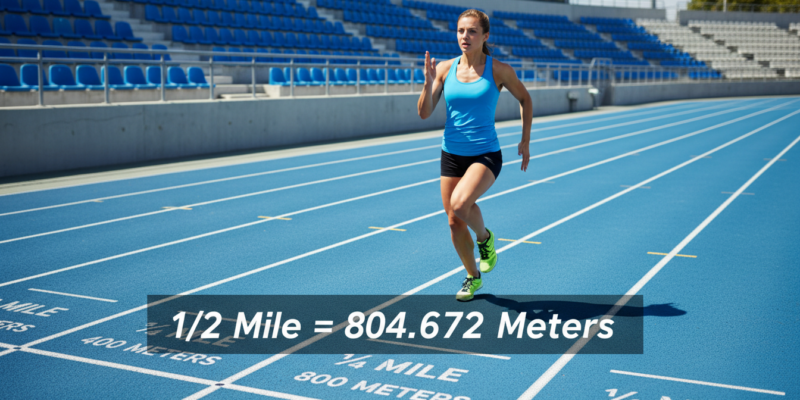
Quick Answer: 1/2 Mile Equals 804.672 Meters
Half a mile converts to 804.672 meters. This conversion comes up more often than you’d think—whether you’re training for a track meet, logging runs on your fitness app, or comparing distances while traveling abroad. Understanding how miles relate to meters helps you make sense of workout plans, race distances, and navigation apps that switch between measurement systems. In this guide, we’ll show you the exact conversion formula, walk through practical examples, and explain when you’ll actually use this measurement. (If you’re also curious about kilometer conversions, we’ve got you covered there too.) At Unit Genie, we make these conversions simple and accurate every time.
Understanding the Half-Mile to Meter Conversion
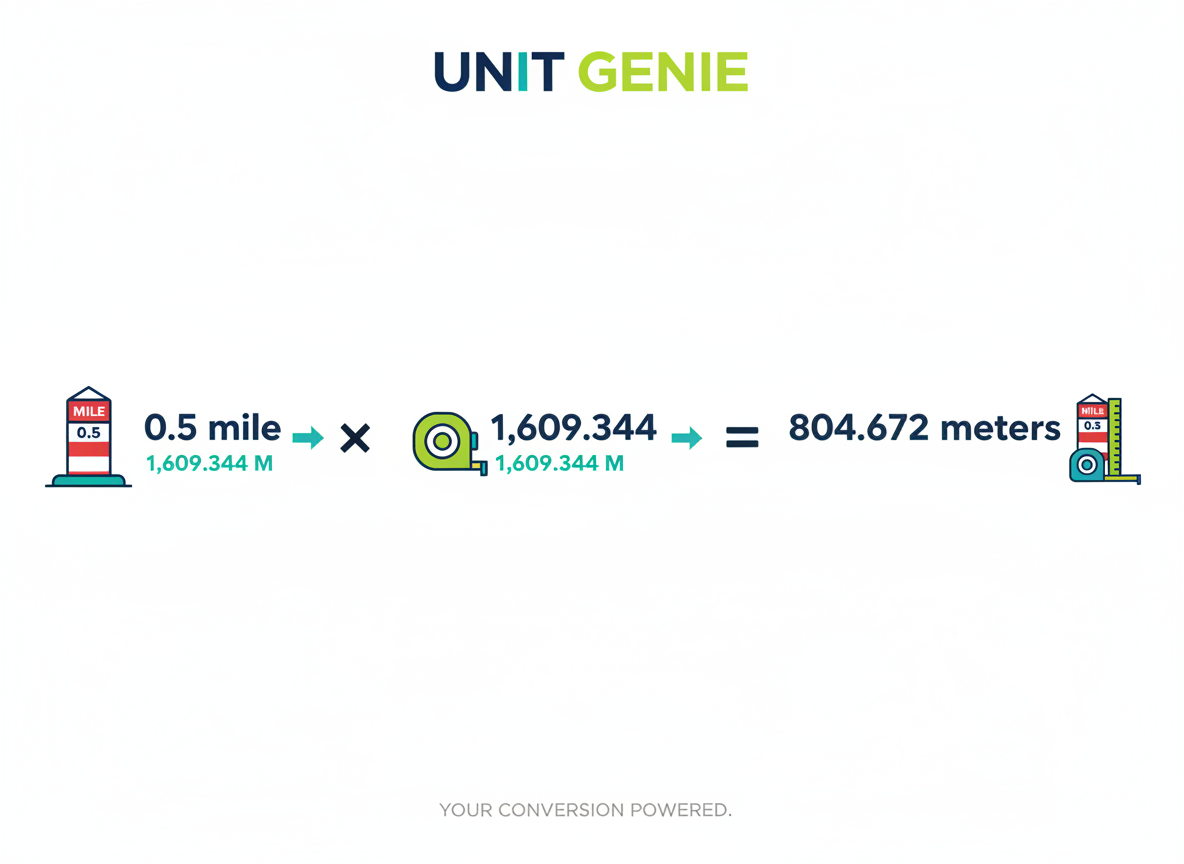
The conversion from miles to meters follows a straightforward formula: miles × 1,609.344 = meters. This conversion factor represents the precise relationship between these two distance units.
For half a mile, here’s the step-by-step calculation:
0.5 × 1,609.344 = 804.672 meters
That’s it—no complex math required. The decimal result (804.672) is already quite precise for most applications. If you’re working on something less technical, rounding to 805 meters works perfectly fine.
One quick note: this conversion uses the statute mile (the standard mile you’ll see on road signs). There’s also a nautical mile (1,852 meters), which sailors and pilots use, but that’s a different beast entirely.
Need to work in the other direction? Check out our guide on converting 1/2 meter to yards for similar distance conversions.
Real-World Examples of Half-Mile Distances
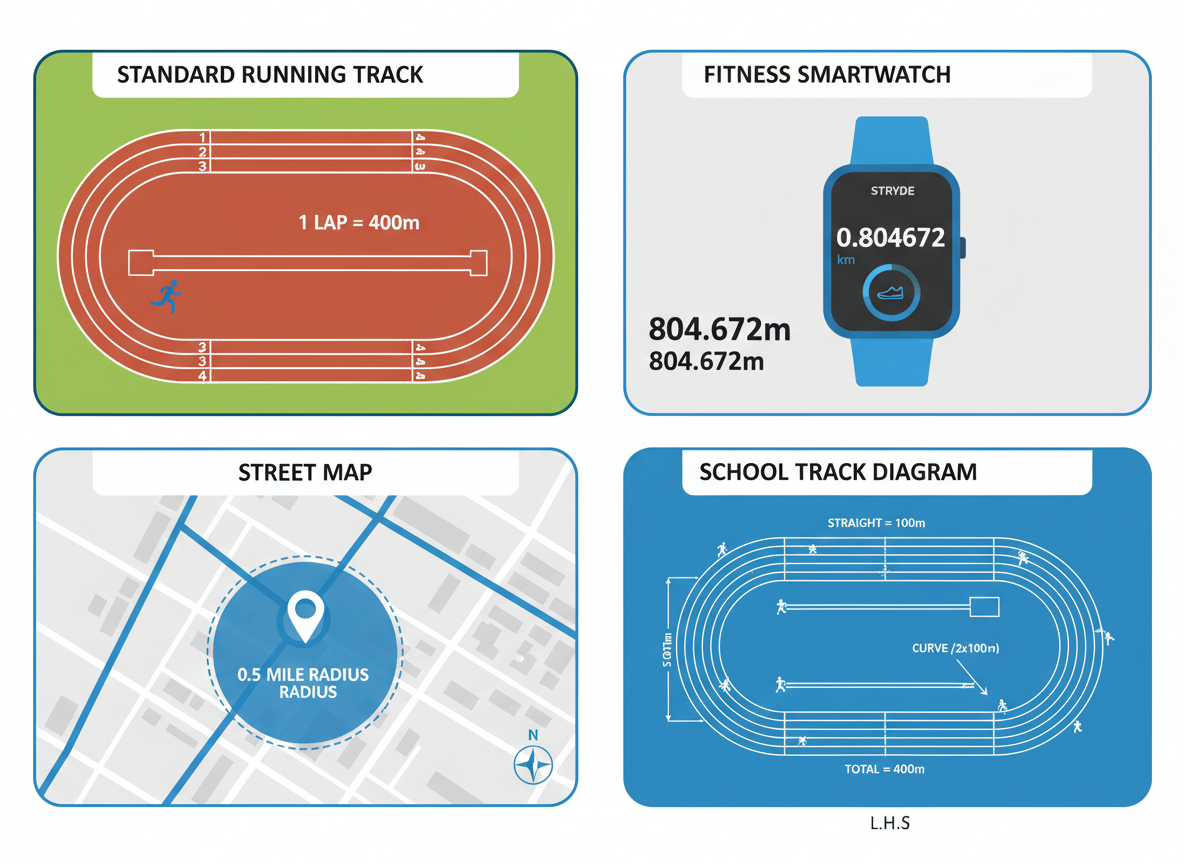
You’ll encounter half-mile measurements more often than you’d think. Track athletes run the 800-meter race, which is just 4.7 meters shorter than a true half-mile—close enough that the two distances often get used interchangeably in conversation.
Most standard outdoor running tracks measure 400 meters per lap, meaning you’ll complete just over two laps (2.01 laps, to be exact) when you’ve covered a half-mile. If you’re walking or jogging for fitness, your smartwatch logs this distance in about 8-10 minutes at a moderate pace.
In cities, half a mile typically spans 8-10 standard city blocks, though this varies wildly depending on location. GPS apps show this as roughly a 10-minute walk. Similar to how you might need to convert 1 2 pounds to kilograms when tracking weight, understanding that your half-mile jog equals 804.672 meters helps you set accurate fitness goals across different measurement systems.
Quick Reference: Common Mile to Meter Conversions
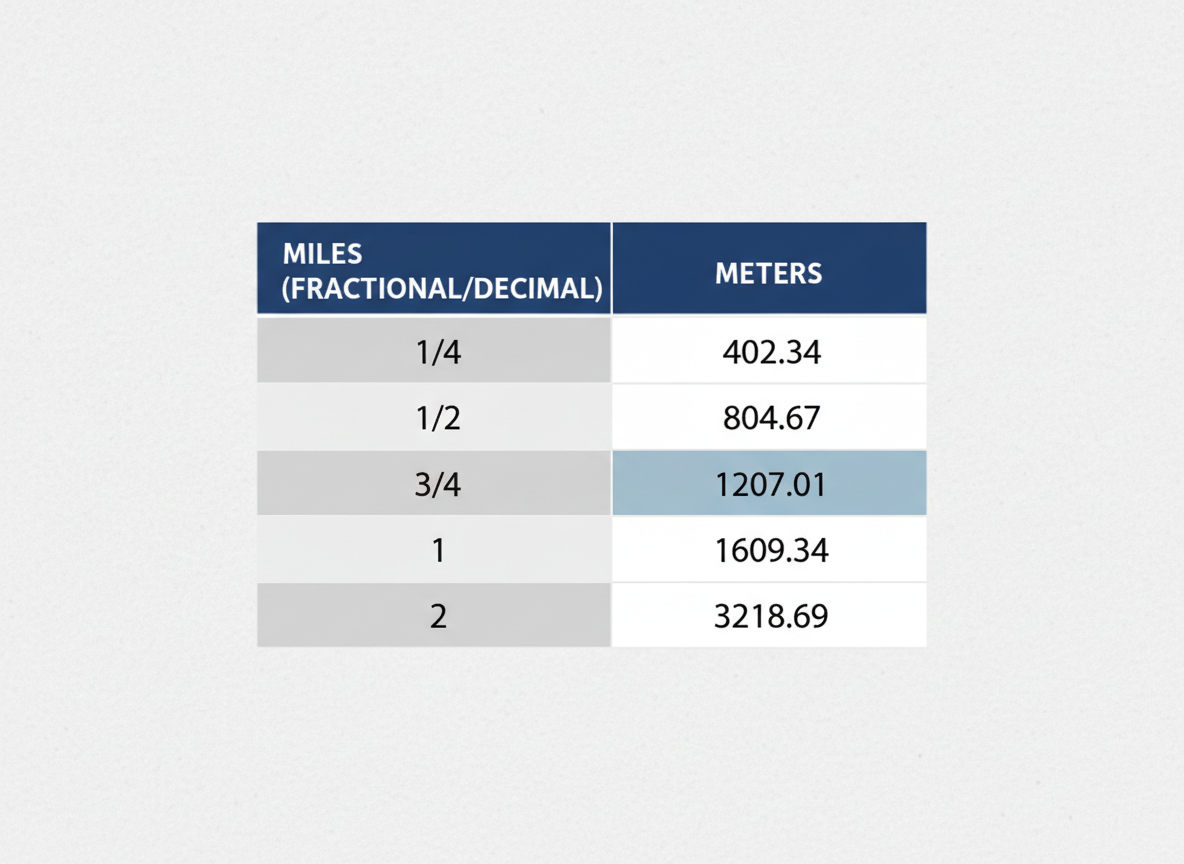
Here’s a handy table for the most frequently converted mile measurements:
| Miles | Exact Meters | Approximate |
|——-|————-|————-|
| 1/4 mile | 402.336 m | ~400 m |
| 1/2 mile | 804.672 m | ~800 m |
| 3/4 mile | 1,207.008 m | ~1,200 m |
| 1 mile | 1,609.344 m | ~1,600 m |
| 2 miles | 3,218.688 m | ~3,200 m |
For quick mental math, remember that half a mile is just over 800 meters. This approximation works well for everyday estimates, though you’ll want the precise 804.672 m figure for technical work—similar to how precision matters when converting smaller units like 0.1 mm to micrometers.
Why Miles and Meters Exist: A Brief History
The mile traces back to ancient Rome—1,000 paces of a Roman soldier. Britain later standardized it as the statute mile (5,280 feet) in 1593. Meanwhile, France developed the metric system in the 1790s, defining the meter as one ten-millionth of the distance from the equator to the North Pole.
Today, only three countries officially use miles: the U.S., Liberia, and Myanmar. The rest of the world embraced metric, and scientists universally prefer it for consistency. This is why you’ll need conversions for recipes too—like converting 1 1/3 cup to liters for international cooking.
Tips for Converting Miles to Meters Quickly
Here’s a handy memory trick: round 1 mile to 1,600 meters for lightning-fast mental math. It’s slightly off (the actual value is 1,609.344m), but perfect for ballpark estimates. For instance, 3 miles becomes roughly 4,800 meters in your head.
When you need spot-on accuracy, tools like Unit Genie deliver instant, precise conversions without the mental gymnastics. Save approximations for casual conversations or quick planning. Reserve exact calculations for engineering projects, scientific work, or anything where a few meters make a difference.
For on-the-go needs, keep a conversion app handy on your phone—they’re lifesavers during travel or worksite measurements. Just like converting grains to milligrams requires precision in specific contexts, knowing when “close enough” works versus when exactness matters will make your conversions smarter and faster.
Frequently Asked Questions
How many meters is exactly half a mile?
Half a mile equals 804.672 meters precisely. This conversion uses the standard mile definition of 1,609.344 meters.
Is 800 meters the same as half a mile?
No, though they’re close. 800 meters equals about 0.497 miles, so you’re roughly 4.672 meters short of an actual half mile.
How many laps around a track is half a mile?
Two full laps on a standard 400-meter track. You’ll cover 800 meters total, which gets you close to that 804.672-meter mark.
Why do some countries use miles and others use meters?
It’s all about historical measurement systems. Most countries adopted the metric system, while the U.S., UK (partially), and a few others stuck with imperial units. If you’re working with different measurements—like converting 1 1/8 cup to mL—knowing both systems helps.
How accurate do I need to be when converting miles to meters?
That depends on what you’re doing. Casual running? 800 meters works fine. Engineering or surveying? Use the exact 804.672 meters.
What’s the difference between statute miles and nautical miles?
A statute mile (the regular one) equals 1,609.344 meters. A nautical mile is longer at 1,852 meters—that’s about 1.15 statute miles.